บทความ
มารู้จัก AVAX ให้มากขึ้น ก่อนลงสนามสอบ Learn & Earn กับ Bitkub
Bitkub Exchange จับมือกับ Ava Labs ผู้พัฒนาแพลตฟอร์ม Avalanche หรือ AVAX นำแคมเปญ Learn & Earn กลับมาอีกครั้ง โดยในคราวนี้เราจะมาวัดความรู้เกี่ยวกับ AVAX ใครที่รู้จริงเตรียมรับ Airdrop เหรียญ Avalanche (AVAX) รวมทั้งสิ้น 3,000 รางวัล
คอยติดตามประกาศเข้าห้องสอบกันให้ดี ผ่านทาง Facebook Bitkub Official
สำหรับบทความนี้ เราจะมาเจาะลึกแพลตฟอร์ม Avalanche และเหรียญ AVAX กันให้มากขึ้น เพื่อเตรียมความพร้อมก่อนลงสนามสอบ Learn & Earn AVAX กัน
อ่านบทความ AVAX ฉบับก่อนหน้าได้ที่นี่
Avalanche เกิดขึ้นมาเพื่อแก้ปัญหาอะไร?
ปัจจุบัน มีแพลตฟอร์ม Smart Contract ใหม่ ๆ เกิดขึ้นมากมาย โดยแต่ละเครือข่ายก็ถูกสร้างขึ้นมาเพื่อแก้ไขปัญหาที่พบในบล็อกเชนรุ่นเดอะอย่าง Ethereum ซึ่ง Avalanche หรือ AVAX ก็คือหนึ่งในแพลตฟอร์มรุ่นใหม่ที่มีกระแสตอบรับน่าสนใจที่สุดแพลตฟอร์มหนึ่ง เพราะถูกสร้างขึ้นมาเพื่อแก้ปัญหาด้านการขยายขนาด (Scalability) และรักษาความกระจายศูนย์ (Decentralized) ไปพร้อม ๆ กัน
ปัญหาของการขยายขนาดคือสิ่งที่อีเธอเรียมกำลังเผชิญอยู่ในปัจจุบัน เนื่องจากจำนวนธุรกรรมบนเครือข่ายที่มีมากเกินไป ส่งผลให้เกิดความล่าช้าในการทำธุรกรรม และค่าธรรมเนียมที่สูงเกินกว่าจะนำมาใช้ในชีวิตจริง
ด้วยเหตุนี้ เครือข่ายบล็อกเชนรุ่นใหม่บางเครือข่ายจึงเลือกที่จะลดการกระจายศูนย์ และหันมาทำให้มีความรวมศูนย์ (Centralized) มากขึ้น เพื่อที่จะสามารถขยายขนาดเครือข่ายและรองรับธุรกรรมได้มากขึ้นแทน แต่การทำเช่นนั้นเท่ากับเป็นการลดความปลอดภัยของเครือข่ายลง เพราะการโจมตีต่าง ๆ จะสามารถมุ่งเป้าหมายมาที่เครื่องหลักได้ง่ายขึ้น ซ้ำยังขัดแย้งกับแนวคิดดั้งเดิมของบล็อกเชนที่ว่าด้วยเรื่องของการกระจายศูนย์
แต่ไม่ใช่กับ Avalanche นอกจากจะเป็นแพลตฟอร์ม Smart Contract ที่รองรับการสร้าง dApps, DeFi, รวมถึง NFT แล้ว Avalanche ยังมีโครงสร้างเครือข่ายที่สามารถขยายขนาดได้ง่าย และเลือกที่จะไม่ละทิ้งความกระจายศูนย์ โดยหนึ่งในวิธีที่ Avalanche เลือก ก็คือการมีโครงสร้างแบบ DAG ที่จะกล่าวถึงต่อไปนี้
DAG คืออะไร?
เมื่อพูดถึงเทคโนโลยีที่อยู่เบื้องหลัง Avalanche อันดับแรกที่ต้องพูดถึงคือโครงสร้างเครือข่ายแบบ DAG ที่ย่อมาจาก Directed Acyclic Graph ซึ่งเป็นโครงสร้างของฐานข้อมูลรูปแบบหนึ่งที่เริ่มถูกนำมาใช้ในวงการคริปโทเคอร์เรนซีมากขึ้น โดยนักพัฒนาบางส่วนเชื่อว่า DAG อาจมาแทนที่ Blockchain ได้เลย หากได้รับการพัฒนาอย่างเหมาะสม
แล้ว DAG แตกต่างและเหนือกว่า Blockchain อย่างไร?
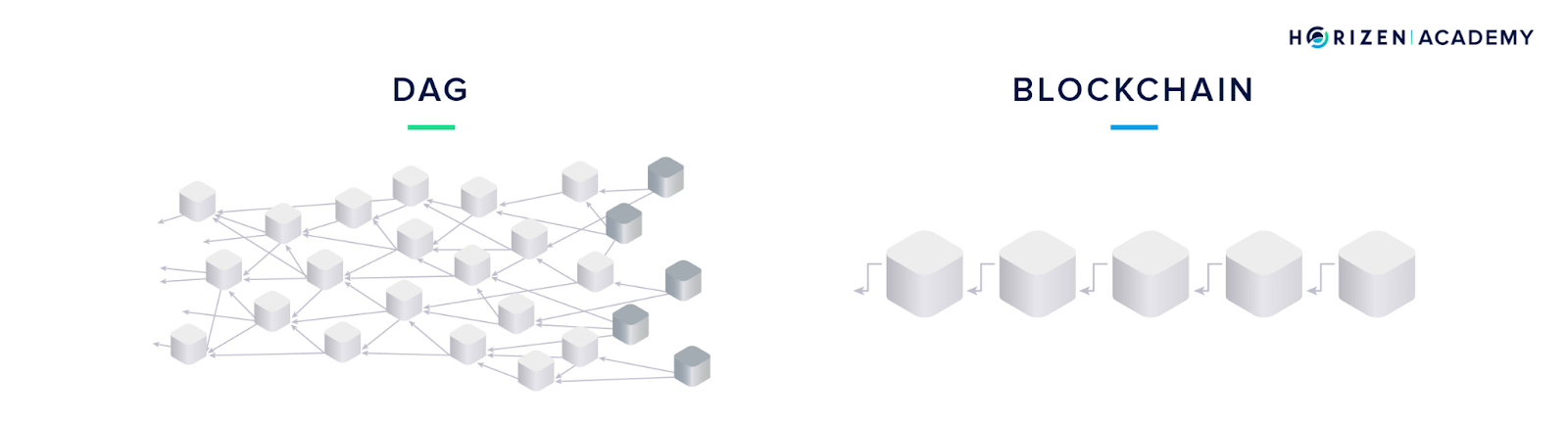
ภาพประกอบจาก Horizen Academy
อันดับแรกลองนึกภาพ Blockchain ที่มีการเก็บข้อมูลเป็นบล็อก (Block) และเอาบล็อกมาเรียงต่อกันไปเรื่อย ๆ จนมีลักษณะคล้ายกับโซ่ (Chain) ซึ่งเป็นที่มาของชื่อ Blockchain นั่นเอง
ในขณะที่ DAG แม้จะมีการเก็บข้อมูลเป็นบล็อกเหมือนกัน แต่บล็อกของ DAG จะสามารถแตกย่อยออกไปได้อีก ไม่ได้จำกัดว่าบล็อกที่ 1 ต้องเชื่อมต่อกับที่ 2 เหมือนกับบล็อกเชนเสมอไป ลองนึกภาพเวลาเราเปิดโฟลเดอร์ (Folder) บนคอมพิวเตอร์ เมื่อเราเปิดโฟลเดอร์แรก ข้างในโฟลเดอร์นั้นก็อาจมีไฟล์และมีโฟลเดอร์อื่น ๆ อีก หากเราเปิดโฟลเดอร์ที่อยู่ในนั้นอีกที เราก็อาจเข้าไปเจอโฟลเดอร์อื่นอีกเรื่อย ๆ
ด้วยโครงสร้างลักษณะนี้เอง DAG จึงสามารถยืนยันธุรกรรมหลาย ๆ ธุรกรรมพร้อมกันได้ในคราวเดียว หรือที่เรียกว่า Parallel Processing ไม่จำเป็นต้องรอยืนยันธุรกรรมทีละบล็อกเหมือนกับบล็อกเชน ทำให้ความเร็วโดยรวมของเครือข่ายสูงขึ้นอย่างมีนัยสำคัญ
ภาพจากเว็บไซต์หลักของ Avalanche
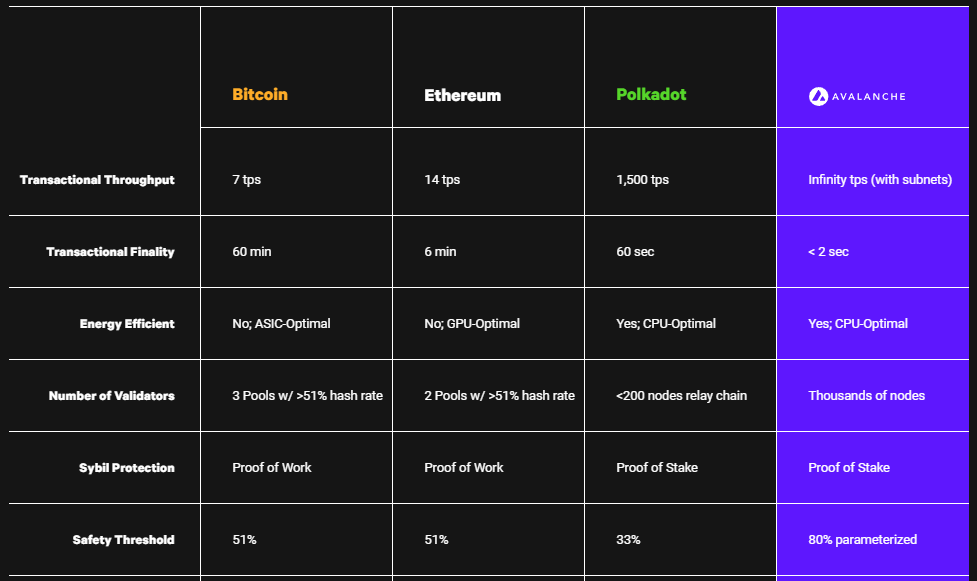
หากดูภาพประกอบด้านบนจะเห็นได้ว่า Avalanche สามารถเพิ่มความเร็วในการยืนยันธุรกรรมได้อย่างไม่มีขีดจำกัดหากมีการนำเครือข่ายย่อย หรือ Subnets เข้ามาช่วยยืนยันธุรกรรมด้วย ในขณะที่เครือข่ายอื่น ๆ อย่าง Bitcoin กับ Ethereum สามารถยืนยันธุรกรรมได้เพียง 7 และ 14 ธุรกรรมต่อวินาทีตามลำดับ ในขณะที่ Polkadot ที่เป็นหนึ่งในบล็อกเชนรุ่นใหม่สามารถยืนยันธุรกรรมได้ 1,500 ธุรกรรมต่อวินาที
นอกจากนี้ จากภาพประกอบยังเห็นได้อีกว่า Avalanche มี Safety Threshold ที่ 80% หมายความว่า การจะควบคุมเครือข่าย Avalanche ได้ จำเป็นต้องควบคุมโหนด (Node) ในเครือข่ายให้ได้อย่างน้อย 80% ของโหนดทั้งหมด โดยในกรณีของ Avalanche ที่ใช้ระบบฉันทามติแบบ Proof-of-Stake หมายความว่า ถ้าจะควบคุมเครือข่ายก็ต้องถือเหรียญ AVAX ให้ได้อย่างน้อย 80% ของเหรียญที่หมุนเวียนอยู่ในระบบ ซึ่งในทางปฏิบัติแล้วยิ่งเป็นไปไม่ได้เลย โดยเฉพาะเมื่อเทียบกับ Safety Threshold ของเครือข่ายอื่น ๆ อย่าง Bitcoin และ Ethereum ที่ 51% ซึ่งยังไม่มีใครเคยควบคุมเครือข่ายเหล่านี้ได้เกิน 51% เลย จึงยิ่งเป็นเครื่องการันตีความปลอดภัยของ Avalanche
Avalanche ประกอบไปด้วย 3 เครือข่าย
ภาพจากเว็บไซต์หลักของ Avalanche
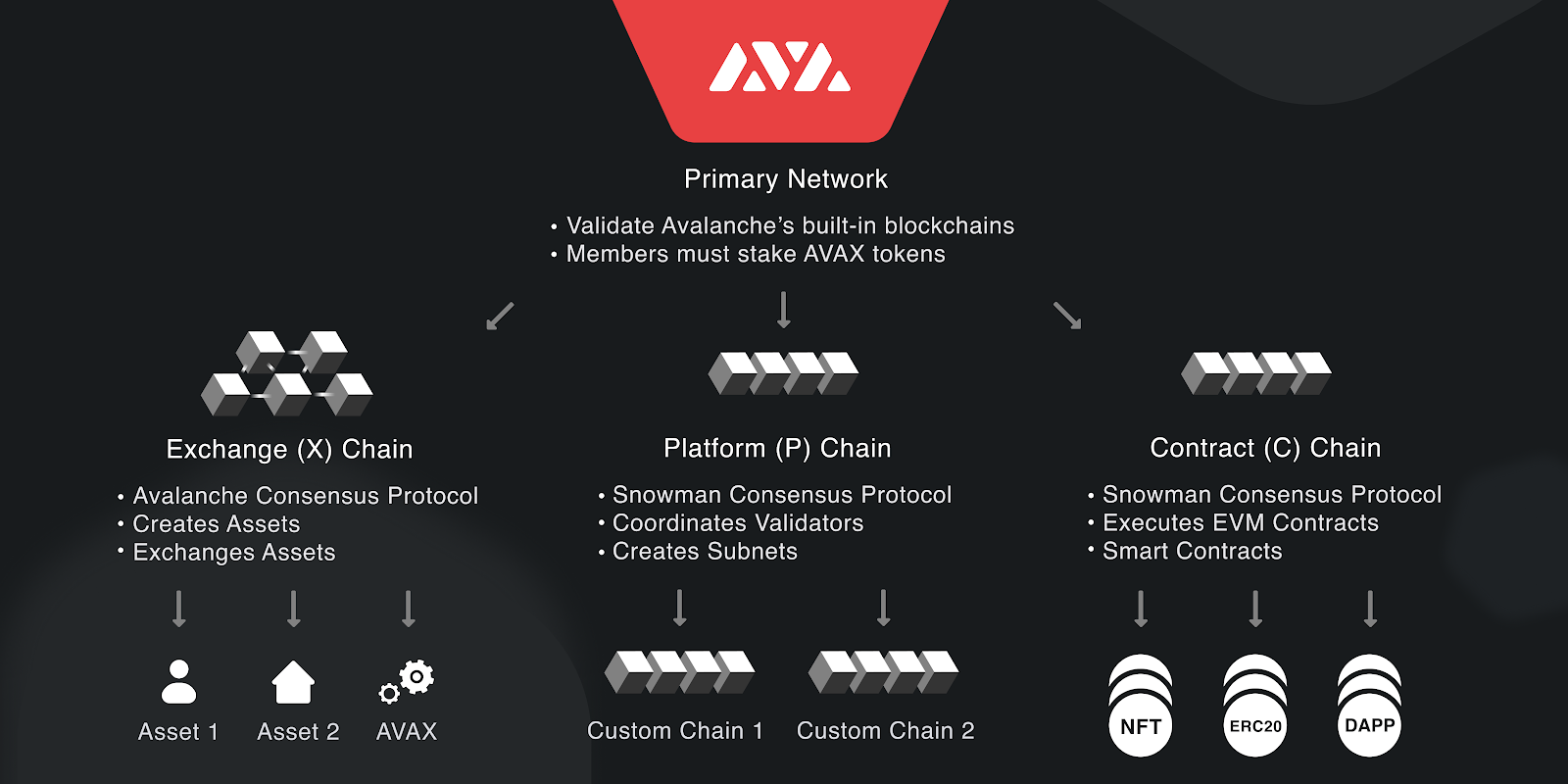
อย่างที่เคยกล่าวไว้ในบทความ AVAX ก่อนหน้านี้ Avalanche ไม่ใช่บล็อกเชนแค่เครือข่ายเดียวเหมือนกับเครือข่ายอื่น แต่ประกอบไปด้วย 3 เครือข่าย ได้แก่
X-Chain (Exchange Chain) คือบล็อกเชนที่ใช้สำหรับการแลกเปลี่ยนหรือส่งต่อมูลค่าที่ไม่ต้องเรียกใช้ Smart contract โดยมี AVAX เป็นสกุลเงินหลักสำหรับการแลกเปลี่ยนมูลค่า รวมถึงเป็นค่าธรรมเนียมสำหรับการโอนสินทรัพย์ นอกจากนี้ X-Chain ยังรองรับการสร้างโทเคน รวมถึงการส่งต่อมูลค่าระหว่างเครือข่ายย่อย (Cross-subnet) อีกด้วย
C-Chain (Contract Chain) คือบล็อกเชนที่นักพัฒนาสามารถเขียน Smart Contract เพื่อสร้าง dApps และสินทรัพย์ประเภท NFT ขึ้นบน Avalanche ได้ โดยรองรับภาษา Solidity ซึ่งเป็นภาษาเดียวกับที่ใช้บน Ethereum หมายความว่านักพัฒนาที่คุ้นเคยกับ Ethereum สามารถย้ายมาพัฒนาบน Avalanche ได้อย่างง่ายดาย นอกจากนี้ C-Chain ยังรองรับการเชื่อมต่อกับ Metamask ด้วย
P-Chain (Platform Chain) คือบล็อกเชนที่รองรับการสร้าง เชื่อมต่อ และติดตามเครือข่ายย่อย รวมถึงเป็นเครือข่ายที่เปิดให้ผู้ที่ต้องการเข้ามาเป็นผู้ตรวจสอบธุรกรรม (Validator) สามารถเข้าล็อก (Stake) เหรียญ AVAX เพื่อร่วมตรวจสอบธุรกรรมได้
สำหรับระบบฉันทามติ X-Chain ใช้ระบบฉันทามติพิเศษที่เรียกว่า Avalanche Consensus Protocol ส่วน C-Chain และ P-Chain จะใช้ระบบฉันทามติที่เรียกว่า Snowman Consensus Protocol
Avalanche Consensus Protocol คืออะไร?
Avalanche Consensus Protocol คือระบบฉันทามติแบบเฉพาะของ Avalanche โดยมีพื้นฐานมาจาก Proof-of-Stake แต่แทนที่จะสุ่มเลือกผู้ตรวจสอบธุรกรรมขึ้นมาทีละโหนด Avalanche Consensus จะให้ทุกโหนดช่วยกันโหวตว่าจะ “ยอมรับ” หรือ “ปฏิเสธ” ธุรกรรมนั้น ๆ และตัดสินจากเสียงข้างมากแทน วิธีนี้ทำให้ไม่มีโหนดไหนที่มีอำนาจเหนือกว่ากัน ประกอบกับซอฟต์แวร์ที่ใช้ในการรันโหนดก็จะมีวิธีตรวจสอบความน่าเชื่อถือของธุรกรรมติดตั้งไว้อยู่แล้ว
ทั้งนี้ หนึ่งในเครือข่ายของ Avalanche อย่าง X-Chain ได้นำ Avalanche Consensus Protocol มาใช้เพื่อประมวลผลธุรกรรมทั้งขนาดเล็กและใหญ่ได้อย่างรวดเร็ว ในขณะที่ C-Chain กับ P-Chain ใช้ระบบฉันทามติแบบ Snowman Consensus Protocol ที่ถูกปรับแต่งมาจาก Avalanche Consensus อีกที โดยมีพื้นฐานการทำงานคล้าย ๆ กันแต่สามารถรองรับธุรกรรมที่มีความซับซ้อนได้ดีกว่า
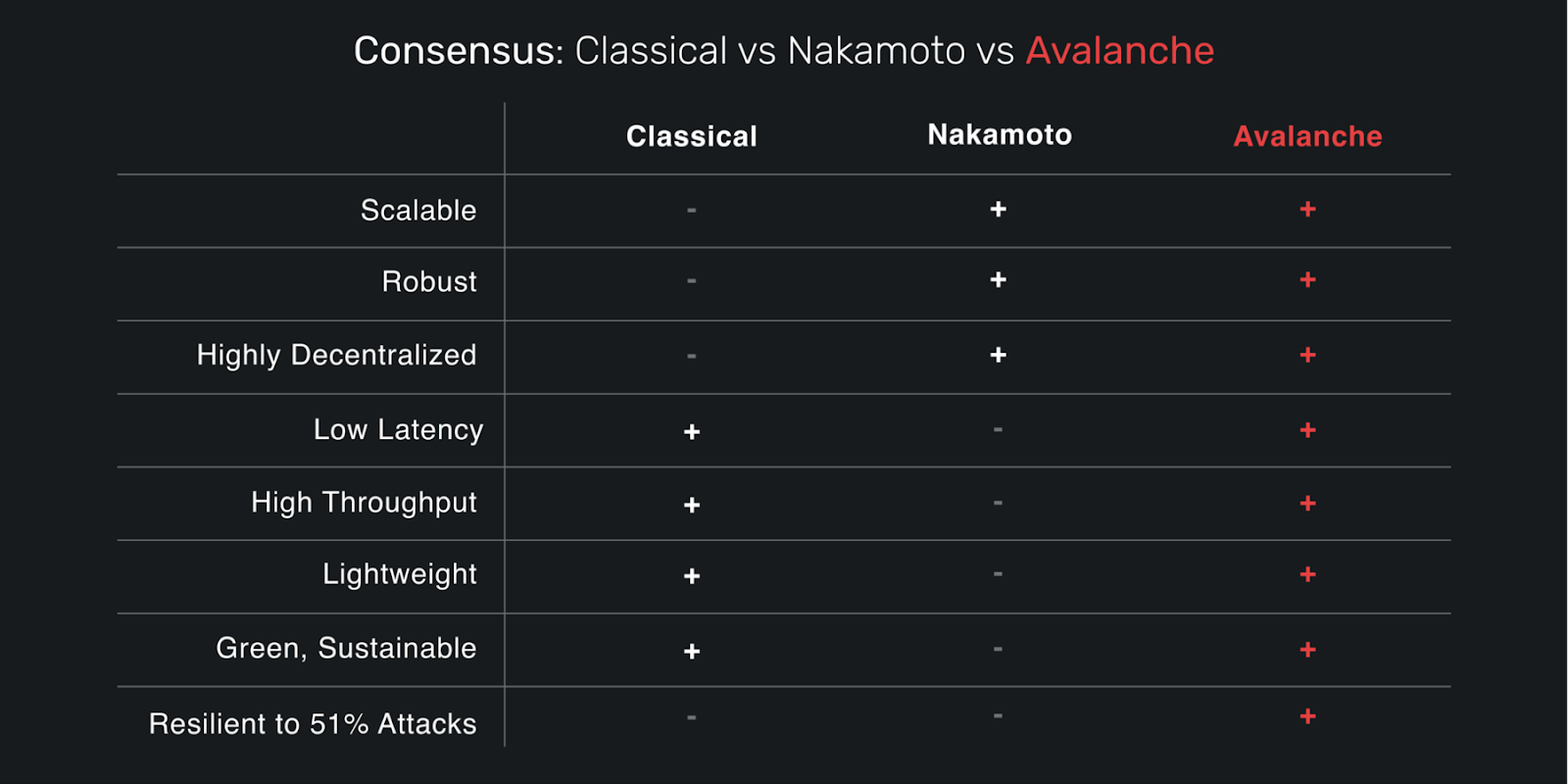
ภาพจากเว็บไซต์หลักของ Avalanche
จากภาพประกอบจะเห็นได้ว่า ระบบฉันทามติของ Avalanche นอกจากจะมีความเร็วในการยืนยันธุรกรรมที่สูงแล้ว ยังสามารถขยายขนาดเพือรองรับจำนวนธุรกรรมที่สูงขึ้นได้ แถมประหยัดพลังงานกว่าระบบฉันทามติแบบเดิม ๆ และที่สำคัญคือสามารถป้องกันการโจมตี 51% (51% Attacks) ได้อย่างมีประสิทธิภาพ
สรุป
Avalanche หรือ AVAX คือหนึ่งในแพลตฟอร์มที่รองรับ Smart Contract รุ่นใหม่ที่น่าจับตาที่สุดแพลตฟอร์มหนึ่ง โดยถูกสร้างขึ้นมาเพื่อปัญหาด้านการขยายขนาด (Scalability) และรักษาความกระจายศูนย์ (Decentralized) ไปพร้อม ๆ กัน
Avalanche สามารถแก้ปัญหานั้นได้ โดยการมีโครงสร้างเครือข่ายแบบ DAG ที่สามารถยืนยันธุรกรรมจำนวนมาก ๆ ได้พร้อมกัน แถม Avalanche ยังประกอบไปด้วย 3 เครือข่ายที่คอยทำงานเกื้อหนุนกันและกัน และยังมีระบบฉันทามติพิเศษของตัวเองที่เรียกว่า Avalanche Consensus Protocol ที่มีประสิทธิภาพ ความเร็ว และความปลอดภัยสูง ทำให้ AVAX เป็นหนึ่งในสกุลเงินดิจิทัลที่น่าจับตามากที่สุดเครือข่ายหนึ่ง
อ้างอิง Avalanche Main Website, Avalanche Docs, Avalanche Consensus 101
ติดตามบทความและความรู้ดี ๆ ในโลกคริปโต ได้ที่ Bitkub Academy
เปิดบัญชีและเริ่มลงทุนใน AVAX กับ Bitkub ได้เลย: https://www.bitkub.com/signup
*การลงทุนในสินทรัพย์ดิจิทัลมีความเสี่ยงสูง ควรศึกษาและทำความเข้าใจก่อนลงทุน
==========
Learn More about AVAX Before Learn & Earn with Bitkub
Bitkub Exchange, in collaboration with Ava Labs, the minds behind Avalanche or AVAX, are bringing back the much anticipated Learn & Earn campaign, this time to provide and test your knowledge about the AVAX coin. Set your calendars for the quiz date to potentially earn Avalanche (AVAX) airdrop rewards.
Keep an eye out for the quiz announcement at Facebook Bitkub Official.
In this article, we’ll dive deeper into Avalanche and the AVAX to prepare for the intensive Learn & Earn campaign quiz.
Read the previous AVAX Article here.
What Problem was Avalanche Created to Solve?
In the current day, numerous smart contracts platforms are being continuously developed, with various blockchain networks aiming to solve the array of issues previously found by their predecessor; Ethereum. While Avalanche is also becoming a well-recognized new-generation platform that aims to solve scalability issues, whilst simultaneously maintaining decentralization.
Issues in scaling is a premise Ethereum has been facing due to the immensely-overflowing amounts of transactions on its network, resulting in slowing transaction processing and inaccessible or costly fees that hinders its real use case adoption opportunities.
Taking this into account, new-generation blockchains have been moving away from decentralization and towards the concept of centralization instead to maintain their scalability capabilities to handle large amounts of transactions. However, by doing so, it understandably risks the network’s security measures, as various network attacks would then be able to aim for one single server or device. Additionally, this hinders the very concept of blockchain, which was built upon the foundation of decentralization.
For Avalanche, this doesn’t apply, as not only is it a smart contract-based platform that is able to handle dApps, DeFi, and NFT capacities, but Avalanche is also recognized to have an easily-scaled infrastructure that still upholds the quality of decentralization. For this to be possible, Avalanche employs the DAG network architecture to be described as follows.
What is DAG?
When mentioning the technology behind Avalanche, a notion to acknowledge is the DAG architecture. Abbreviated from “Directed Acyclic Graph”, the DAG structure is an increasingly-popular approach in the cryptocurrency ecosystem, due to the belief that it could one day replace blockchain as a whole, if properly developed.
But how different or superior is DAG, in comparison to blockchain?
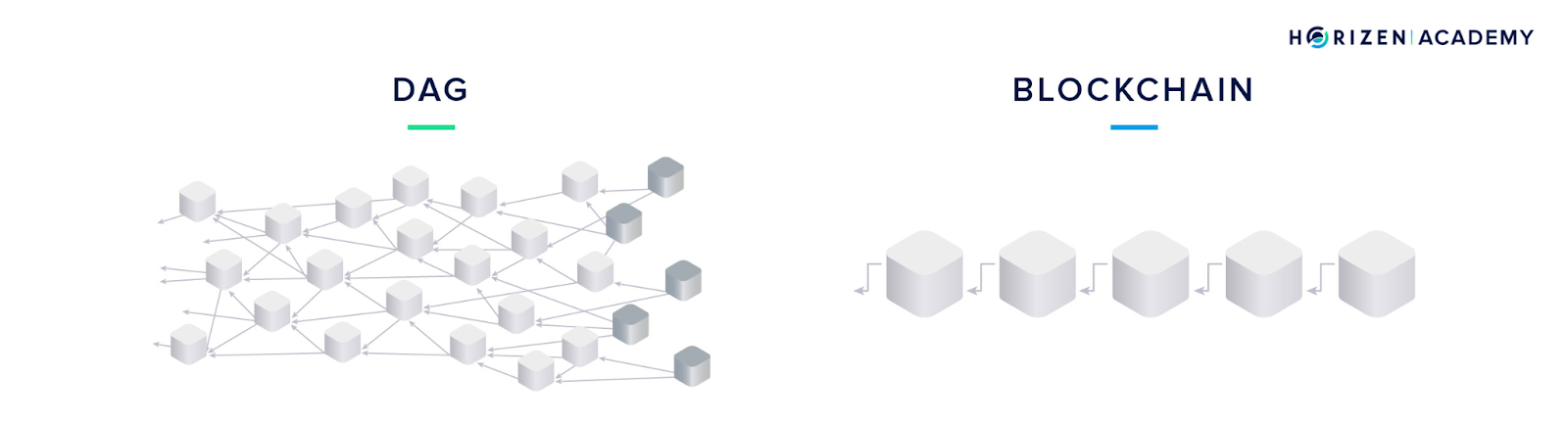
Image from Horizen Academy
Firstly, picture a blockchain system with information storage in the form of blocks, with each block interconnected in the form of a chain, hence the name; blockchain.
Though DAG attains the quality of storing information in the form of blocks as well, DAG’s blocks can be further broken down and isn’t limited to always requiring block number 1 to be connected to block number 2. Imagine opening a folder on your computer. When one opens, many more inside it can be found and inside them, even more.
It is with this characteristic that DAG is able to validate large amounts of transactions all at once, which is referred to as parallel processing, which is also recognized to not require block-by-block validation like blockchain systems, further enhancing the network’s capabilities.
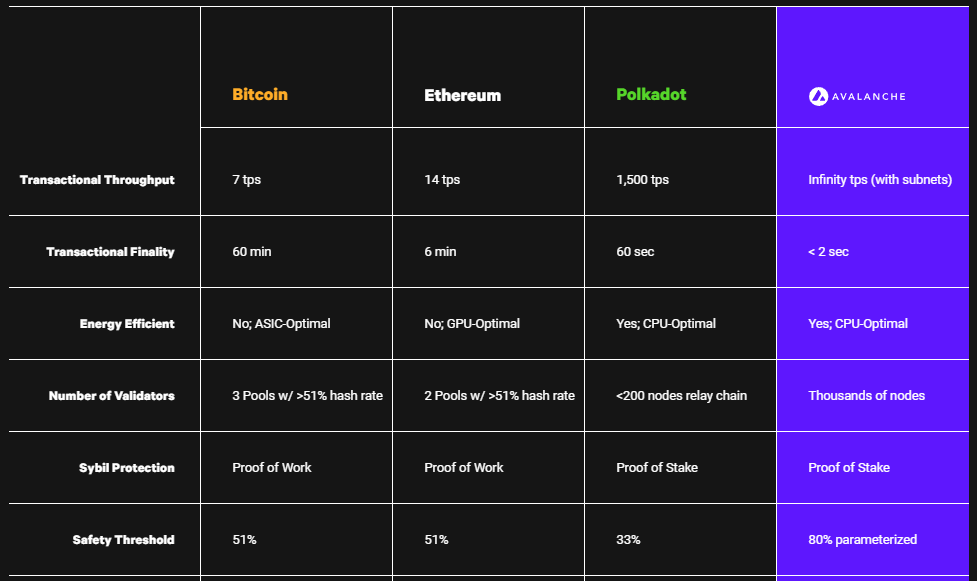
Image from Avalanche website
In reference to the above-shown image, Avalanche is capable of infinitely increasing the ability to confirm transactions, if there are subnets involved in the process. Whereas other networks, like Bitcoin and Ethereum, are only able to validate 7 and 14 transactions per second, respectively. A noteworthy mention is Polkadot, a new-generation blockchain network, which is able to validate up to 1,400 transactions per second.
Furthermore, the image also illustrates Avalanche’s safety threshold capacity of being able to hold up to 80%, meaning the possibility of overtaking the network would require the collusion of at least 80% of the network’s nodes. In the case of Avalanche, the proof-of-stake consensus system is employed, meaning that the aim of overtaking the network would also require 80% of the current circulating supply of AVAX, which in practical terms, is nearly impossible. This is even better illustrated when comparing the safety threshold of other networks, such as Bitcoin and Ethereum, where 51% of the network’s nodes’ efforts are required and has yet to have been conquered, further guaranteeing the security behind Avalanche’s progressions.
Avalanche Consists of 3 Networks
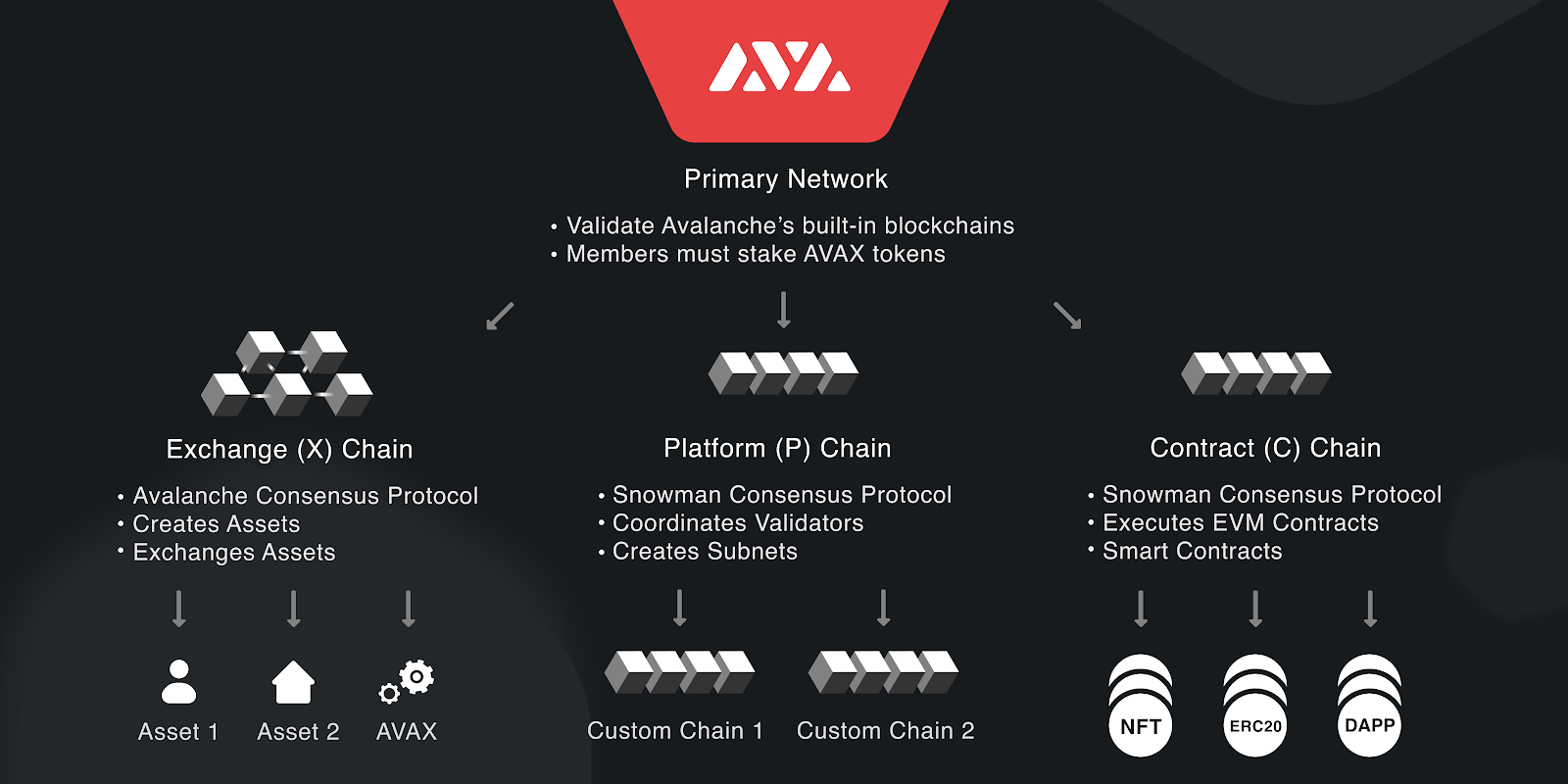
Image from Avalanche website
As mentioned in the previous AVAX article, Avalanche is not just a network like other smart contract platform, instead Avalanche is consisted of 3 networks working together, which are;
X-Chain (Exchange Chain): A network designed specifically for simple financial transactions where smart contracts are not required, using AVAX as the medium of exchange and gas fee for the network. In addition, X-Chain also supports token creation and transferring between subnets.
C-Chain (Contract Chain): As the name suggests, C-Chain is for Smart Contract. Developers can hop on the network to create dApps, DeFi, NFT, and more on this network. C-Chain also supports Solidity, which is the same language used to write smart contracts on Ethereum. This means developers who are familiar with Solidity and migrate to Avalanche with ease. Furthermore, Metamask can also connect with this network as well.
P-Chain (Platform Chain): This network is designed to create, coordinate, and track validator nodes. In order to join the network as a validator, one must stake AVAX in this network.
For Consensus Protocol, X-Chain utilize a special protocol called Avalanche Consensus Protocol, while C-Chain and P-Chain use Snowman Consensus Protocol
What is the Avalanche Consensus Protocol?
The Avalanche Consensus Protocol is Avalanche’s distinct consensus system based around the proof-of-stake algorithm, but instead replaces the randomization of node validators with a voting mechanism, wherein nodes vote to either “accept” or “decline” on various transactions and decide on the majority votes. This ensures that no node has a superior vote over others’, in addition to having software guaranteeing credibility of transactions as well.
Nevertheless, Avalanche’s X-Chain has already implemented the Avalanche Consensus Protocol to validate both small and large transactions with ease and high-speed processing. Whereas the C-Chain and P-Chain are both functioning on the Snowman Consensus Protocol, which has been adapted from the Avalanche Consensus, but with a focusing grip on handling complex transactions better.
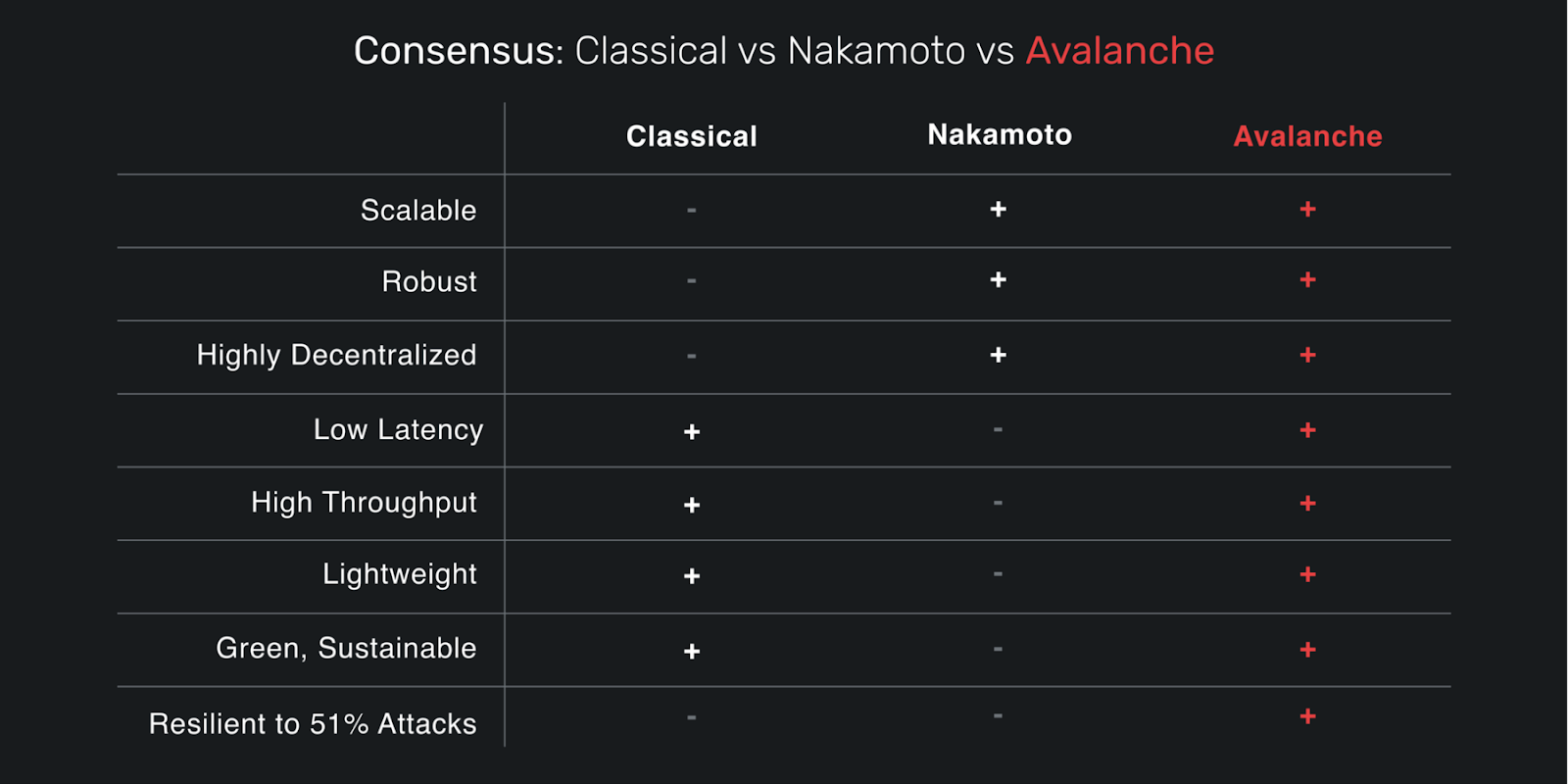
Image taken from Avalanche website
From the provided image, one can see that the consensus protocol behind Avalanche is not only adept in fast processing, but also able to scale to handle high influxes of transactions as well, whilst maintaining an energy-saving approach and, most importantly, also being able to be effectively immune to 51% Attacks.
Conclusion
Avalanche or AVAX is one of the rising smart contract platforms. It is created to solve the scalability issue while simultaneously maintaining decentralization.
The platform is able to achieve that by being a DAG that enables parallel processing for even more transactions per second. Unlike other smart contract platforms, Avalanche consists of 3 networks that work in tandem and use its own Avalanche Consensus Protocol to offer the most secure, fast, and effective platform worldwide.
Reference: Avalanche Main Website, Avalanche Docs, Avalanche Consensus 101
For more Cryptocurrency and Blockchain content, please visit Bitkub Academy
Start trading AVAX with Bitkub today: https://www.bitkub.com/signup
*Investment in digital assets is considered high-risk, investors must do a thorough research before making any investment decision.
ที่มา:
Medium