

Vitalik Buterin Backs Moonshot AI Hacking Limits
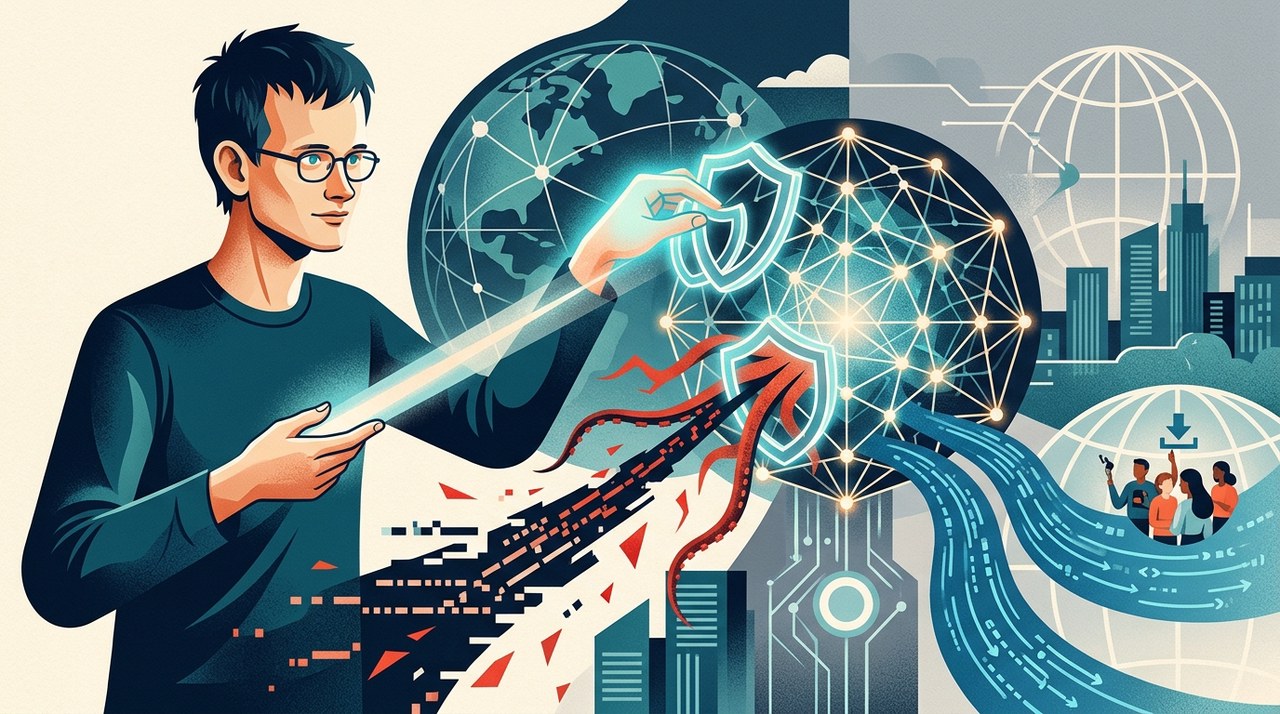
Vitalik Buterin Weighs In on AI Safety and Hacking Risks
EthereumETH-0.60% co-founder Vitalik Buterin has publicly thrown his support behind a decision by Moonshot AI to intentionally strip advanced hacking capabilities from its latest artificial intelligence model, the Kimi K3.1 Pro.
Rather than restricting who is allowed to access artificial intelligence, Buterin believes it is far better to place limits on what the software can actually do. While this safety tweak makes the software slightly less powerful at complex tasks, Buterin views it as a necessary trade-off to protect global cybersecurity.
Inside Moonshot AI's Kimi K3.1 Pro Model
Moonshot AI, a prominent tech startup based in Beijing, is preparing to release the 'open weights' for its Kimi K3.1 Pro model by November 4. Releasing open weights means that anyone around the world will be able to download the model and run it directly on their own personal computers or servers.
Because open models can be run privately without centralized censorship or monitoring, Moonshot decided to scrub offensive cyberattack data from its training materials and reinforcement learning environments. However, standard coding skills were left intact so developers can still use the tool for normal programming.
This safety filtering came with a clear drop in performance on technical exploit tests:
- Unfiltered model: Successfully solved 90.5% of internal exploit benchmark tasks.
- Filtered model (Kimi K3.1 Pro): Solved 81% of the same exploit benchmark tasks.
- Competitor comparison: DeepSeek's rival open model, V4.1-Flash, achieved an 85.7% score on the identical benchmark test.
Why Feature Limits Beat User Discrimination
In a post on X on October 26, 2026, Buterin explained why he strongly prefers placing boundaries on AI functionality rather than policing human users.
I am okay with Kimi 3.1 deliberately leaving out top-end offensive cyberCYBER+0.00% capabilities from their training data. Discriminating against use cases is MUCH less bad than discriminating against users. And the world does need all the time it can get to prepare, harden, check old...
For Buterin, restricting capabilities ensures that open-source software remains available to everyone equally. He argues that trying to vet users creates unfair hurdles, whereas paring back dangerous features protects the broader tech ecosystem.
Buying Time for Cybersecurity Defenders
Why is slowing down AI hacking abilities so important right now? According to Buterin, automated AI cyberattacks will eventually become an inescapable reality. Until that day arrives, software developers and security engineers need every spare moment to fortify critical systems.
Security teams need time to inspect legacy code, patch existing vulnerabilities, and thoroughly verify newly written software before AI tools can execute attacks automatically.
The urgency of this issue is backed by recent industry data. Earlier this year, Binance Research discovered that AI systems are currently twice as effective at exploiting smart contract vulnerabilities as they are at finding and fixing those same security flaws. This 2-to-1 offensive advantage puts decentralized applications and crypto protocols at significant risk.
The Danger of Dystopian AI Surveillance
Buterin also issued a stern warning about what could happen if early AI security incidents go terribly wrong. If the first major wave of AI risks results in catastrophic cyberattacks, governments and regulators might react by locking down software completely.
In that worst-case scenario, access to artificial intelligence could require invasive Know Your Customer (KYC) identity checks, heavy digital surveillance, and strict geographic restrictions.
Under such rules, a user's ability to run advanced software would depend on their official documentation and nationality, effectively reducing millions of people to 'second-, third-, or fourth-class users.'
As someone who regularly tests and runs open-source AI models locally on his own laptop, Buterin wants to preserve decentralized access while minimizing immediate dangers.
A Temporary Shield in a High-Stakes Race
Despite his praise for Moonshot AI, Buterin remains realistic about the limits of content filtering. When a social media user pointed out that competing AI labs would eventually build offensive cyber tools anyway, Buterin acknowledged that this is inevitable.
Because competitors like DeepSeek are already pushing ahead with higher benchmark scores, filtering offensive code is not a permanent solution. Instead, Buterin sees AI safety as a high-stakes race against time.
In his view, delaying offensive AI capabilities gives defenders a crucial window to implement redundant security measures and strengthen blockchain protocols before automated exploit tools catch up.
Latest blog posts


Could Quantum Gravity Erase Black Hole Singularities?
A new physics study suggests quantum gravity corrections might eliminate infinite singularities in black holes and the Big Bang, smoothing out space-time.
|

Fed Decision and US Economic Data Gear Up to Move Crypto
The crypto market cap dipped to $2.75 trillion as traders prepare for a big week featuring Fed interest rate news, U.S. GDP data, and billions in options expiry.
|
Over 11 Million Bitcoin Has No Known Owner: Here Is Why
Galaxy Research data reveals that over 55 percent of all mined bitcoin sits in unidentified wallets. Here is what that means for everyday investors.
|