
Could Quantum Gravity Erase Black Hole Singularities?
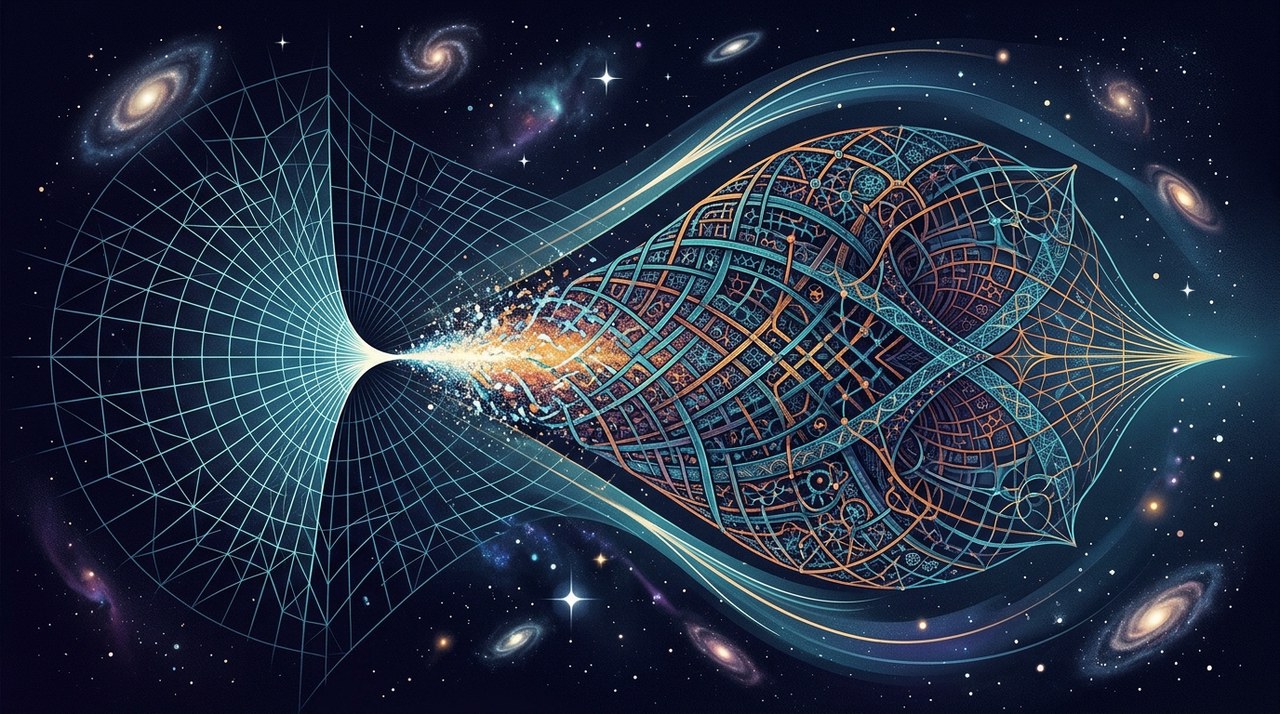
When Einstein's Best Math Hits a Brick Wall
Albert Einstein gave us general relativity back in 1915. For over a century, it has proven remarkably accurate.
It helps us map galaxies, bend light, and keep our phone GPS timing perfectly synchronized. But at extreme edges of nature, his math breaks down.
Those trouble spots occur at the center of black holes and the initial moment of the Big Bang.
What Exactly Is the Singularity Problem?
In classic physics equations, extreme conditions yield a point of infinite density and infinite space-time curvature. Scientists call this point a singularity.
Infinities disrupt standard calculations because they ruin scientific predictability. When density reaches infinity, normal physics formulas stop making sense.
When your model produces infinities, it is often a sign that the model is being asked to operate outside its jurisdiction.
Think of it like an otherwise detailed world map with a missing, unreadable center labeled unknown.
How Quantum Gravity Offers a Solution
A study published in Physics Letters B offers a fresh perspective written by theoretical researchers.
The authors suggest adding an infinite series of quantum-gravity corrections to Einstein's original field equations.
- Replaces infinite density points with intensely curved but smooth regions of space-time.
- Allows equations to remain mathematically stable and predictable.
- Provides potential scenarios where space-time contracts and expands without crashing.
Rethinking Black Hole Interiors and the Big Bang
If these quantum corrections are correct, black holes may not hide a terrifying point of infinite destruction.
Instead, the interior becomes a highly curved but well-behaved region of space-time that physics can still describe.
This framework could also rewrite our understanding of cosmology by softening the universe's earliest moments into a manageable finite scenario.
How Scientists Plan to Test This Theory
Nobody can travel inside a black hole or travel back to the Big Bang. That means direct testing is out of the question.
Instead, researchers must search for subtle deviations in gravitational-wave signals caused by massive black hole collisions.
Observatories like LIGO and next-generation space detectors will analyze these cosmic ripples to see if Einstein's equations hold or need quantum tweaks.
Broader Technology and Market Context
Advanced scientific discoveries often run parallel to technological shifts, computing advances, and digital asset markets. Past performance of digital assets is not an indicator of future results.
Whether singularities are real features of nature or mathematical artifacts, testing them will push human technology to new horizons.
Latest blog posts



Vitalik Buterin Backs Moonshot AI Hacking Limits
Ethereum co-founder Vitalik Buterin supports Moonshot AI removing hacking capabilities from its new open model to buy time for cybersecurity defenders.
|

Fed Decision and US Economic Data Gear Up to Move Crypto
The crypto market cap dipped to $2.75 trillion as traders prepare for a big week featuring Fed interest rate news, U.S. GDP data, and billions in options expiry.
|
Over 11 Million Bitcoin Has No Known Owner: Here Is Why
Galaxy Research data reveals that over 55 percent of all mined bitcoin sits in unidentified wallets. Here is what that means for everyday investors.
|