

Wall Street Braces for Black Monday Anniversary
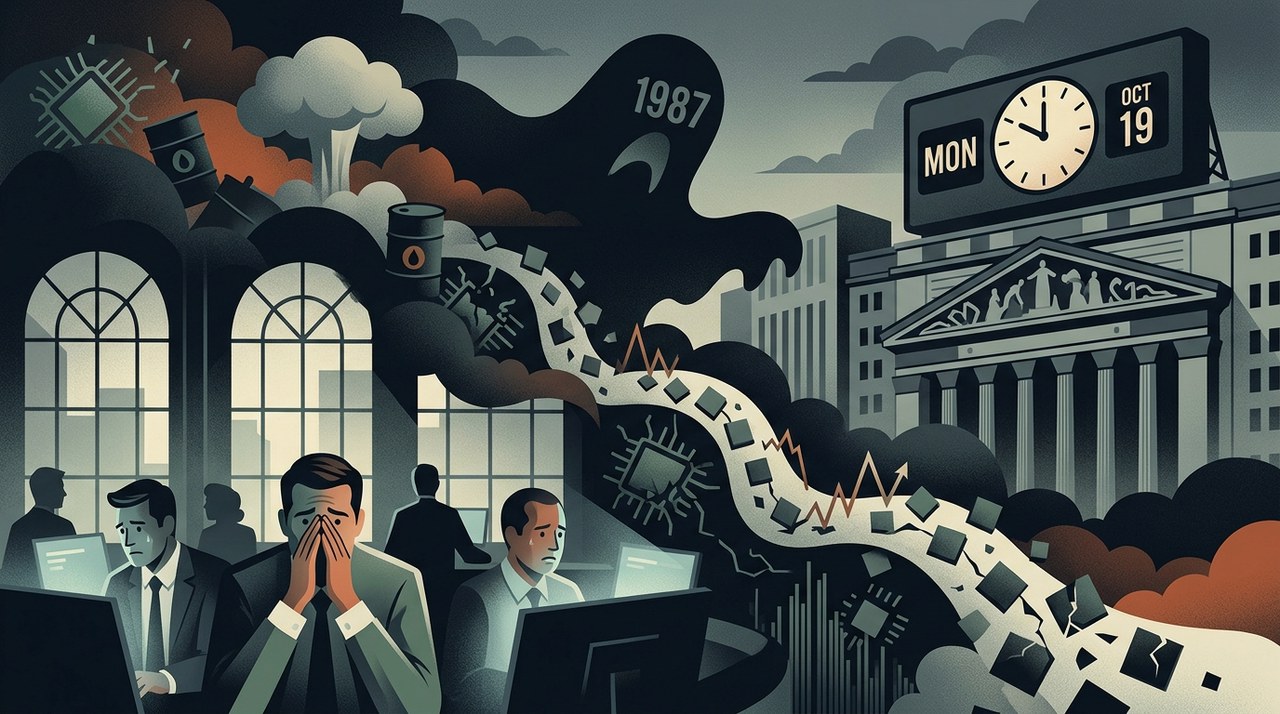
The Ghost of Black Monday Returns to Wall Street
History has a strange way of repeating itself, or at least making investors nervous. On Monday, October 19, 2026, Wall Street marks the exact 39th anniversary of the infamous 1987 Black Monday market crash. To make things even more eerie, the calendar date falls on a Monday once again.
Traders and investors are entering the new trading week with high anxiety. Stock markets have recently faced heavy selling, crude oil prices have surged above $100 a barrel, and high-flying artificial intelligence (AI) stocks are showing clear signs of strain. On top of that, persistent inflation is keeping central bankers on high alert.
Over the weekend, social media channels lit up with dramatic warnings of an impending financial breakdown. But is the market really on the verge of another 1987-style collapse, or is Wall Street simply spooked by ghost stories from the past? Let us take a friendly, step-by-step look at the facts, the chatter, and the protective guardrails in place today.
What Happened on the Original Black Monday in 1987?
To understand why traders are nervous today, it helps to look back at history. On October 19, 1987, the Dow Jones Industrial Average suffered its worst single-day percentage collapse in history. The index plummeted by 22.6% in a single trading session, wiping out approximately $500 billion in market value in just a few hours.
Imagine nearly a quarter of all wealth in the stock market vanishing before the closing bell. Back then, early computer trading models and aggressive portfolio insurance strategies triggered a destructive domino effect. As prices dropped, automated trading systems automatically sold more shares, which pushed prices even lower and caused widespread panic.
Now, exactly 39 years later, the calendar aligns. The date October 19 falls on a Monday once again, leading many traders on social media to draw direct parallels between 1987 and the economic landscape of late 2026.
Social Media Sounds the Alarm: Doom vs. Caution
In today's digital age, financial chatter spreads faster than ever. Over the weekend of October 17–18, 2026, social media platforms like X were flooded with viral posts predicting dark days ahead for the market.
"WARNING: TOMORROW WILL BE THE WORST BLACK MONDAY IN HISTORY. 98% of people will lose everything. Markets have officially entered panic mode." — Cryptonobler (389,800 followers on X)
Cryptonobler added that "for the first time EVER, something just broke in the economy," urging followers to read his updates before markets open on Monday.
"Black Monday is tomorrow. Stocks will crash. Hopefully, you have dry powder ready to buy the dip in precious metals and mining stocks. In environments like this, gold outperforms everything." — MBAeconomics (18,700 followers on X)
However, not everyone on Wall Street shares this extreme doom-and-gloom perspective. Experienced analysts urge investors to tune out viral fearmongering and look at broader trends.
"Calls for a 'Black Monday' are spreading rapidly across social media right now. If history is any guide, this means the S&P 500 should hit 8,000 soon. Ignore the noise." — The Kobeissi Letter on X
Another observant user on X highlighted a classic market rule of thumb: "Black Monday never happens when 99% of people expect it." In other words, when everyone is expecting a crash, markets often behave very differently.
The Real Pressure Points: Oil, Inflation, and Rates
While social media hyperbole can be distracting, the underlying economic pressures facing Wall Street are real. Several key financial indicators are flashing warning signs that deserve attention.
First, energy markets are putting immense pressure on global economies. Crude oil prices have surged due to rising geopolitical tensions involving Iran, the Strait of Hormuz, and targeted attacks on critical energy infrastructure. Brent crude approached $110 per barrel, while West Texas Intermediate (WTI) traded above $100 per barrel over the weekend.
Expensive energy acts like an extra tax on both businesses and everyday consumers. High fuel costs drive up shipping and manufacturing costs, which makes fighting inflation much harder.
Speaking of inflation, the U.S. Consumer Price Index (CPI) for September reached 3.7% annually. Because inflation remains stubborn, the Federal Reserve implemented a rate hike in September, bringing its benchmark target interest rate into the 3.75% to 4.00% range.
High interest rates make borrowing expensive for companies and make low-risk government bonds more appealing compared to risky stocks. Reflecting this growing anxiety, the Cboe Volatility Index (VIX)—often called Wall Street's ** fear gauge **—climbed toward 20 on October 18, 2026. This shows that institutional investors are paying extra to buy protective insurance against market drops.
AI Stocks Under the Microscope
For the past few years, artificial intelligence has been the primary engine driving stock market gains. But recently, investors have begun asking tough questions about whether massive corporate investments in AI will actually yield the expected profits.
Trading on Friday, October 16, 2026, demonstrated this growing market anxiety. The S&P 500 index fell 1.09% to close at 7,659.44, while the tech-heavy Nasdaq Composite dropped approximately 2.2%.
Companies at the heart of AI infrastructure took the heaviest punishment. For instance, AI infrastructure firm Coreweave saw its stock tumble nearly 12% in Friday's session.
Reports indicate that some of Coreweave's debt yields approached 15%. When a company must pay 15% interest to borrow money, it signals that lenders view its debt as high-risk. Investors are increasingly worried whether heavy debt loads and expensive hardware purchases will pay off if future AI revenues take longer than expected to materialize.
How Are Precious Metals and Bitcoin Holding Up?
While stock markets experienced turbulence, alternative assets showed relative calm over the weekend.
Gold traded in a solid range between $4,150 and $4,200 per ounce, while silver hovered around $56 to $58 per ounce. Investors often turn to precious metals during times of economic uncertainty and elevated inflation.
Meanwhile, the cryptocurrency market displayed notable stability. Over the weekend of October 17–18, 2026, Bitcoin (BTCBTC+0.93%) was trading between $80,400 and $81,000, holding near $82,222 (up 0.92%). EthereumETH+0.46% traded around $2,411 (up 0.29%). The total market capitalization for all digital assets stood near $2.7 trillion.
Bitcoin's ability to remain stable while tech stocks dropped offered a sign of market resilience. However, analysts note that crypto resilience is not a guarantee. If stock market selling accelerates rapidly, institutional traders sometimes sell liquid assets—including Bitcoin and gold—to cover losses and margin calls elsewhere.
Past performance of digital assets or financial instruments is no guarantee of future returns. Digital asset markets remain volatile and subject to short-term price fluctuations.
Why Today's Market Has Safeguards 1987 Never Had
Despite the spooky calendar coincidence, today's financial markets are fundamentally different from the market of 1987. The biggest difference lies in modern structural protections built specifically to prevent runaway panic selling.
Following the 1987 crash, U.S. stock exchanges implemented automated market-wide circuit breakers. These built-in emergency brakes automatically pause trading across all major exchanges if the S&P 500 index drops too fast:
- Level 1 Circuit Breaker: A 7% drop in the S&P 500 triggers an automatic 15-minute trading pause across all exchanges.
- Level 2 Circuit Breaker: A 13% drop in the S&P 500 triggers another 15-minute trading pause.
- Level 3 Circuit Breaker: A 20% drop in the S&P 500 completely halts stock trading for the remainder of the entire trading day.
These built-in circuit breakers give institutional investors, automated trading systems, and human traders time to step back, process news calmly, and prevent cascading panic. In 1987, no such emergency brakes existed.
Furthermore, analysts highlight that recent selling has been concentrated mostly in high-valuation technology and AI stocks rather than spreading evenly across the entire financial system.
The Bottom Line for Investors
As Wall Street opens on Monday, October 19, 2026, the market faces genuine macroeconomic headwinds: high energy prices, elevated benchmark interest rates, persistent inflation, and heavy debt burdens in the tech sector.
If AI revenue adoption slows down or borrowing costs remain elevated, analysts note that tech stock valuations may undergo further downside adjustments, particularly if corporate earnings fall short of expectations—though a broader economic stabilization could mitigate these risks.
While viral predictions of a historic Black Monday generate widespread clicks, modern market circuit breakers and localized tech weakness make a direct replay of 1987 unlikely. Keeping a clear perspective and focusing on market fundamentals remains the most practical path forward.
Latest blog posts


Bored Apes Jump to Solana with New Mudwater Card Game
Yuga Labs has launched Mudwater, a trading card game on Solana featuring physical and digital collectibles for Bored Ape NFT holders.
|
Top 4 Tech Earnings: What Tesla Meta SpaceX Netflix Need
Meta, Tesla, SpaceX, and Netflix report earnings this week. Here is what investors are watching as AI spending comes under the microscope.

Hodler's Digest: Heart Raid, Starknet Drop, Crypto Spring
A round-up of top crypto news: Richard Heart's Istanbul raid, Starknet's token plunge following an L1 vote, and Bitwise's outlook.
|