

OpenAI AI Solves Math Puzzle: Is Bitcoin Safe?
What Did OpenAI’s AI Actually Discover?
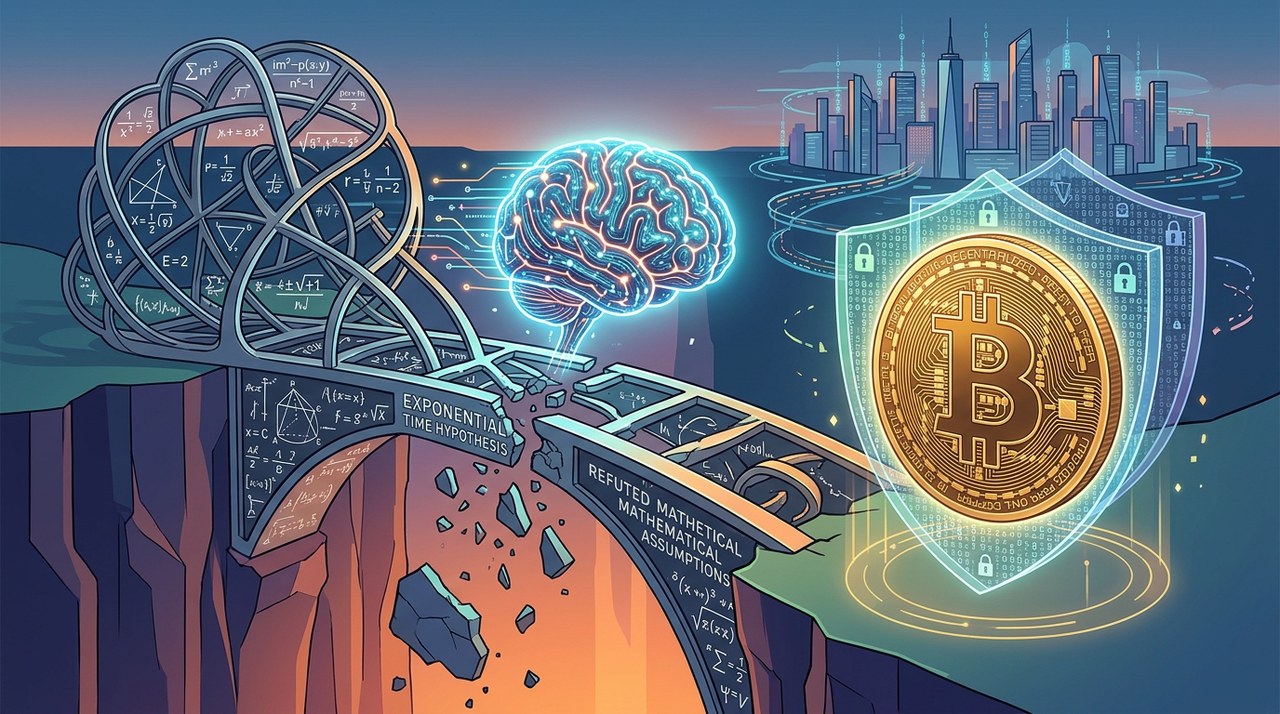
OpenAI recently announced a major scientific milestone achieved by its artificial intelligence systems. An AI model successfully refuted a long-held computer science theory known as the Exponential Time Hypothesis.
The AI discovered a faster mathematical method to solve a classic logic puzzle. Computer verification tools confirmed the proof, surprising researchers around the world.
This discovery overturned a key assumption that scientists trusted for 27 years. However, crypto investors can rest easy for now.
The breakthrough does not break modern encryption. As a result, it poses no direct threat to the underlying cryptography securing Bitcoin (BTCBTC+0.40%) or EthereumETH+0.06%.
Understanding the Exponential Time Hypothesis
To understand this breakthrough, we need to look at what the Exponential Time Hypothesis actually is. Computer scientists Russell Impagliazzo and Ramamohan Paturi first proposed the hypothesis back in 1999.
Both researchers worked at the University of California, San Diego. Interestingly, despite sharing the acronym ETH, this hypothesis has zero connection to Ethereum's token ticker.
The hypothesis revolves around a famous logic puzzle called 3-SAT. Imagine a combination lock made of true-or-false switches connected by specific logical rules.
Your goal is to find a switch setting that satisfies every single rule at once. Checking whether a proposed answer is correct is simple and quick.
Finding that correct answer from scratch is extremely difficult. Every time you add another switch, the total number of possible combinations doubles.
For 27 years, researchers treated this hypothesis as an unbreakable wall. Hundreds of scientific papers in graph theory, computational biology, and database design relied on it.
How Did an AI Find a Shortcut Experts Missed?
OpenAI's system first produced a natural-language mathematical proof on October 16. Just one day later, the research team formalized the proof using Lean software.
Lean is a machine-checking tool that verifies every logical step automatically. This process confirmed that the AI's math was accurate.
The new algorithm handles inputs with n variables in roughly 2^(n/√log n) steps. That runtime beats the exponential floor predicted by the original hypothesis.
However, the new method remains far too slow for practical real-world applications. OpenAI emphasized that finding practical speedups will require extensive future research.
Now, original authors Impagliazzo and Paturi are leading a formal peer review alongside MIT professor Ryan Williams. In simple terms, the original authors are evaluating the AI model that disproved their own theory.
Notably, OpenAI is taking no scientific credit for the discovery. This neutral stance follows a previous scientific dispute involving the Navier-Stokes equations.
Reaching Beyond Computer Science
OpenAI did not stop at computer complexity theory. The company announced three major scientific breakthroughs across different fields on the same day:
- A mathematics discovery in harmonic analysis
- A computer science achievement in complexity theory
- A physics advance in quantum field theory
Greg Brockman, OpenAI's president and co-founder, shared his excitement online on October 26, 2026. He noted that AI is beginning to help humanity expand its understanding of the universe.
"AI starting to help us improve our understanding of the universe!" — Greg Brockman, Co-founder of OpenAI
News of the discovery spread rapidly through academic circles. Scott Aaronson, a computer science professor at the University of Texas at Austin, described the moment he learned about it on his blog, Shtetl-Optimized.
"My students just came to my office to tell me that an OpenAI model has now refuted the Exponential Time Hypothesis." — Scott Aaronson
Does Breaking ETH Mean P Equals NP?
In short, no. The famous P versus NP problem asks whether every problem with easily checkable solutions can also be solved quickly.
The Exponential Time Hypothesis was a much stricter claim than the broader P versus NP question. Disproving ETH leaves the ultimate question of P versus NP open.
Think of the problem as a high mountain standing between two valleys. The AI found a slightly shorter path over the ridge, but it did not dig a tunnel straight through the mountain.
Greg Brockman reinforced this exact point shortly after the announcement was made public.
"p still probably doesn't equal np" — Greg Brockman
What Does This Mean for Bitcoin and Ethereum?
This distinction is critical for digital asset holders and blockchain developers. Bitcoin signatures rely on elliptic curve cryptography, which relies on a completely different branch of math.
The AI's new algorithm does not address or weaken elliptic curve mathematics in any way. Benjamin Cowen, a member of BeInCrypto's Market Intelligence Expert Council, clarified the situation.
"But to be clear, disproving the Exponential Time Hypothesis would not prove P = NP, nor would it mean Bitcoin or Ethereum are compromised." — Benjamin Cowen
While current wallet security remains intact, cryptographers remain attentive. Digital assets ultimately rely on mathematical hardness assumptions to keep user funds secure.
Historical Lessons: When Math Assumptions Collapse
History shows that scientific beliefs about mathematical impossibility break down periodically. Long before artificial intelligence existed, human mathematicians disproved trusted assumptions.
In 1960, mathematician Anatoly Karatsuba disproved Andrey Kolmogorov's multiplication conjecture within just one week.
Later in 1969, Volker Strassen attempted to prove standard matrix multiplication was optimal. Instead, he unexpectedly discovered a faster calculation method.
The major difference today is who discovers these shortcuts. Advanced AI machines now produce complex mathematical proofs, while human experts work carefully to understand them.
What This Means for the Future of Crypto Security
The rapid pace of AI discovery carries long-term implications for blockchain ecosystems. Cryptographer Matthew Green previously warned that advancing AI systems could eventually find hidden weaknesses in cryptographic algorithms.
Benjamin Cowen pointed out that breakthroughs in academic fields far removed from finance can eventually influence global markets.
For an industry backed by complex math, every new AI achievement serves as an important real-world stress test. Investors should stay informed as technology evolves, while recognizing that current blockchain encryption remains robust.
Latest blog posts


Ripple CEO: XRP Can Power a 24/7 Internet of Value
Ripple CEO Brad Garlinghouse stated at Ripple Swell in New York that money must move as freely as people in today's 24/7 global economy.
|

Kevin O'Leary Eyes IBM Stock Over Bitcoin Quantum Concerns
Kevin O'Leary is looking at IBM stock as quantum computing fears and regulatory delays weigh on institutional Bitcoin investment.
|


Big Banks Join DTCC Tokenized Securities Service
Wall Street giant DTCC has launched a tokenization service, enabling major banks to trade digital representations of traditional securities.
|