
OCC Faces Banking Backlash Over $850 Billion Stablecoin Threat
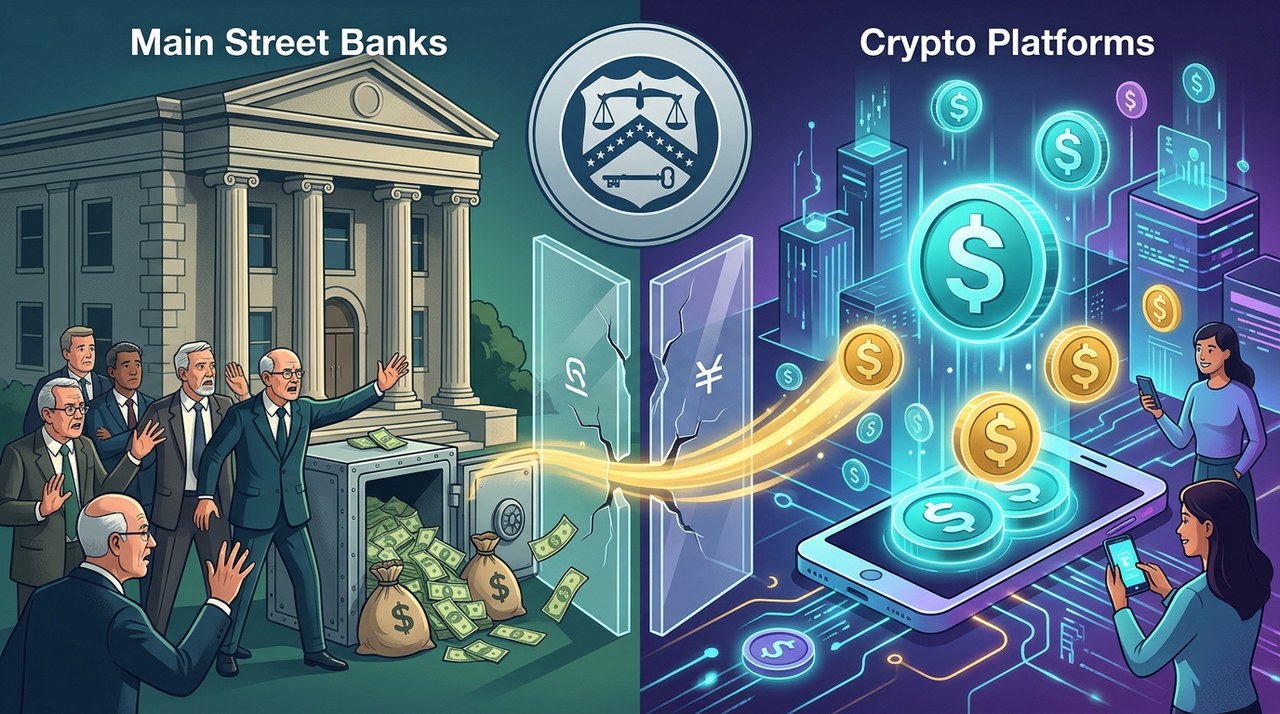
A Battle Brewing Between Main Street Banks and Crypto Platforms
Imagine putting your savings into a digital dollar wallet that pays you extra rewards every month. Sounds pretty appealing for consumers, right? But traditional local banks are sounding the alarm, warning that this exact trend could disrupt local economies across America.
On Wednesday, October 21, 2026, a major regulatory conflict erupted in Washington. Two of America's most influential banking trade groups publicly challenged the Office of the Comptroller of the Currency (OCC). Their main grievance centers on how the federal regulator finalized rules for stablecoins under the recently passed GENIUS Act.
The banking lobby argues that the new rules leave a massive loophole open. By allowing crypto platforms to offer indirect rewards on digital dollars, regulators might accidentally cause hundreds of billions of dollars to leave traditional bank accounts.
Understanding the Core Dispute: What Are Indirect Yield Loopholes?
To understand why bankers are so upset, we need to look at how stablecoin rules were originally intended to work. Congress designed the GENIUS Act with a clear goal: prevent digital dollar issuers from paying direct interest to holders, keeping them distinct from traditional banks.
However, the OCC's final rules removed previously proposed safeguards that restricted indirect yield arrangements. This means while a primary stablecoin issuer cannot pay you interest directly, third-party partners can still offer financial incentives.
These third parties include cryptocurrency exchanges, parent companies, affiliate platforms, and distribution partners. They can offer cash-back perks, trading bonuses, or promotional rewards simply for holding digital dollars on their platforms.
Rob Nichols, the President and Chief Executive Officer of the American Bankers Association (ABA), expressed deep disappointment with this regulatory decision.
The result is a final rule that will preserve the status quo for crypto platforms despite Congress's clear intent to protect local lending.
Nichols pointed out that omitting these safeguards allows crypto firms to effectively bypass lawmakers' original intentions. Without strict limits on partner incentives, digital wallets can function much like high-yield deposit accounts without meeting the same regulatory burdens.
The $850 Billion Warning: Community Banks Sound the Alarm
While the ABA focused on regulatory fairness, the Independent Community Bankers of America (ICBA) highlighted the potential economic impact on everyday citizens.
In a statement provided to Bitcoin.com News, ICBA President and Chief Executive Officer Rebeca Romero Rainey shared a striking financial projection based on the association's economic analysis.
The ICBA estimates that widespread adoption of payment stablecoins under these loose rules could reduce community bank lending capacity by at least $850 billion in the coming years.
It is important to remember that this $850 billion figure represents a projected economic scenario created by the banking association, rather than a guaranteed outcome. Actual figures will depend on market conditions, interest rates, and regulatory enforcement.
We remain focused on ensuring the agency's policies protect against the risks that payment stablecoins pose to community bank lending, local communities, and financial stability.
Romero Rainey emphasized that community banks rely heavily on customer deposits to fund essential loans. When local residents keep their savings in local banks, those funds get lent out to neighborhood small businesses, family farms, and home buyers.
If depositors move their money out of local banks and into crypto platforms offering attractive rewards, community banks face higher funding costs. Ultimately, this can lead to tighter credit availability for local communities.
Romero Rainey added: 'ICBA will continue working to protect local small businesses, farmers, and consumers from the risks that loosely regulated, yield-bearing payment stablecoins pose to community bank lending capacity.'
A 150-Year-Old Banking Legacy Meets Digital Assets
This battle is not just about new tech versus old rules. It involves institutions with deep historical roots in the American financial infrastructure.
The American Bankers Association was established in 1875, shortly after the severe financial panic of 1873. Over the last 150 years, the organization has played a key role in shaping how money moves across the United States.
For instance, the ABA helped create standardized bank routing numbers, pioneered check-processing systems, and helped launch the automated clearing house (ACH) network that powers electronic bill payments today.
Today, the ABA represents a massive banking sector that safeguards roughly $20.7 trillion in customer deposits and provides over $13.9 trillion in loans to businesses and consumers.
Despite what some might think, the ABA is not against digital assets or blockchain technology altogether. The group supports regulated bank involvement in digital asset custody, issuing bank-backed stablecoins, and exploring blockchain infrastructure.
However, the ABA insists that non-bank crypto platforms should not offer bank-like yield products without following bank-like regulations and consumer protection laws.
This is not a new position for the group. In December 2025, the ABA teamed up with 52 state bankers' associations to demand stricter regulations on stablecoin rewards, continuing their lobbying efforts throughout 2026.
The ABA has also voiced strong opposition to a potential U.S. consumer-facing Central Bank Digital Currency (CBDC), citing similar risks regarding deposit migration away from commercial banks.
Nichols warned regulators against taking a wait-and-see approach, stating: 'Those gaps risk undermining the distinction Congress drew between payment stablecoins and traditional bank deposits.'
What Are the OCC's Final Rules Under the GENIUS Act?
To put this pushback into context, it helps to understand what the OCC actually finalized in its latest regulatory package.
The OCC published its finalized rules to implement key sections of the GENIUS Act. These rules establish new federal guidelines governing how stablecoin issuers handle their operations.
Key provisions of the OCC's final rules include:
- Reserve Requirements: Mandating that payment stablecoins are backed 1:1 with high-quality liquid assets like cash and short-term U.S. Treasuries.
- Redemption Protections: Setting clear rules so consumers can redeem their stablecoins for underlying dollars without unexpected delays.
- Custody Standards: Defining how digital asset custodians must secure customer tokens and underlying reserve assets.
- Risk Management Frameworks: Requiring issuers and participating institutions to maintain robust operational controls and cyberCYBER+1.28% defenses.
While bankers acknowledge these operational standards are a step forward, they believe leaving out the indirect yield ban creates an uneven playing field.
Comparing Bank Deposits and Stablecoin Yields
For consumers navigating these options, understanding the differences between traditional bank deposits and stablecoin reward programs is essential.
Traditional bank deposits benefit from federal deposit insurance (such as FDIC coverage in the United States up to applicable limits), regulatory capital requirements, and strict consumer protection frameworks.
On the other hand, stablecoins and crypto platform reward programs operate differently:
- FDIC Coverage: Stablecoins themselves are generally not FDIC-insured bank deposits. If an exchange or affiliate platform fails, customer funds could be at risk.
- Yield Variability: Crypto rewards and platform yield rates depend heavily on market conditions, corporate promotions, and business models. Past promotional returns do not guarantee future performance.
- Operational and Smart Contract Risks: Holding digital assets on centralized exchanges or decentralized platforms involves smart contract vulnerabilities, cybersecurity risks, and potential liquidity bottlenecks during market downturns.
The Big Question for Washington and Wall Street
As the OCC finalizes its framework under the GENIUS Act, the broader debate over digital dollars is far from over.
The banking industry faces a fundamental question: Can traditional institutions compete directly with innovative digital financial products, or will regulators ultimately restrict how much competition stablecoins can bring to the market?
For now, community banks and financial lobbies will keep pushing lawmakers and federal agencies for stricter controls on indirect yield structures.
Consumers and market participants should continue to monitor how these regulations develop while keeping in mind that high-reward digital asset offerings carry different risk profiles than insured bank accounts.
Latest blog posts

Trump Omits 'Crypto' Term at Cybercrime Event
During a White House cybercrime roundtable, US President Donald Trump detailed various fraud schemes but referred only to 'cybercurrency' in relation to scams, completely omitting the term 'crypto'.
|
Meta Fined $25 Billion: Why Isn't Meta Stock Crashing?
A judge ordered Meta to pay $25 billion over privacy violations. Yet its stock price is climbing as investors focus on AI and earnings.

Starlink Powers Wall Street Rallies for United and SpaceX
United Airlines and SpaceX stocks jumped over 6% following Q3 earnings, showing how Starlink satellite internet is shaping both businesses.