


France Proposes 31.4% Tax on Regulated Stablecoin Swaps
What Is France Proposing for Crypto Taxes?
French lawmakers are debating major updates to how digital assets are taxed as part of the country's proposed 2027 budget. The National Assembly began discussing these measures recently, and legislators have until December 10 to pass the final budget package.
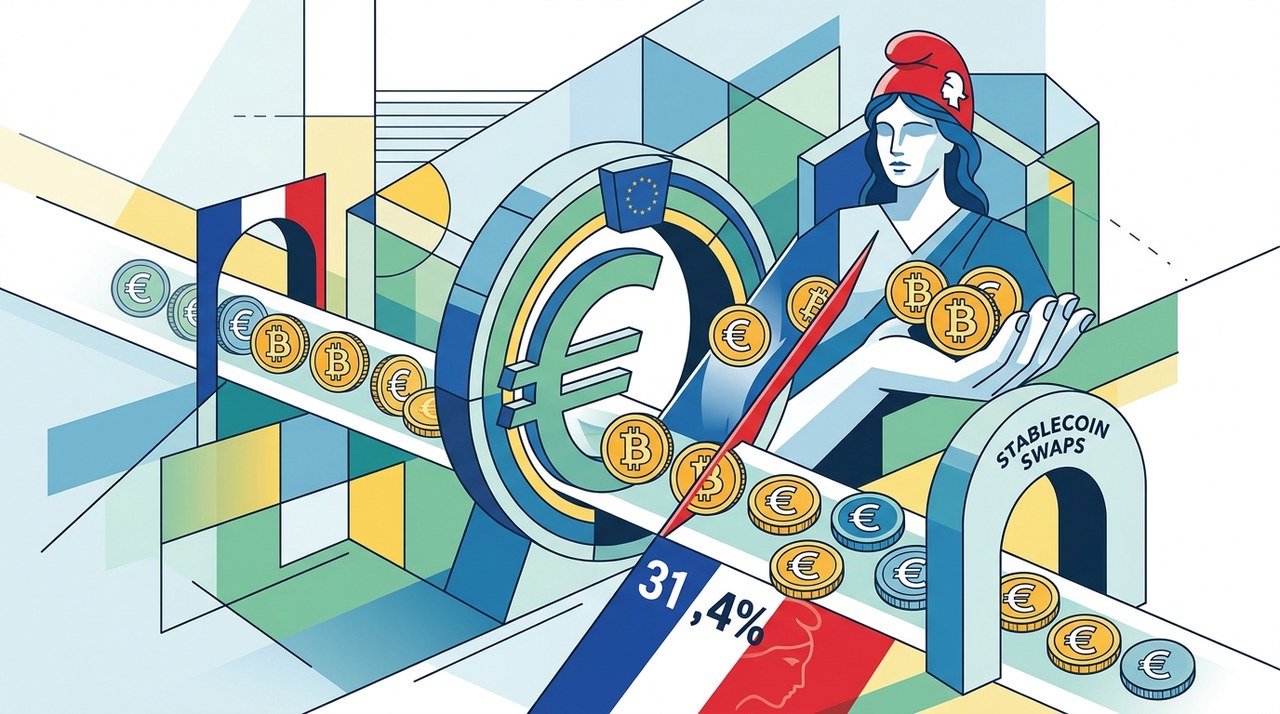
The most controversial proposal is an expansion of France's 31.4% capital gains tax. Under a new amendment, trades from cryptocurrencies like BitcoinBTC-0.20% into European Union (EU)-regulated stablecoins would trigger a taxable event starting January 1, 2027.
Currently, swapping one cryptocurrency for another does not trigger capital gains tax in France. The existing flat rate of 31.4% only applies when investors cash out into traditional fiat currency or use crypto to buy goods and services.
Why Industry Experts Warn Against the Stablecoin Tax
Industry experts warn that taxing swaps into regulated stablecoins could backfire on regulators. Francois Volpoet, the CEO for France at blockchain analytics firm Chainalysis, expressed strong concern about the proposed tax.
Do we want more taxpayers to declare their assets, or a higher tax rate applied to a base that is increasingly evaded?
Volpoet explained that stablecoins regulated as electronic money tokens under the EU's Markets in Crypto-Assets (MiCA) framework are easy for authorities to monitor. MiCA rules fully took effect on July 1 to create standard oversight across Europe.
If France taxes these compliant stablecoins, investors might move toward unregulated, less transparent stablecoins outside the EU. Traders could also turn to decentralized finance (DeFi) platforms or self-hosted wallets, which are far harder for tax officials to track.
Reporting Self-Hosted Wallets: Security Risks and Fines
Another amendment approved by the finance committee on October 9 targets private crypto storage. The measure requires French taxpayers to declare any self-hosted wallet holding at least €100,000 (about $116,000). Failing to report a qualifying wallet could result in fines up to $11,600.
Volpoet raised critical safety concerns about forcing citizens to disclose large personal crypto holdings. He pointed to a steep rise in physical extortion and targeted attacks against crypto owners across Europe.
As of July, Europe recorded 39 out of 52 global physical attacks against crypto holders. France alone accounted for 33 of those cases, representing 63.5% of the global total. Physical security remains a major concern, highlighted by a recent incident in the UK where a trader lost nearly $800,000 in a violent knife assault.
Exit Taxes, Loss Rules, and Next Legislative Steps
French lawmakers are considering several additional updates to crypto tax rules:
- Exit Tax Extension: Lawmakers backed expanding France's exit tax to include crypto holdings worth roughly $900,000. This subjects unrealized crypto gains to the same tax rules applied to wealthy stockholders moving abroad.
- 10-Year Loss Carry-Forward: A separate amendment approved on October 7 allows investors to offset crypto losses against future gains for up to 10 years, matching the tax treatment of traditional stock investments.
None of these amendments have become law yet. On the broader budget, the finance committee rejected the revenue section of the 2027 budget by a 31 to 3 vote. As a result, these crypto proposals must be resubmitted and debated in the full National Assembly, with a key vote set for October 20.
How France Compares to the Rest of Europe
France's tightening tax rules contrast sharply with policies in other European nations. For instance, Greece published a draft bill proposing a 10% capital gains tax on cryptocurrencies, placing it among the most tax-friendly crypto countries in the EU.
In contrast, major European economies like Germany, France, and Italy are planning or setting capital gains tax rates well above 25%.
Global Crypto Market Roundup
While European regulators debate tax reform, significant developments are happening across the global crypto landscape:
- Market Movements: Bitcoin trended toward $84,000 after Federal Reserve official Williams signaled no interest rate hikes in 2027. Note that historical asset performance does not guarantee future results, and crypto markets remain highly volatile.
- Institutional Banking: Standard Chartered introduced direct Bitcoin and EtherETH-0.39% trading for affluent clients in the UAE. Meanwhile, BNY and Citadel Securities are testing tokenized U.S. Treasuries to streamline Wall Street settlement.
- Quantum Preparation: Coinbase, which holds 5% of all circulating Bitcoin, urged developers to start building quantum-resistant security fixes immediately.
- Blockchain Upgrades: SolanaSOL-0.48% set October 21 for its Alpenglow network upgrade, aiming for block finality times of 150 milliseconds.
- Global Regulation: South Korea blocked 27 unregistered crypto exchanges, including Bitmart and KuCoin, while the central bank in the Philippines initiated regulatory action against exchange Coins.ph.
- Real-World Asset Yields: Research highlights that real-world asset (RWA) stablecoins offer 5-7% yields from private credit, compared to traditional crypto funding rates near 4%. Historical yield data should not be taken as a guarantee of future returns.
What This Means for Crypto Holders
The ongoing tax debates in France highlight the balancing act between collecting tax revenue and protecting market compliance. High tax rates on regulated channels can unintentionally encourage users to seek unmonitored offshore options.
Crypto investors should follow upcoming legislative votes closely to understand their reporting obligations. Staying informed about tax changes helps ensure full legal compliance while keeping personal assets secure.
Latest blog posts

Michael Saylor Sees $100K Bitcoin Ahead as Market Bottoms
Strategy's Michael Saylor believes Bitcoin hit its bottom near $60,000 and is entering a new bull market.
|
Standard Chartered Offers Direct Crypto Trading in UAE
Standard Chartered now lets eligible wealthy UAE clients trade Bitcoin and Ether directly through their bank accounts.
|

BlackRock Upgrades US Treasuries After Six Years
BlackRock Investment Institute has upgraded US Treasuries after almost six years, favoring short-term bonds as yields become more attractive.
|