BlackRock CEO Warns Halting Data Centers Could Cause Recession
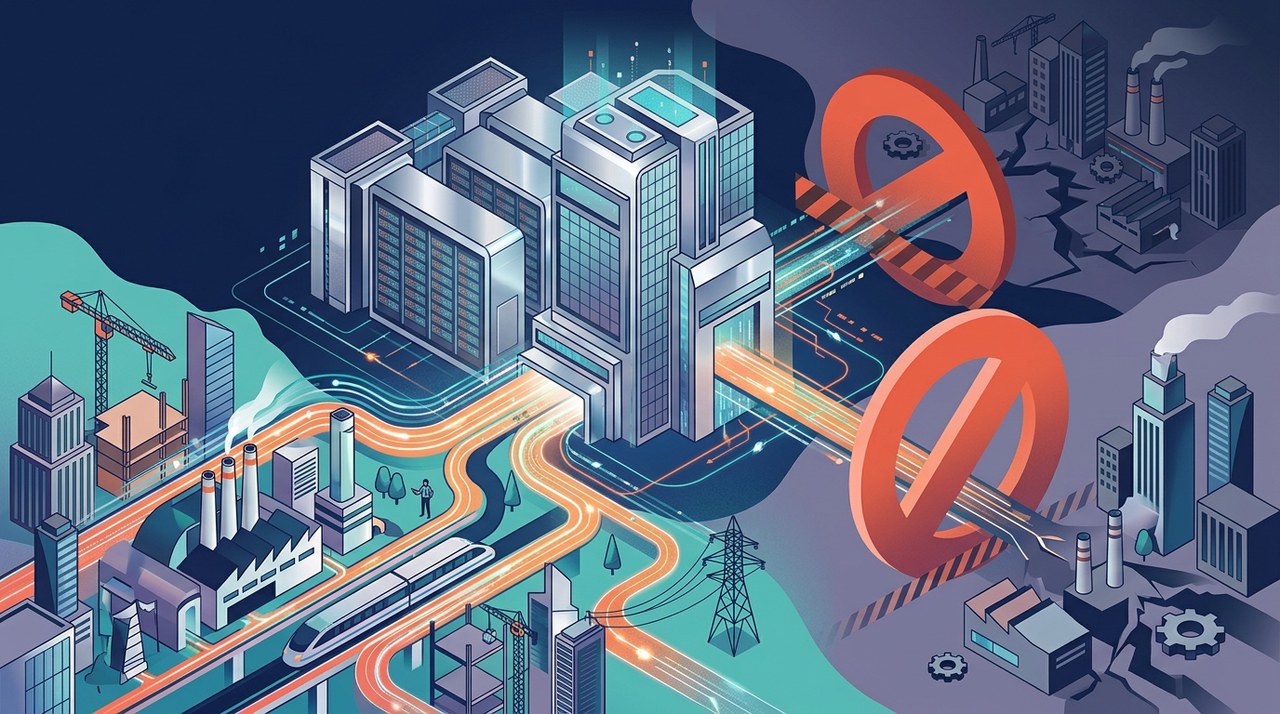
Why Data Centers Are Turning Into a Major Economic Debate
Imagine building a massive high-speed rail network across the nation. It creates thousands of jobs, boosts industrial sales, and keeps the economic engine humming along.
That is essentially how Larry Fink, chief executive of BlackRock, views artificial intelligence data centers today. Speaking to CNBC, Fink argued that putting a freeze on building new data centers could drag the US economy straight into a downturn.
His statements came shortly after BlackRock, the world's largest asset management firm, reported managing a record $15.5 trillion in assets. However, his warning arrives at a tense moment as local opposition to data centers mounts ahead of the November 3 midterm elections.
If we have a moratorium of some sort in this country, we will be in a recession.
How Much Does the US Economy Rely on AI Spending?
To understand Fink's perspective, it helps to look at where recent US economic expansion is originating.
According to Fink, a major portion of US growth now depends on capital expenditure—specifically spending on specialized facilities, computer chips, and high-voltage power lines.
Several key economic figures highlight this heavy reliance on technology infrastructure:
- In 2025, Harvard economist Jason Furman calculated that technology investments accounted for roughly 92% of US economic growth during the first half of the year.
- Wall Street analysts project that annual AI capital spending could cross $1 trillion by 2027.
- Longer-term projections suggest AI-related infrastructure spending might top $5 trillion by 2030.
It is worth noting that these aggressive growth forecasts rely on critical conditions. Analysts assume energy supply will scale up quickly and regulators will keep issuing permits. If local moratoriums spread or if power grids hit capacity limits, infrastructure spending could slow down significantly instead.
Jobs, Energy Grid Demand, and the Case for Infrastructure
Fink describes data centers as a major source of employment across several traditional sectors.
Building a single facility creates demand for skilled construction workers, hardware manufacturers, and utility upgrades. Because of these wide-reaching economic benefits, Fink suggested that public pushback against data centers stems largely from misinformation.
From his viewpoint, slowing down construction threatens to cut off valuable job opportunities and limit necessary investment in modernizing the national energy grid.
Why Local Communities and Critics Are Pushing Back
While financial institutions focus on macro growth, many local residents express growing concern over the immediate impacts on their neighborhoods.
Opponents in several states point to a list of everyday challenges:
- Higher electricity bills as utility companies expand grid capacity to meet huge power requirements.
- Heavy water usage required to cool dense clusters of high-performance servers.
- Local environmental disturbances and noise pollution near residential developments.
- A perceived lack of clear communication regarding long-term community benefits.
These local concerns have already triggered policy changes. In July, New York became the first state to temporarily pause issuing permits for new data centers for up to a year while lawmakers establish clearer guidelines.
BlackRock's Investment Stakes and Market Skepticism
BlackRock's stance comes as the firm increases its direct financial exposure to AI facilities.
In its third-quarter disclosures, the asset manager reported that its dedicated AI Infrastructure Partnership fund deployed its first capital investment during the quarter.
At the same time, prominent voices across the financial landscape are urging caution regarding the rapid pace of expansion:
- Broadcom CEO Hock Tan recently commented that some eager AI market participants resemble gamblers in a casino.
- Billionaire investor Ray Dalio warned that enthusiasm around artificial intelligence may be forming a market bubble that could eventually face a correction.
What Happens Next as Voters Head to the Polls
The debate over data center construction is moving rapidly from corporate boardrooms into public voting booths.
With the midterm elections set for November 3, voters across several districts will evaluate candidates whose platforms include local energy policies and development bans.
How local governments decide to balance environmental priorities against infrastructure investment will likely play a key role in shaping regional economies over the coming years.
Latest blog posts



Chainlink Brings Data Feeds to Stellar Ecosystem
Chainlink's data feeds are now live on Stellar, empowering developers to build new DeFi tools for over $4 billion in tokenized assets.
|


Sberbank Wins Approval to Trade Bitcoin in Russia
Russia's largest bank, Sberbank, received official regulatory approval to buy and sell digital currencies for its clients starting in December.
|

Solana Sets Date for Major Upgrade to Boost Speed
Solana's upcoming Alpenglow upgrade on October 21 will replace Tower BFT, cutting block finality from 12.8 seconds down to just 150 milliseconds.
|