
A 10.8-Billion-Year-Old Radio Signal Finds a Surprising Home
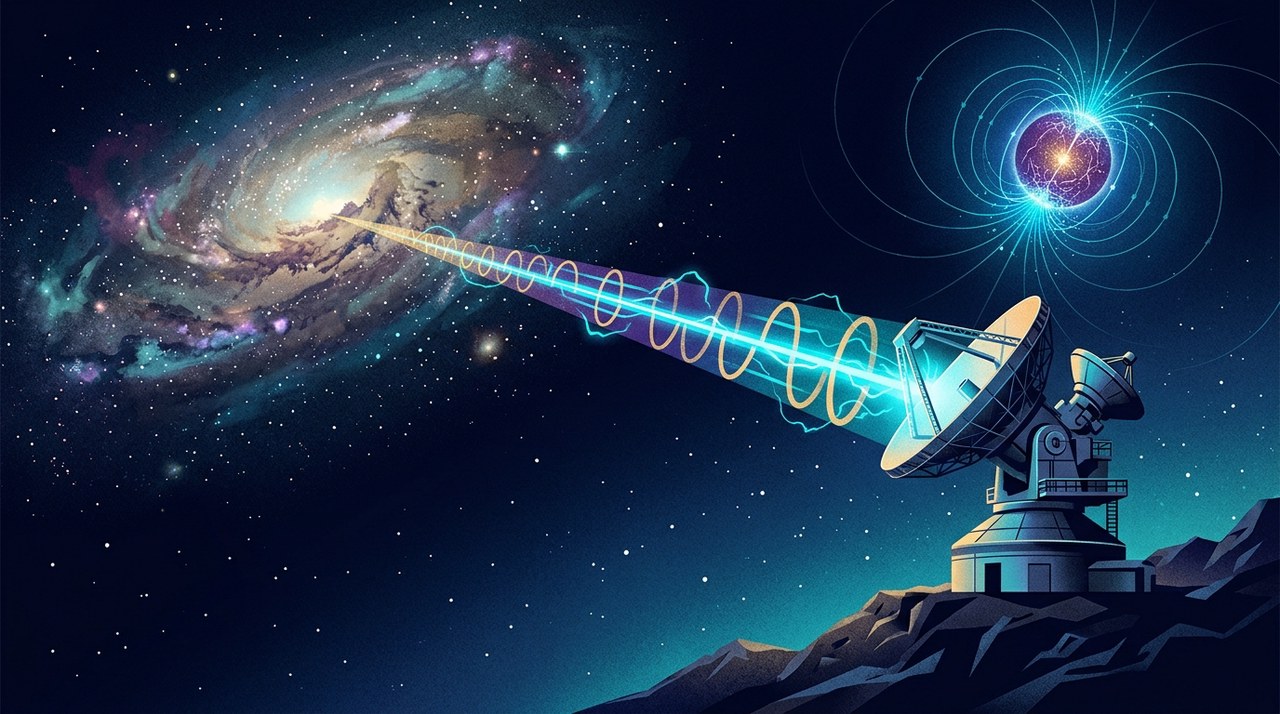
A Mysterious Signal from the Edge of Time
Imagine receiving a message that took 10.8 billion years to reach Earth. That is not science fiction—it is real life. In March 2024, scientists picked up a fleeting burst of energy that began its journey when our universe was just a toddler.
This cosmic signal, named FRB 20240304B, is officially the most distant Fast Radio Burst (FRB) ever recorded. To figure out where it came from, astronomers had to piece together clues using some of the most powerful telescopes on Earth and in space.
What Exactly Is a Fast Radio Burst?
Before diving into the detective work, let's break down what a Fast Radio Burst actually is.
A Fast Radio Burst is a quick, intensely powerful flash of radio waves coming from deep space. These flashes last for only a fraction of a second—literally milliseconds. Yet in that tiny split second, they can release as much energy as our Sun produces in days or even years.
Scientists first discovered FRBs back in 2007. Since then, thousands have been logged across the night sky. But even with all those detections, experts are still debating what creates them.
The Prime Suspect: Magnetars
The leading theory centers around magnetars. A magnetar is a special type of neutron star—the ultra-dense leftover core of a collapsed massive star—that possesses an insanely strong magnetic field. These extreme cosmic objects can dump tremendous amounts of energy into space very quickly. Some FRBs even repeat, which aligns nicely with the behavior of a compact spinning object.
Catching FRB 20240304B Across Cosmic History
The story of FRB 20240304B began in March 2024. South Africa's MeerKAT array—an impressive setup of 64 radio dishes working in unison—spotted the flash.
The burst itself lasted a mere 0.001 seconds (one millisecond). That duration is standard for an FRB, but what blew scientists away was its incredible distance.
Analyzing the signal's properties showed it had traveled through the void of space for roughly 10.8 billion years. That means it was emitted during a chaotic era known as 'cosmic noon.' Back then, the universe was only about 3 billion years old, and galaxies were forming new stars at a furious rate. The official findings from this observation were published on October 8, 2026, in the journal Science.
The Hunt for the Signal's Origin
Detecting a radio burst is one thing, but pinpointing its exact home address in the vast cosmos is a completely different challenge.
At first, ground-based telescopes pointed toward the patch of sky where the signal originated, but they saw nothing. Why? Over a 10.8-billion-year journey, cosmic expansion stretches light waves. Visible light gets stretched into infrared wavelengths, making the source host invisible to standard optical telescopes.
Enter the James Webb Space Telescope
To solve the mystery, researchers turned to the James Webb Space Telescope (JWST). JWST is specifically built to detect infrared light, operating across wavelengths from 0.6 to 28.5 microns.
When Webb locked onto the coordinates, it revealed a huge surprise. Scientists expected to find a massive, mature galaxy capable of hosting such a violent event. Instead, Webb found a tiny dwarf galaxy.
A Surprising Cosmic Cradle
The host galaxy turned out to be roughly 1,000 times less massive than standard theoretical models predicted for a burst this energetic. But the real shocker was the age of the stars inside it.
Astronomers calculated that about 90% of the stars in this dwarf galaxy formed within the last 30 million years. In cosmic terms, 30 million years is extremely young!
This extremely young stellarXLM-0.84% environment fits the magnetar origin theory remarkably well. Because magnetars form when massive stars die young, finding an FRB in a fresh star-forming region suggests we could be seeing a newly minted magnetar in action.
Using FRBs to Map the Universe
Fast radio bursts are not just exciting scientific puzzles—they are also incredible tools for probing deep space.
As the signal from FRB 20240304B traveled across billions of light-years, lower radio frequencies interacted with ionized gas scattered between galaxies. This interaction left subtle distortions, or 'fingerprints,' on the signal.
By decoding these distortions, the research team discovered a previously unknown group of galaxies located about 3.5 billion light-years away from Earth.
Looking Ahead in Space Exploration
This discovery proves that distant radio signals can act like natural flashlights, illuminating dark matter and hidden gas floating between galaxies.
As astronomers collect more ultra-distant bursts in the future, FRBs could help scientists in several key ways:
- Map hidden intergalactic matter that is otherwise nearly impossible to measure.
- Understand how quickly the early universe could form energetic, compact objects like magnetars.
- Test fundamental theories about cosmic expansion and stellar evolution during the universe's early years.
From a 0.001-second flash picked up in South Africa to deep-space infrared observations with JWST, FRB 20240304B shows just how far science has come in unlocking the secrets of our ancient sky.
Latest blog posts

Bank of England Eyes Rate Hikes as Inflation Rises
Bank of England policymakers lean hawkish as rising energy costs drive UK inflation forecasts above 4%, increasing expectations for interest rate adjustments.



XRP Takes Over New York City Subways Ahead of Ripple Swell
New York City subway cars on Manhattan's 42nd Street feature bold new XRP branding as Ripple prepares for its annual Swell conference.
|


 +2
Stablecoin Market Drops $12.7B: Where Did Cash Go?
The total stablecoin market cap fell by $12.73 billion since May 22, 2026. Here is what the shrinking supply means for crypto liquidity.
|