


Why XRP Has Lagged Behind Bitcoin and Ether
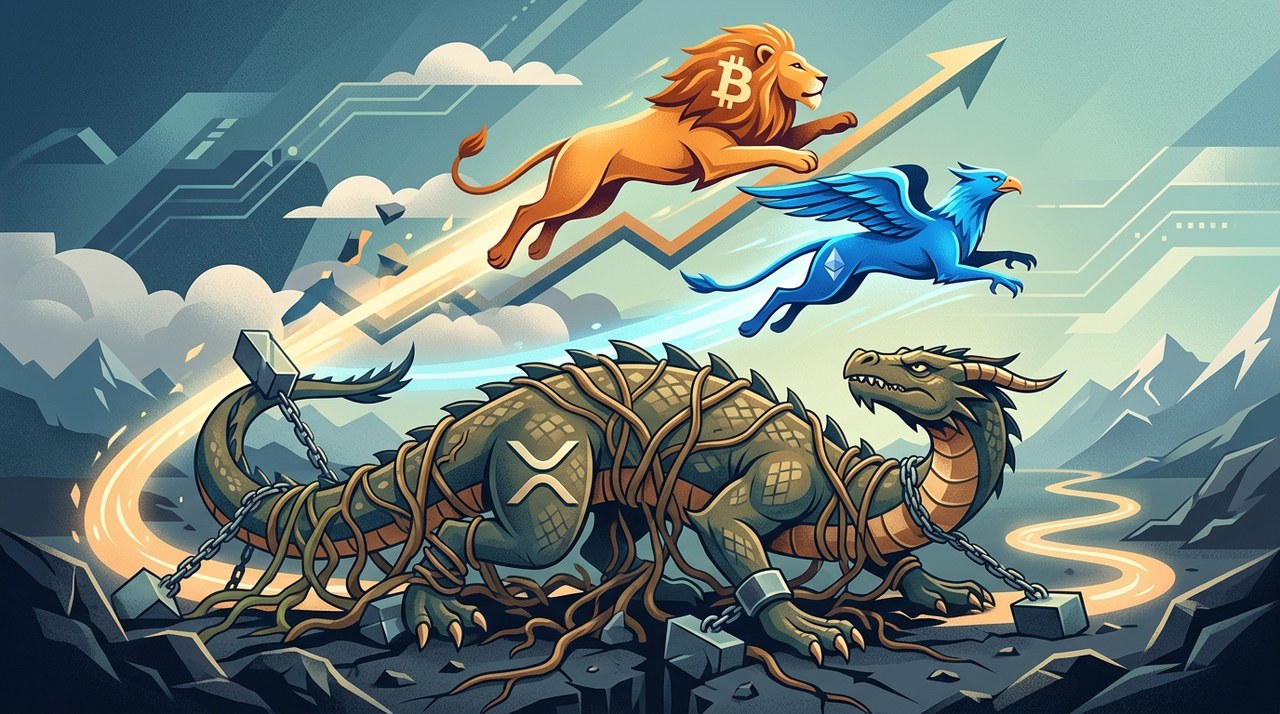
Why Holding XRP Has Not Delivered the Same Gains as Bitcoin
Buying and holding cryptocurrency for years is often touted as a great strategy for building wealth in the digital asset space. However, this long-term approach has not yielded the same results for every major token.
Take XRP, the native token of the XRP Ledger and the world's fifth-largest cryptocurrency by market value. While leading assets like Bitcoin and Ether climbed to new historic records in recent cycles, XRP continues to trade far below its peak from early 2018.
As of October 2026, XRP trades around $1.33. That is roughly 62.5% below its January 2018 high of $3.55. Although XRP briefly reached $3.66 in July 2025 before pulling back, long-term investors who bought at the 2018 high remain underwater nearly nine years later.
Comparing XRP to Other Major Cryptocurrencies
To understand XRP's price performance, it helps to compare it with other top digital assets over the exact same period.
Past performance of digital assets is not an indicator of future returns. You can review real-time prices and historical market data on Bitkub Market.
- Bitcoin (BTCBTC-0.72%): Trades around $80,955.28, up 314% from its December 2017 high of $19,804.
- Dogecoin (DOGEDOGE-2.23%): Trades around $0.08215, up 322% from its January 2018 peak.
- BNB: Trades at $729.39, up approximately 2,800% over the same period.
- Ether (ETH): Trades at $2,442.94, up 66% from its early 2018 high.
- Zcash (ZEC): Up about 38% since 2018.
- Tron (TRX): Down slightly by roughly 4% from its previous peak.
While Bitcoin and Ether have experienced pullbacks from their 2025 peaks, both remain far above their 2017 and 2018 levels. This contrast leads many investors to ask why XRP has struggled to keep pace.
Factor 1: Rapid Supply Growth Diluted Token Value
The primary reason analysts point to is supply dilution. When the overall circulating supply of a cryptocurrency grows significantly, each individual token represents a smaller share of the network's total value.
Nicolai Sondergaard, a senior research analyst at analytics firm Nansen, highlights that XRP's circulating supply grew by 63%, expanding from 38.7 billion tokens in 2017 to 63.1 billion today. Meanwhile, XRP's total market value fell by only 3%.
More XRP in circulation means each token represents a smaller share of roughly the same total value.
Oliver Carding, head of marketing at Tesseract Group (an institutional digital asset management firm managing over $500 million in assets), notes that XRP's growth looks much stronger when evaluating total market cap rather than unit price.
On value, XRP recovered. About 63% more XRP is in circulation than at that peak, so the same circulating market capitalization would mean a price roughly 39% lower.
Factor 2: Institutional Capital Favored Bitcoin and Ether ETFs
The introduction of U.S. exchange-traded funds (ETFs) allowed institutional investors to allocate billions of dollars directly into digital assets. However, these fund flows heavily favored Bitcoin and Ether.
Paul Howard, senior director at market-making firm Wincent, explains that institutional uptake for XRP funds has remained muted relative to BTC and ETH.
Data from SoSoValue reveals that XRP funds have brought in about $1.80 billion in net investor inflows since debuting nearly a year ago. By comparison, spot Bitcoin ETFs often record over $1 billion in capital inflows in a single day.
On-chain data from Nansen also shows reduced user engagement across the XRP ecosystem over recent years:
- XRP spot trading volume fell by 53.5%.
- Perpetual futures trading volume dropped by 44%.
- Active network addresses declined by 10.7%.
Factor 3: Focus on Payment Rails Over High-Growth Crypto Trends
Another factor is ecosystem direction. While networks like EthereumETH-0.91% and SolanaSOL-1.56% became hubs for Decentralized Finance (DeFi), Artificial Intelligence (AI), and popular memecoins, RippleXRP-2.65% focused primarily on enterprise payment solutions.
Ripple dedicated its resources toward cross-border payment infrastructure, trade financing tools, and its RLUSD stablecoin. While these tools build long-term enterprise utility, they did not attract the intense retail capital flows seen in other sectors.
Ripple, meanwhile, has been working hard to build payment infrastructure, RLUSD and trade financing products around the usage of the ledger and coin, and this has taken focus from just core XRP. The role of DeFi for investment into ETH, SOL and HYPE has also been a new narrative which XRP has not focused on.
Factor 4: Multi-Year SEC Lawsuit Created Market Uncertainty
Regulatory challenges placed a heavy drag on XRP's market adoption. In December 2020, the U.S. Securities and Exchange Commission (SEC) filed a lawsuit against Ripple and two executives, alleging they raised $1.3 billion through unregistered securities sales.
This legal dispute created prolonged uncertainty. Major cryptocurrency exchanges, including Coinbase, suspended XRP trading during the 2021 bull market, preventing many retail and institutional investors from buying the asset while the rest of the market surged.
In 2023, a federal judge ruled that retail sales of XRP on public exchanges were not securities offerings, though sales to institutional buyers were. In 2024, Ripple was ordered to pay a $125 million civil penalty.
The case finally ended in August 2025 when both sides dropped their appeals. Although XRP rose above $3 during that period, it later dropped about 59%. Over that same period, Bitcoin declined 32% and Ether dropped 44%.
Is XRP the Only Token Trading Below Its 2018 Record?
While XRP's lag stands out due to its high market ranking, it is far from the only asset that failed to regain its early 2018 price levels.
On price, six of the other nine assets in the January 2018 top ten are further below their levels of that week.
Key Indicators to Watch Moving Forward
For analysts and market participants tracking XRP, experts recommend evaluating specific supply and demand metrics rather than relying purely on unit price.
Oliver Carding suggests tracking XRP's relative strength against Bitcoin, alongside net monthly token distributions after re-escrow releases and overall institutional fund holdings.
In simple terms, if Ripple slows the release of new XRP tokens from escrow but XRP continues to underperform Bitcoin, it would signal that investor demand remains soft. Conversely, sustained institutional inflows or increased enterprise adoption could shift the supply-demand balance over time.
Latest blog posts
Strategy Stock Drops 10% on MSCI News, But Holds $5B Gain
Strategy stock fell nearly 10% after MSCI announced new index eligibility rules, though the company holds a $5 billion profit on its Bitcoin.
|

NASA Sent Jellyfish to Space—Here Is What Happened
In 1991, NASA sent thousands of jellyfish into orbit. When they returned, the space-born babies could not figure out which way was down.
|
Claude AI Solves a 25-Year NSA Crypto Mystery
An Anthropic AI model solved a quarter-century-old mathematical mystery behind NSA cryptographic seeds in under 30 minutes, confirming Bitcoin was never affected.
|