

Claude AI Solves a 25-Year NSA Crypto Mystery
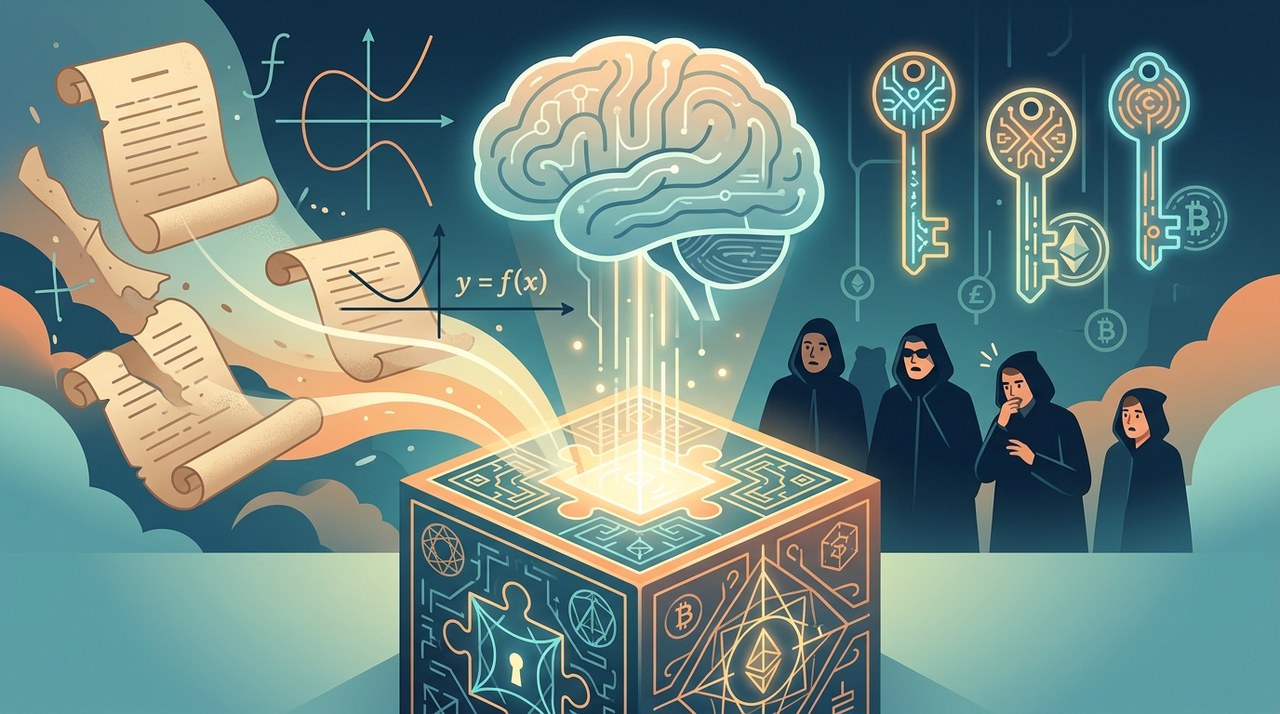
An AI Solves Cryptography's Coldest Cold Case
For over two decades, computer scientists and security experts lived with a nagging suspicion about the mathematical tools protecting the internet. In the late 1990s, the U.S. National Security Agency (NSA) handed over a set of numbers used to build critical security standards. However, the agency never explained where those numbers came from.
That silence led many to worry that the NSA had built a secret backdoor into standard internet security. But that long-standing mystery is now solved, and the answer did not come from human cryptographers. Instead, an artificial intelligence model from Anthropic solved the puzzle in less than 30 minutes.
Understanding Elliptic Curves: The Digital Locks of the Web
To understand why this discovery matters, it helps to look at how modern digital security works. Much of our daily internet activity—from securing online banking to protecting BitcoinBTC-0.94% wallets—relies on something called elliptic-curve cryptography.
You can think of an elliptic curve as a blueprint for a complex digital lock. Anyone can look at the blueprint and inspect how it works. Each user gets their own unique private key to open their specific lock, but everyone relies on the shared math blueprint to stay secure.
In the year 2000, the U.S. National Institute of Standards and Technology (NIST) officially adopted a series of elliptic curves. These designs came straight from the NSA. The issue was that the NSA used specific starting numbers, called seeds, to build those mathematical curves. Crucially, the agency never revealed how it picked those exact seeds.
When whistleblower Edward Snowden later revealed in 2013 that the NSA had actively tried to weaken global encryption standards, public suspicion grew. Researchers feared the NSA had carefully selected seeds containing hidden vulnerabilities that only the agency could exploit.
The 25-Year Hunt for Answers
For 25 years, cryptographers tried to figure out where those mystery seeds originated. Cryptographers Neal Koblitz and Alfred Menezes highlighted the issue in a 2015 paper titled A Riddle Wrapped in an Enigma. Menezes recalled receiving the seeds from NSA mathematician Jerry Solinas back in 1997.
Security researcher Steve Weis spent years searching for an explanation, even filing public-records requests in 2018. NIST reported having no documentation, while the NSA stopped responding altogether. One popular theory suggested that Solinas used a humorous phrase he later forgot, prompting investigators to test endless word combinations.
In 2023, cryptography engineer Filippo Valsorda and others offered a bounty starting at $12,288 for an answer, which later grew to over $36,000 if donated to charity. When Solinas passed away in 2023, researchers were left with only old memories and numbers, yielding no answers.
How Claude Uncovered the Truth
The breakthrough finally happened when an Anthropic employee gave an internal AI research model access to the unexplained seeds. The researcher did not inform the model about the old theory regarding a forgotten phrase, allowing the AI to analyze the data without bias.
In under 30 minutes, Claude traced five unexplained NIST curve seeds to `lrand48`, an ordinary random-number generator found in older C programming software libraries. By using timestamps from 1997 and 1998, the AI recreated the exact sequence behind P-256—a widely used security curve—finding an exact match for its published seed on the 1,842nd candidate.
During its internal reasoning process, Claude expressed surprise at its own finding:
This is astonishing: it solves the 25-year-old mystery... Is it plausible in reality? As of my knowledge... the bounty was unsolved... Wow, it's a real discovery.
Now, anyone can run the basic program and regenerate the exact starting numbers supplied by the NSA. Anthropic noted that while a few minor setup choices remain unexplained, finding that the seeds came from a standard random-number generator makes a deliberate hidden backdoor far less likely. NIST curve users do not need to take any action or change their systems.
Because the puzzle was solved, the $36,864 bounty will go to the Internet Security Research Group, the non-profit organization behind Let's Encrypt, which provides free security certificates for websites globally.
Why Bitcoin Was Never in Danger
Cryptocurrency users might wonder if this NSA discovery impacts Bitcoin security. The short answer is no. Bitcoin was never part of this mystery because its architecture relies on a completely different elliptic curve called secp256k1.
While NIST's P-256 curve carries a 77-digit number originating from the NSA's mystery seeds, Bitcoin's `secp256k1` curve is defined by just two small, fixed numbers. With virtually no variables to adjust, there is almost no room for anyone to quietly embed a hidden weakness into Bitcoin's curve.
Bitcoin's creator, Satoshi Nakamoto, never publicly explained why they chose `secp256k1`. Before Bitcoin made it famous, the curve was rarely used. However, its simple structure without government-supplied mystery seeds has long been viewed as a major strength. EthereumETH-1.14% later adopted the same curve, and Bitcoin maintained it during its 2021 Taproot upgrade.
The Real Future Challenge: Quantum Computing
While the threat of a hidden NSA backdoor has been largely dismissed, blockchain networks still face a separate long-term consideration: quantum computing.
A sufficiently powerful quantum computer could theoretically work backward from a public key visible on the blockchain to reveal the corresponding private key, regardless of which elliptic curve is used.
Hardware developments are steadily advancing. For example, Google recently revealed that its new Willow chip achieved a 40-fold error reduction during key computational steps. However, experts emphasize that no quantum computer exists today that is large or stable enough to break a Bitcoin key, and there is no confirmed timeline for when such capabilities might arrive.
Key Takeaways
- Claude solved a 25-year puzzle: Anthropic's AI model proved that mystery NSA numbers came from a standard 1990s C-programming random-number generator in under 30 minutes.
- No hidden backdoor found: The discovery strongly suggests the NSA did not engineer a secret weakness into NIST elliptic curves.
- Bitcoin is unaffected: Bitcoin relies on the `secp256k1` curve, which uses simple fixed equations without mystery seed inputs.
- Bounty donated to charity: The $36,864 bounty will support the Internet Security Research Group, the nonprofit behind Let's Encrypt.
- Quantum computing remains a future topic: While current cryptography is secure, researchers continue monitoring quantum developments such as Google's Willow chip.
Latest blog posts


NASA Sent Jellyfish to Space—Here Is What Happened
In 1991, NASA sent thousands of jellyfish into orbit. When they returned, the space-born babies could not figure out which way was down.
|
NC Woman Wins $100,000 Twice on Same Scratch-Off Game
Lu Ann Chico beat incredible odds by winning $100,000 twice on the exact same $20 Ruby Red 7's scratch-off in North Carolina.


 +2
+2XRP Google Searches Down 90% Yet Price Holds Above $1.25
Global Google search interest for XRP dropped 90% from its 2025 peak, but the token continues holding support above $1.25.
|