


Why Stablecoins Rely on Legacy Banks: Frgmnt CEO
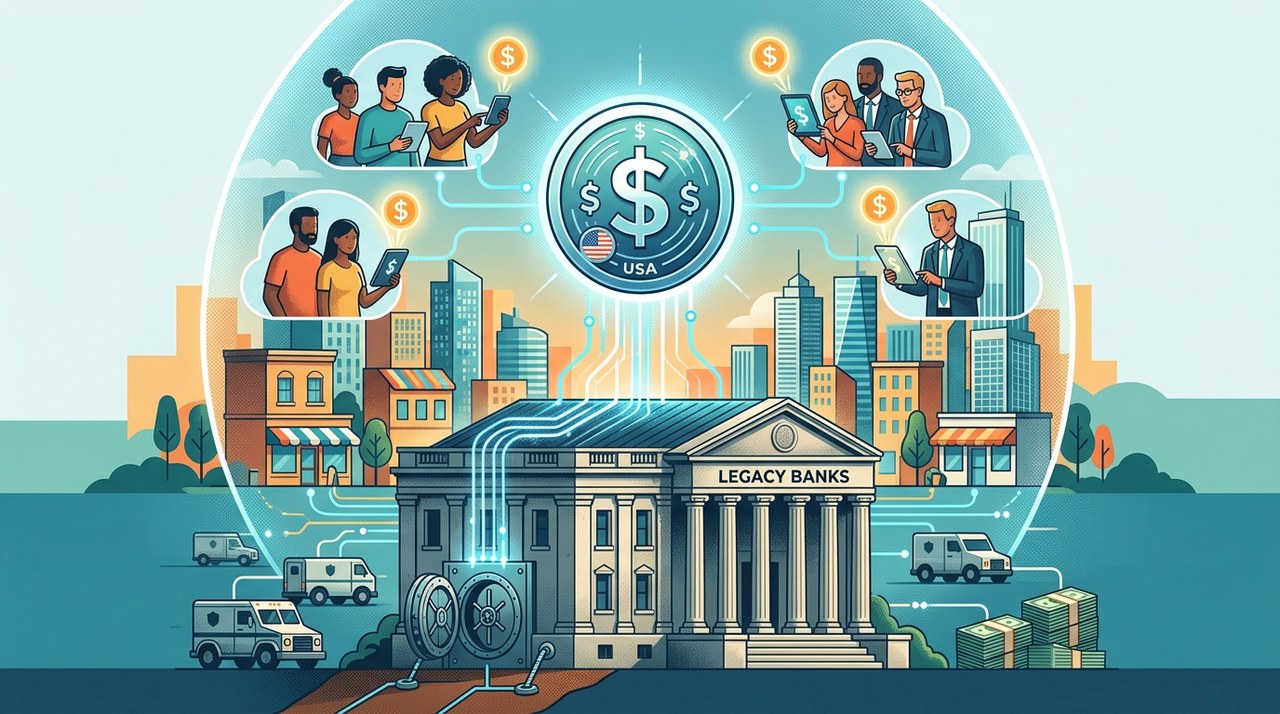
When stablecoins first made headlines in the crypto world, most people treated them as handy tools for trading digital tokens. They were mainly used to jump in and out of volatile cryptocurrencies like BitcoinBTC-0.54% or EthereumETH-1.24%. But today, that picture looks very different.
Across global markets and developing economies, millions of individuals and businesses now use stablecoins for a completely different reason: fast, direct access to the United States dollar. However, as billions of dollars flow into these digital assets, a major financial dilemma comes into focus. Can stablecoins ever truly stand on their own, or will they always be tied to the risks of traditional banking?
According to Aurélien Roussel, co-founder and CEO of stablecoin infrastructure company Frgmnt, the industry has reached a crucial crossroad. Roussel, who previously served as Chief Operating Officer at real estate platform Bricks.co, understands both the clumsy friction of legacy banking and the massive scale of modern blockchain tech. He believes the future of stablecoins relies on making blockchain technology practically invisible to everyday users.
From Speculative Trading to Everyday Dollar Access
For people living in emerging economies, using stablecoins isn't about chasing high returns in complex decentralized finance (DeFi) platforms. It is about basic financial protection. When local currencies lose value due to inflation, holding digital dollars offers a way to preserve purchasing power without dealing with strict bank controls or heavy transfer fees.
I think the biggest shift is that stablecoins are becoming less about crypto and more about access to dollars. That user doesn't necessarily care about DeFi yields. They care about reliability, liquidity, and cost.
Roussel points out that the next major wave of worldwide adoption will happen seamlessly. People will use stablecoins embedded right inside everyday financial tools like cross-border payments, company payrolls, merchant checkouts, and corporate treasuries—without even realizing a blockchain is running in the background.
This evolution leads to an interesting distinction between transactional liquidity and productive liquidity. Transactional liquidity is the money you keep ready for immediate payments. Productive liquidity is what happens when those dollars sit idle. Roussel argues that a well-designed financial system lets a single digital dollar stay ready for instant spending while earning a safe return when it is not being actively moved.
Can Stablecoins Escaping Traditional Banking Risks?
The banking sector turmoil of 2023 highlighted a major paradox for stablecoins tied to standard fiat currency. While a stablecoin exists as a decentralized, smart-contract token on a public blockchain, its actual cash backing sits inside centralized traditional banks offchain. If those banks fail, the stablecoin can face severe stress.
When asked if fiat-backed stablecoins can ever completely disconnect from traditional banking hazards, Roussel offers a pragmatic reality check:
I don't think a fiat-backed stablecoin can ever be completely decoupled from the traditional financial system. The question is how that dependency is structured and how much resilience is built around it. The lesson from previous banking failures is that stablecoin infrastructure needs to assume that individual banking counterparties can fail.
To build a safer system, Roussel highlights several protective measures that stablecoin issuers should adopt:
- Diversifying banking partners: Spreading funds across multiple institutions to prevent single-point-of-failure risks.
- Segregating reserves: Keeping user collateral completely isolated from operating funds.
- Real-time attestations: Providing transparent, verifiable proof of reserves on a continuous basis.
- Operational redundancy: Maintaining multiple paths for redeeming tokens back into physical fiat currency.
It is crucial to remember that while blockchain technology improves auditability, speed, and transparency, it does not magically eliminate underlying counterparty or credit risks in the financial ecosystem.
TetherUSDT-0.03%'s Market Hold and the Future of Stablecoin Diversity
Tether's USDT has long maintained a dominant leadership position in global non-Western commerce. Deep network effects make it tough for newer competitors to convince businesses and traders to switch away.
While newer stablecoin issuers emphasize regulatory compliance as their key selling point, Roussel believes compliance alone is not enough to displace existing liquidity overnight. Once a token is widely accepted across thousands of exchanges and merchants, replacing it takes time.
However, Roussel does not expect one single winner to take the entire global market. Instead, he expects the industry to split into specialized segments based on specific user needs:
- Retail Payments: Fast, low-cost tokens optimized for quick everyday shopping.
- Corporate Treasury Management: Highly regulated tokens built for corporate balance sheets.
- Institutional Settlement: Tokens tailored for high-volume transactions between banks and large funds.
- Long-Term Savings: Yield-bearing assets designed to preserve value over time.
Navigating Patchwork Regulations and Central Bank Tokens
As different regions enact their own crypto legislation—such as Europe's comprehensive Markets in Crypto-Assets (MiCA) framework—stablecoin issuers face a fragmented global landscape. Roussel compares this dynamic to how the wider internet evolved across national borders.
The internet operates under one shared technical foundation, while local jurisdictions enforce specific regional laws at access points. Roussel envisions a similar setup for digital money: global protocol standards paired with localized, compliant onboarding ramps.
What about Central Bank Digital Currencies (CBDCs)? Some analysts worry that government-backed digital currencies might push private stablecoins out of the market entirely. Roussel sees them working side-by-side instead.
A CBDC provides an official sovereign unit of account, but a complete financial ecosystem requires wallets, payment processing, cross-border connectivity, and custom treasury tools. Private stablecoin providers excel at building these flexible user-facing layers, creating a collaborative relationship rather than a direct battle.
Layer 2 Networks and the Rise of Programmable Capital
The rapid migration of stablecoin transactions to Layer 2 scaling networks and high-performance Layer 1 blockchains has reduced network fees to less than a penny while speeding up settlement to fractions of a second.
When transfer costs fall near zero, stablecoin companies can no longer rely on simple transaction fees for revenue. Instead, they must compete on value-added services, seamless distribution, liquidity depth, and financial management tools.
A stablecoin shouldn't just be a cheap way to move dollars. It can become a programmable financial asset that can move, settle, earn, and interact with financial infrastructure.
This vision is already becoming a reality in traditional payments. For instance, payment giant Mastercard recently opened its global payments network to stablecoin spending through a platform developed with crypto infrastructure firm BVNK, giving millions of retail consumers direct access to stablecoin payments at everyday checkouts.
As blockchain mechanics fade into the background, the real value of stablecoins will focus less on basic money transfers and far more on creating smart, reliable financial software for a connected global economy.
Latest blog posts
Robert Kiyosaki Warns of the Sixth Major Money Trap
Rich Dad Poor Dad author Robert Kiyosaki shared six critical money problems, explaining why losing sudden wealth is the most dangerous trap of all.
France Proposes 31.4% Tax on Stablecoin Swaps
French lawmakers narrowly approved a proposal to levy a 31.4% capital gains tax on crypto-to-stablecoin swaps starting in 2027.
|
9 Companies Object to Tokenized Shares on OKXICE
Nine major firms, including Verizon and Broadcom, have raised concerns about tokenized share trading on OKXICE over stock volatility and liquidity risks.