
Why Small Crypto Wallets Struggle to Earn Money and Win
The Hidden Revenue Leak in Small Crypto Wallets
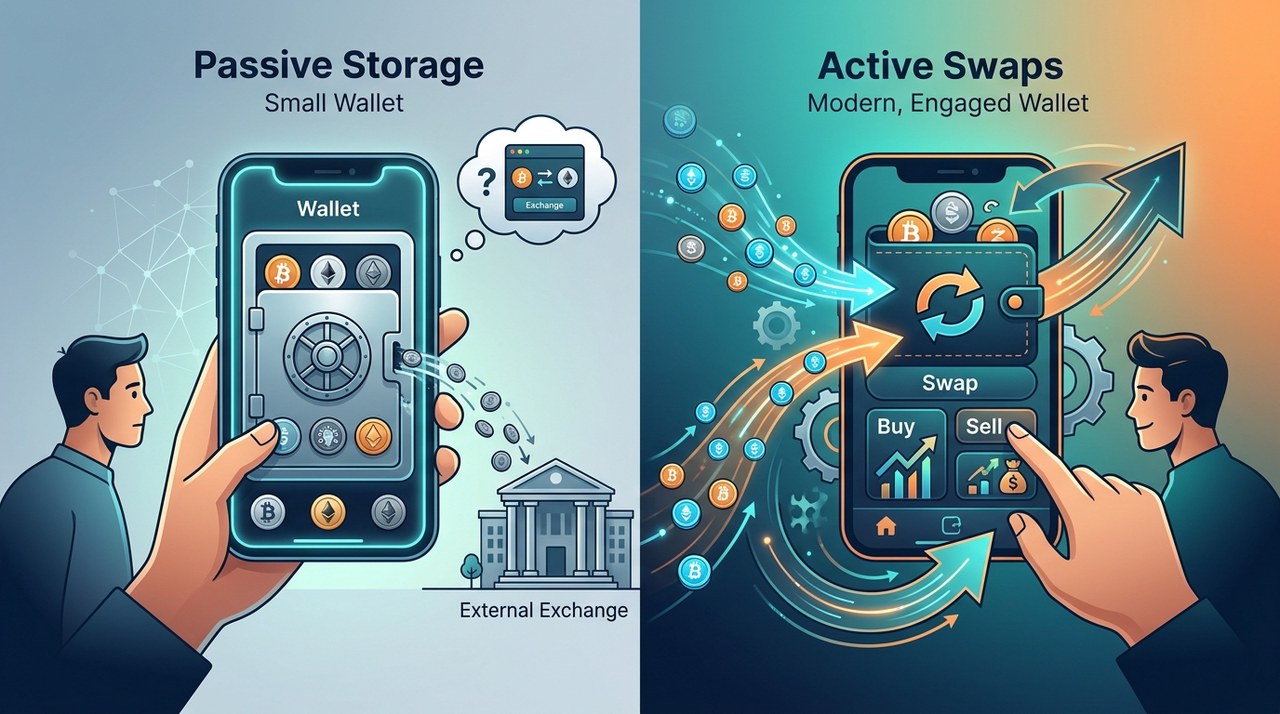
Imagine this scenario: a user opens a small crypto wallet app, looks around for a quick token swap button, and finds nothing. What do they do next? They close the app, head over to an external exchange, and make the trade there.
In that brief moment, the wallet keeps the user as a passive asset holder, but the transaction fee walks out the door. At the TOKEN2049 event in Singapore, Yana Mar, Head of B2B and Partnerships at ChangeNOW, pointed out that this situation hurts both user experience and app retention.
The wallet owner retains the customer on paper, but gains zero income from their activity. As Mar clearly stated, the community itself does not pay simply by holding coins in a digital vault.
Moving Users From Passive Storage to Active Swaps
Storage alone brings a wallet provider zero financial return. To build a sustainable business model, a crypto wallet needs active transactors rather than quiet long-term holders.
When users have to leave an application every time they want to swap, buy, sell, or stake assets, the wallet is effectively handing potential profits over to third-party exchanges. Keeping these core features inside the app gives users a compelling reason to stay while boosting overall in-app activity.
However, building financial infrastructure from the ground up requires significant technical overhead and heavy funding. The cost of developing and maintaining in-house trading rails weighs most heavily on small development teams.
For bootstrapped crypto projects, Mar recommends skipping the costly step of building from scratch. Instead, teams can plug in ready-made third-party solutions for fiat gateways, token swaps, and staking rewards.
Five Ways Small Wallets Can Beat Market Giants
Today's largest wallet providers offer all-in-one financial ecosystems, handling everything from stablecoin debit card payments to tokenized stock trading. This massive scope leaves smaller development teams with a challenging landscape.
According to Mar, small teams should not attempt to match giant rivals feature for feature. Instead, they should select a narrow niche and execute it exceptionally well.
Mar highlighted five practical strategies for small crypto wallets to stand out in a crowded market:
- Target a Specific Region: Focus on local geographic areas by integrating regional fiat payment methods and offering localized customer support teams.
- Serve a Specific Audience: Design tailored features for niche communities. For example, Dreamster—a participant in ChangeNOW's Fast Track program—built a wallet specifically for music enthusiasts. Users can purchase Digital Music Assets, stream tracks inside the wallet, and trade their fractional music shares whenever they choose.
- Deliver a Specific Promise: Focus heavily on security as a core brand commitment, which stands out clearly in a market frequently troubled by hacks and exploits.
- Move with Speed: Nimble development teams can roll out requested features in a single week, whereas large corporate wallet teams often take months or quarters to navigate approval processes.
- Maintain High Quality: As massive platforms expand, their user interface often becomes cluttered and sluggish. Smaller apps can focus on delivering a clean, frictionless user experience.
The Reality Behind Zero-Fee Swaps
To attract volume, several major crypto wallets have introduced zero-fee promotions on select stablecoin trades. For small wallet operators, trying to match zero-fee pricing sounds like a quick path to lost revenue.
However, Mar advises looking closely at how those zero-fee offers are structured in practice. These promotions typically come with major restrictions:
- They only apply to a tiny list of specific blockchain networks and select coin pairs.
- They only waive the wallet provider's custom markup, meaning network gas fees still apply to every trade.
- They rarely include complex cross-chain swaps that bridge assets across different blockchains.
Industry giants can afford zero-fee stablecoin promos because swapping is not their primary income stream. They use zero-fee offers as a loss leader to drive general user traffic into other monetized products.
Small wallets do not need to copy these fee waivers to keep their audience engaged. Instead, they can differentiate themselves by delivering smooth cross-chain transactions and offering support for niche tokens that big wallets overlook or route poorly.
At the end of the day, users care much more about the actual payout that arrives in their wallet balance than a zero-fee marketing label. ChangeNOW reports that around 98% of its executed swaps settle within approximately 0.5% slippage, providing reliable trading execution.
How to Handle Support When Transactions Fail
Integrating built-in exchange features brings up an essential question: who takes care of the user when a trade gets stuck or encounters an error?
Mar outlines a clean division of responsibility between the backend exchange provider and the wallet application team.
The exchange service provider is responsible for resolving technical blockchain execution problems and ensuring transactions clear successfully. The wallet team, meanwhile, handles customer relationship management and front-end communication.
In ChangeNOW's partner system, when a user reports a stuck transaction, the wallet support team forwards the transaction ID to ChangeNOW's technical team. ChangeNOW then investigates and resolves the underlying network issue.
This collaborative workflow applies even when errors stem from user mistakes, such as selecting the wrong blockchain network, sending the wrong token, or forgetting a required memo tag.
Earning Swap Revenue From Day One
To help early-stage wallet projects establish sustainable business models, ChangeNOW introduced its Free Fast Track program.
The program targets two primary needs facing small crypto startups: growing their user traffic and securing consistent revenue.
By connecting ChangeNOW's exchange API, a wallet team can start earning a share of revenue on every user swap immediately upon going live, with profit shares starting at 0.4% per transaction.
While earning transaction fees creates ongoing cash flow, wallet operators and users should keep in mind that digital asset markets remain volatile, and overall trading volume can fluctuate based on broader market trends.
Alongside swap integration, Fast Track participants receive dedicated marketing assistance, including press coverage, podcast features, co-promotions, and visibility at major industry events like TOKEN2049.
Best Practices: What Wallet Teams Should and Should Not Do
To build a successful digital wallet business, development teams must carefully manage operational priorities and product features.
Make Security the Top Priority
Security must remain the highest priority for every wallet provider. Mar noted that the crypto sector lost roughly $1 billion to exploits and hacks over a six-month period.
Data from security firm PeckShield reveals even higher figures, with September losses alone hitting $766.49 million, largely driven by a $387 million breach at Bitget. Persistent fears surrounding hacks and scams continue to represent major barriers to widespread crypto adoption.
Building a platform that users feel confident trusting is non-negotiable for long-term growth.
Listen to User Requests and Plug in API Solutions
Because standard functions like buy, sell, and staking are now baseline features across digital wallets, staying competitive requires listening closely to specific user needs.
Rather than spending extensive time and capital developing custom tools in-house, wallets can leverage modular third-party APIs to deliver specialized capabilities quickly.
ChangeNOW's own feature roadmap reflects this feedback-driven approach:
- Automated Revenue Conversion: Wallet partners can receive swap fee earnings in any supported asset, with auto-conversion features into USDT or other preferred fiat-pegged tokens to reduce price volatility risks.
- Compliance Pre-Checks: Built-in deposit pre-screening screens out non-compliant deposits before processing, reducing support tickets related to KYC and AML halts down to near zero.
- Gasless USDT Swaps on TronTRX-0.89%: To resolve the common friction point where users holding USDT on the Tron network lack TRX tokens to cover gas fees, gasless swap options eliminate fee barriers and increase completed trades.
Ultimately, a small wallet's long-term business success relies on the actual value delivered to the end user. By eliminating user friction one feature at a time, small wallets can achieve reliable user retention and sustainable earnings.
Past performance of digital assets or past operational results do not guarantee future returns or future operational performance.
Latest blog posts


Ledger CEO and Ex-Mt. Gox Boss Clash Over $90M Wallet Feud
A high-stakes clash erupted between Ledger CEO Pascal Gauthier and former Mt. Gox boss Mark Karpelès over hardware wallet spy implants linked to $90 million in losses.
|

Cardano Founder Building New Programming Language
Charles Hoskinson announced he is personally creating a new programming language for Cardano with advanced cryptography features.
|


Crypto Traders Lose $52M in 10-Minute Chip Stock Flash Crash
Leveraged chip-stock futures plunged on Saturday while Wall Street was closed, triggering $52 million in liquidations in just 10 minutes.
|