
Who Owns Dogecoin? Corporate Merger Splits Community
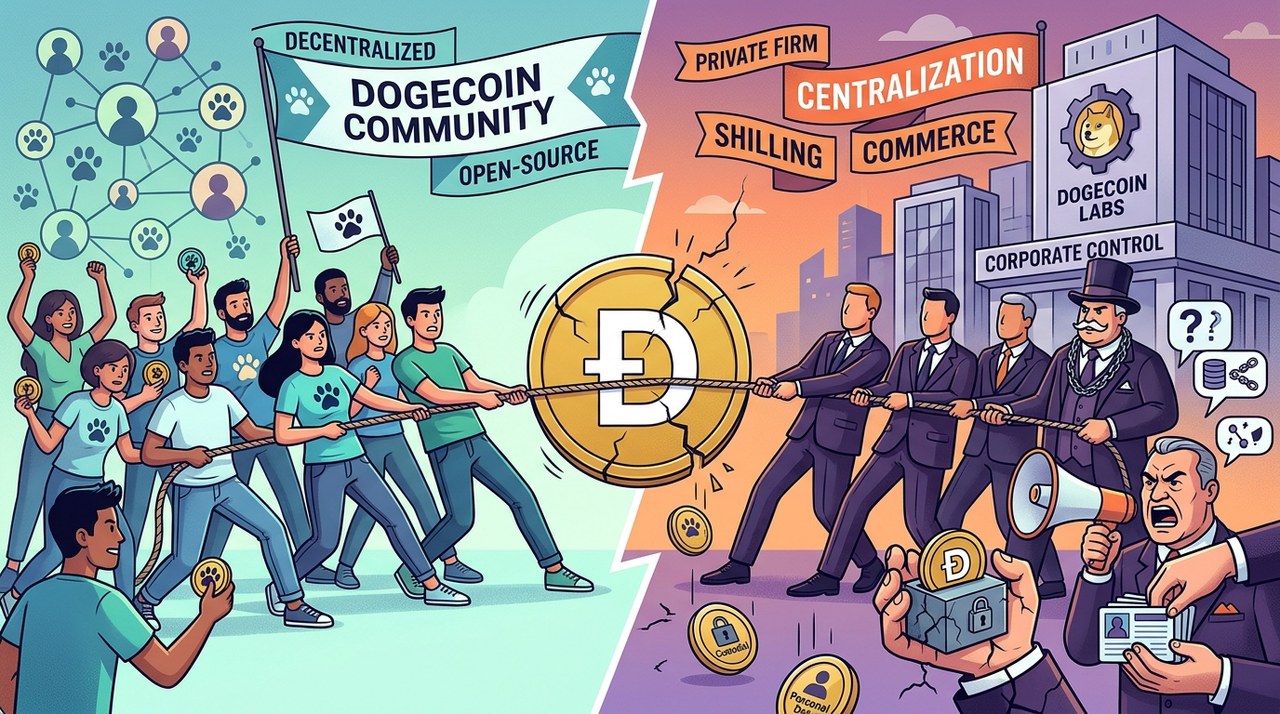
The Controversy Over Dogecoin Control
Dogecoin is currently navigating a significant internal crisis over its governance and future identity.
The controversy started when the historical X account belonging to independent Dogecoin Core developers was renamed. Management of this key information resource was handed over to a private firm called Dogecoin Labs.
For many community members, this transfer feels like unwanted centralization. Critics contend that placing official channels in private hands compromises the core principles of a decentralized movement.
Allegations of Corporate Influence and Shilling
Prominent community blogger Mishaboar has emerged as one of the main voices opposing the move.
Mishaboar publicly accused the Dogecoin Foundation leadership of lobbying for private commercial interests. He claimed official channels are now being used for aggressive marketing (shilling) of commercial products.
Critics pointed to several specific issues regarding the promoted content:
- Promoting Custodial Options: Encouraging users to adopt services where third parties hold their private keys.
- Collecting Personal Data: Asking community members to attach real-world personal identification to crypto wallets.
- Advertising High-Risk Tools: Promoting a cross-chain bridge that reportedly contained critical security vulnerabilities at the time of the announcement.
Opponents maintain that commercial businesses should build their audience from scratch rather than absorbing community-owned assets.
The Corporate Merger Behind Dogecoin Labs
To understand this debate, it helps to look at the corporate restructuring that sparked it.
Three distinct ecosystem entities combined under the new Dogecoin Labs banner:
- My DogeDOGE+0.38%: A well-known software wallet application.
- Doge OS: An operating platform built for Dogecoin integration.
- Such App: A dedicated payment service designed for DOGE transactions.
This merger received support from the Dogecoin Foundation and House of Doge (HODO), a publicly traded company based in the United States.
Commercial Growth vs. Decentralized Values
The leadership at Dogecoin Labs, led by Jordan Jefferson, defends the central strategy as a practical necessity.
Jefferson argues that Dogecoin needs unified commercial infrastructure and payment tools to achieve real-world adoption. Without these tools, he believes DOGE risks remaining a speculative asset reliant on social media posts.
The Dogecoin Foundation has tried to remain neutral in the dispute. They emphasize that underlying development for the Dogecoin Core blockchain stays open-source and decentralized, while Labs handles commercial expansion.
Proposed Compromises and Future Challenges
Independent community participants have proposed solutions to resolve the dispute peacefully.
Their suggestions aim to remove Dogecoin Labs' exclusive control over shared communication channels through several steps:
- Decentralized Account Governance: Transferring social media accounts to shared community administration.
- Content Voting: Allowing community members to vote on key media updates and announcements.
- Moderator Rotation: Instituting regular rotation of channel moderators to avoid monopoly control.
The conflict reflects a core issue facing Dogecoin: scaling into a global payment system while preserving its original status as an open, decentralized project.
Past performance of digital assets is not a guarantee of future results. To review market information, check the Bitkub DOGE Market.
Latest blog posts



Anthropic $2 Trillion IPO Risk Warning
Devere Group CEO Nigel Green warns that Anthropic's proposed $2 trillion IPO could transfer massive financial risks to everyday pension holders and index fund investors.
|
Lula Wins Brazil Election: Stock Market Reaction Explained
Luiz Inácio Lula da Silva won Brazil's presidential election with 51.77% of the vote, prompting immediate shifts across local stock, bond, and currency markets.


XT Exchange Launches Hyperliquid Copy Trading Feature
XT Exchange now lets users mirror Hyperliquid traders directly in their exchange accounts, eliminating complex on-chain steps while maintaining portfolio controls.
|