
What is SUI (SUI)?
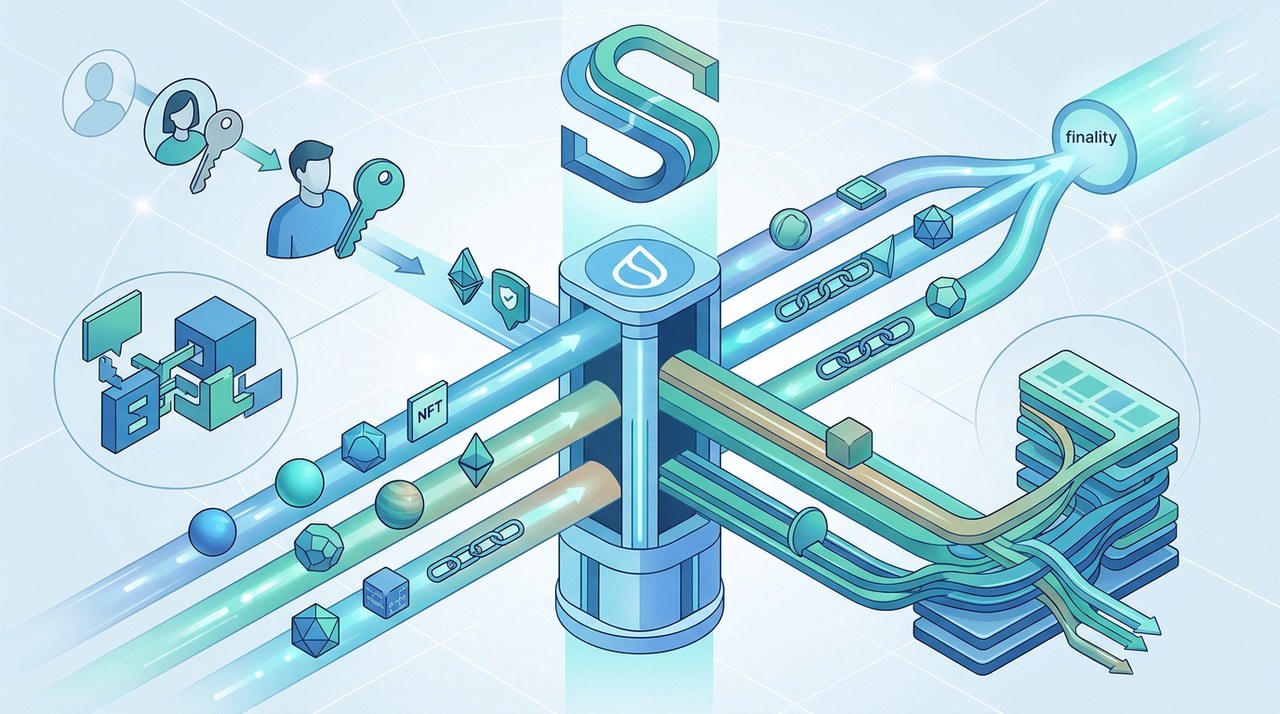
- SuiSUI-1.73% is a high-performance Layer-1 blockchain engineered with an object-centric data model for parallel execution and sub-second transaction finality.
- Created by Mysten Labs and former Meta engineers behind the Diem project, Sui uses the safe and flexible Sui Move programming language.
- Key platform features include zkLogin for seedless Web2 user onboarding, Programmable Transaction Blocks (PTBs), and the native DeepBook order book.
- SUI is the native utility token used for transaction gas fees, staking network consensus, and protocol governance.
1. Introduction - What is SUI?
Sui is a high-performance Layer-1 blockchain platform engineered from the ground up to make digital asset ownership fast, private, secure, and accessible to everyone. Unlike traditional blockchain architectures that process transactions sequentially, Sui utilizes an object-centric data model and novel consensus mechanisms to achieve parallel transaction execution. This approach allows the network to scale throughput horizontally, maintain extremely low execution costs, and deliver sub-second transaction finality.
At the heart of the Sui network is its native cryptocurrency, SUI. The SUI token serves multiple critical functions across the platform. It is used to pay gas fees for executing transactions and interacting with smart contracts, staked by users to secure the network through a Delegated Proof-of-Stake (DPoS) consensus system, and utilized as a governance token that enables holders to participate in voting on future protocol upgrades and ecosystem parameters.
As Web3 applications scale to accommodate millions of concurrent users, legacy blockchains often encounter severe bottlenecks leading to congested networks, delayed confirmations, and exorbitant transaction fees. Sui addresses these challenges directly by rethinking how blockchain state is represented and updated. By treating assets as individual data objects rather than central account balances, Sui enables independent transactions to run concurrently, paving the way for enterprise-grade applications in Web3 gaming, decentralized finance (DeFi), dynamic NFTs, and social platforms.
2. History and Background
The origins of Sui can be traced back to Meta (formerly Facebook) and its ambitious cryptographic currency initiatives, known initially as Libra and later rebranded as Diem. Although Meta eventually discontinued the Diem project due to regulatory hurdles, the technological foundation developed by its research arm spawned several groundbreaking innovations, most notably the Move programming language and advanced parallel execution frameworks.
In late 2021, former key executive researchers and lead engineers from Meta's Novi Research founded Mysten Labs. The founding team included Evan Cheng (CEO), Adeniyi Abiodun (CPO), Sam Blackshear (CTO), George Danezis (Chief Scientist), and Kostas Kryptos (Chief Cryptographer). Drawing upon their extensive experience in distributed systems, cryptography, and programming language design, the team set out to build a new blockchain architecture that could solve the fundamental scalability bottlenecks hindering global blockchain adoption.
Mysten Labs quickly gained significant traction in the blockchain venture capital ecosystem. In December 2021, Mysten Labs raised $36 million in a Series A funding round led by Andreessen Horowitz (a16z). This was followed in September 2022 by a massive $300 million Series B round valued at over $2 billion, which featured participation from major investors including FTX Ventures, Jump Crypto, Apollo, Binance Labs, Franklin Templeton, and Circle Ventures.
After extensive developer testnets and incentivized trial phases, the Sui Mainnet officially launched on May 3, 2023. Alongside the mainnet launch, the Sui Foundation was established as an independent organization dedicated to fostering community development, supporting developer grants, promoting education, and guiding decentralized governance for the Sui ecosystem.
3. How SUI Works: Technical Mechanics
To appreciate why Sui stands out in the competitive landscape of smart contract platforms, it is essential to understand its underlying technical infrastructure. Sui replaces traditional design assumptions with novel primitives specifically designed for parallel processing.
The Move Programming Language (Sui Move)
Sui smart contracts are written in Move, a Rust-based programming language originally developed for the Diem project. Sui uses a tailored variant known as Sui Move. Traditional smart contract languages like Solidity model assets as numerical balances inside global contract state maps. In contrast, Move adopts an object-oriented architecture where assets are explicitly represented as custom resource types.
In Sui Move, resources possess specific type safety properties: they cannot be copied, duplicated, or implicitly destroyed. An asset can only be moved between storage locations, providing mathematical protection against entire classes of smart contract vulnerabilities such as reentrancy attacks, double-spending, and accidental asset creation.
Object-Centric Data Model
The defining innovation of Sui is its object-centric storage model. In Sui, basic data units are called objects, which have distinct IDs, owners, and version numbers. Objects are categorized primarily into two operational types:
- Owned Objects: Assets owned exclusively by a single wallet address (such as a specific NFT, user token balance, or game item). Transactions involving owned objects do not interact with other users' state.
- Shared Objects: Assets accessible or mutable by multiple user accounts simultaneously (such as a decentralized exchange liquidity pool, public order book, or shared smart contract vault).
Because owned objects belong strictly to one owner, transactions involving them do not require total consensus ordering across the entire network. Sui processes independent transactions in parallel using Byzantine Consistent Broadcast, bypassing full consensus protocols entirely for simple peer-to-peer transfers. This drastically reduces latency to less than half a second.
Consensus Engine: Narwhal, Bullshark, and Mysticeti
For transactions involving shared objects where state order is critical (such as swapping tokens in a liquidity pool), Sui employs an advanced multi-layered consensus architecture. The original engine combined Narwhal, a high-throughput Mempool protocol responsible for data availability and batching, with Bullshark, a Directed Acyclic Graph (DAG) based consensus protocol that orders transactions.
In 2024, Sui upgraded its engine to Mysticeti, a next-generation consensus framework designed to minimize latency and CPU utilization for consensus nodes. Mysticeti reduces consensus round-trips, allowing shared-object transactions to achieve finality in approximately 390 milliseconds under optimal conditions while sustaining high transaction throughput without network congestion.
Horizontal Scalability
Traditional blockchains suffer from vertical hardware limits; every validator node must process every single transaction on the network. Sui achieves horizontal scalability by enabling validator nodes to allocate additional worker machines to scale execution capacity dynamically. As network demand increases, validator operators can scale their computing infrastructure proportionally, keeping transaction costs predictable and stable.
4. Key Features and Use Cases
By unifying low-latency consensus, asset-centric security, and parallel processing, Sui enables sophisticated decentralized applications that were previously impractical on traditional blockchains.
zkLogin: Frictionless User Onboarding
One of the greatest barriers to mainstream Web3 adoption is managing complex cryptographic keypairs and seed phrases. Sui solves this through zkLogin (Zero-Knowledge Login). zkLogin allows users to authenticate and create non-custodial blockchain wallets using familiar OAuth credentials, such as signing in with Google, Apple, or Twitch.
Through zero-knowledge proofs, zkLogin verifies identity proofs from Web2 identity providers without revealing sensitive personal information to the blockchain or compromising wallet self-custody. Users enjoy a Web2-style login experience while maintaining full cryptographic control over their assets.
Programmable Transaction Blocks (PTBs)
Programmable Transaction Blocks allow developers and users to bundle up to 1,024 execution commands into a single, atomic network transaction. For instance, a single PTB can execute multi-step operations such as claiming rewards, swapping tokens on a DEX, depositing liquidity into a lending protocol, and minting an updated reward NFT.
Because PTBs execute atomically—meaning either all bundled actions succeed or the entire block fails and reverts—users save significant gas fees while avoiding execution risks associated with partial execution across multiple blocks.
Web3 Gaming and Dynamic NFTs
Sui's object model allows digital assets to be dynamic, customizable, and composable. In Web3 gaming, an NFT representing a character can directly own other sub-objects such as weapons, armor, or experience points. As the player levels up, the internal attributes of the main character object update on-chain instantly without requiring complex contract workarounds.
High-Performance Decentralized Finance (DeFi)
DeFi applications demand sub-second latency and minimal execution fees. Sui native infrastructure includes DeepBook, a foundational, fully decentralized Central Limit Order Book (CLOB) built directly into the protocol level. DeFi developers can leverage DeepBook as a shared liquidity layer to build sophisticated trading platforms, options exchanges, and automated yield aggregators.
5. SUI in the Market: Tokenomics, Ecosystem, and Risks
Understanding the economic framework, growth trajectory, and market considerations of SUI is essential for evaluating its position within the digital asset ecosystem.
Tokenomics and Supply Distribution
The maximum supply of SUI is capped at 10,000,000,000 (10 billion) tokens. At the mainnet launch, a portion of the total supply was unlocked, with the remaining tokens scheduled to unlock gradually according to a multi-year vesting schedule managed by the Sui Foundation.
The allocation of SUI supply is structured across several key buckets:
- Community Reserve (50%): Managed by the Sui Foundation to fund developer grants, delegation programs, research, and ecosystem subsidies.
- Early Contributors & Mysten Labs Team (20%): Allocated to core founders, software engineers, and protocol contributors under vesting schedules.
- Investors & Strategic Partners (14%): Allocated to early-stage venture capital backers and private sale participants.
- Community Access Program & Staking Rewards (16%): Distributed to public sale participants, early testers, and validator staking incentives.
Ecosystem Growth and Competitive Positioning
Since its launch, Sui has experienced steady growth in Total Value Locked (TVL), decentralized exchange trading volume, and active developer addresses. Its unique architecture places it in direct competition with high-throughput Layer-1 networks like Solana, Aptos, and Near, as well as Ethereum Layer-2 scaling solutions like Arbitrum, Optimism, and Base.
While Sui offers distinctive technological advantages in parallel processing and developer tools, market participants should assess ecosystem performance neutrally based on real-world adoption, total application activity, and sustained network liquidity.
Risk Factors and Market Dynamics
Like all digital assets, trading or holding SUI involves inherent market, technical, and regulatory risks. Prospective market participants should carefully review the following factors:
- Token Dilution and Unlock Schedules: Periodic token unlocks from core team and investor allocations increase the circulating supply over time, which may create short-term market inflationary pressure.
- Smart Contract Risks: Although Sui Move provides strong security guarantees, complex decentralized applications remain vulnerable to software bugs, exploits, or logic flaws.
- Competitive Landscape: High-throughput L1s face intense competition for developer mindshare, user liquidity, and institutional partnerships.
- General Market Volatility: Cryptocurrency prices are subject to broad macroeconomic trends, regulatory updates, and shifting market sentiment.
Past performance of digital assets or past operational results is not an indication of future performance.
6. How to Buy SUI on Bitkub
Bitkub Exchange provides a secure, fully regulated platform for users in Thailand to buy, sell, and trade SUI using Thai Baht (THB). Follow these simple steps to start trading SUI on Bitkub:
- Create and Verify Your Account: Download the Bitkub app or visit the official website. Register an account and complete the Know Your Customer (KYC) identity verification process.
- Deposit Thai Baht (THB): Log into your verified Bitkub account, navigate to the Wallet section, and deposit THB via instant mobile banking QR code transfer.
- Navigate to the SUI Market: Head to the Bitkub Market section and search for the SUI/THB trading pair.
- Place a Buy Order: Choose your preferred order type—a Limit Order (setting your specific target price) or a Market Order (executing immediately at the current market rate). Enter the amount of THB you wish to trade and confirm your order.
- Secure Your Assets: Once your order is fulfilled, your SUI tokens will appear in your Bitkub balance. You may choose to keep your assets securely stored in your Bitkub wallet or withdraw them to a non-custodial Web3 wallet compatible with the Sui network.
7. Conclusion
Sui represents a major technological leap forward in modern Layer-1 blockchain design. By combining an object-centric data architecture, the secure Sui Move language, innovative consensus mechanisms like Mysticeti, and user-centric features like zkLogin, Sui effectively addresses the long-standing blockchain trilemma of scalability, security, and decentralization.
Whether enabling high-speed DeFi liquidity or powering dynamic, interactive gaming experiences, Sui provides developers with the tools to build next-generation Web3 applications. However, as with any emerging technology and digital asset investment, potential market participants should conduct thorough independent research (DYOR), assess their risk tolerance, and practice sound financial risk management.
Latest blog posts

What is Spark (SPK)?
Spark (SPK) is an innovative decentralized finance protocol designed to power institutional-grade lending and borrowing within the Sky ecosystem. Developed from MakerDAO's Endgame vision, Spark combines capital efficiency, deep liquidity, and decentralized governance. This guide explores Spark's architecture, key features, market role, and safety considerations.
|

What is Mitosis (MITO)?
Mitosis (MITO) is an innovative modular liquidity protocol built to eliminate cross-chain capital fragmentation in decentralized finance. Through its Ecosystem-Owned Liquidity (EOL) architecture and Matrix Vaults, Mitosis empowers users and protocols to compose yield seamlessly across multi-chain ecosystems. This guide covers how Mitosis operates, the utility of the MITO token, market considerations, and trading guidance on Bitkub Exchange.
|

What is Mira (MIRA)?
Mira (MIRA) is a decentralized protocol designed to bring trust and transparency to artificial intelligence systems. By combining off-chain computational pipelines with on-chain cryptographic proofs and cryptoeconomic incentives, Mira allows decentralized applications and autonomous agents to verify AI outputs seamlessly.
|