

Wall Street Bond Warning: What $110B Shock Means for Crypto
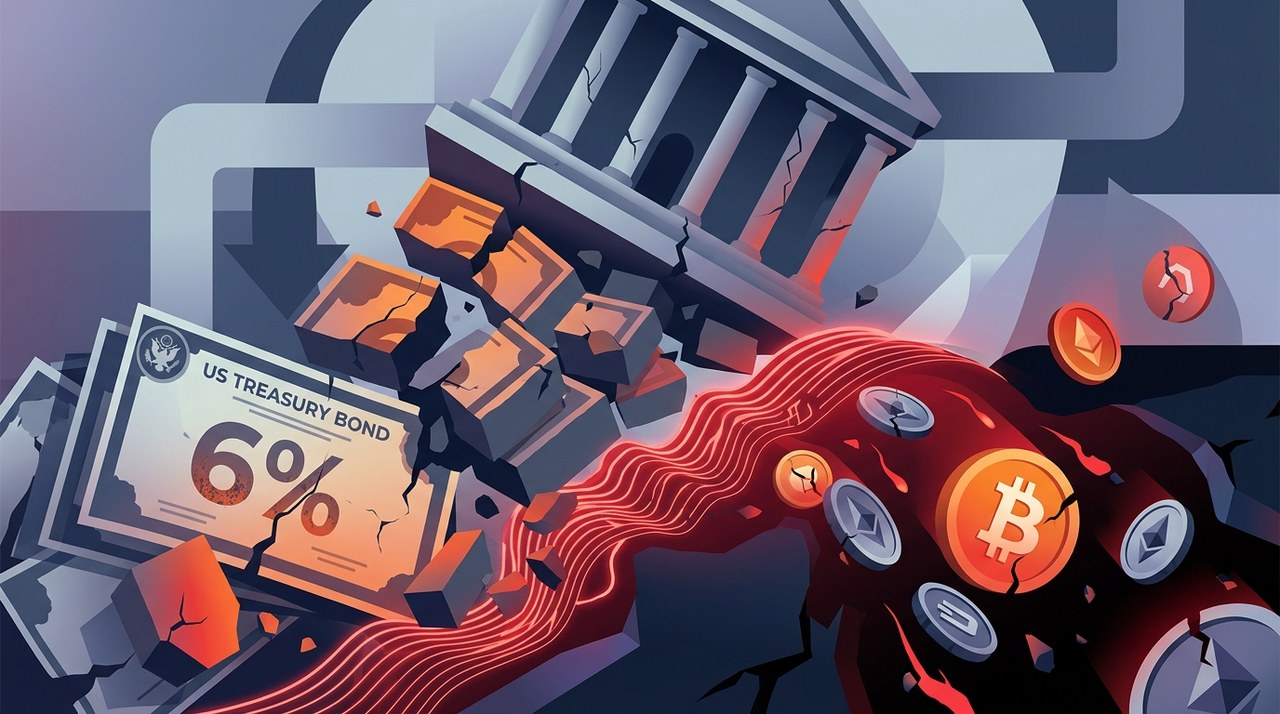
Why Bond Markets Matter to Crypto Investors
Have you ever wondered why cryptocurrency prices sometimes drop even when there is no negative news in the crypto world?
The answer often lies across the street in traditional bond markets.
When traditional financial markets experience turbulence, the ripples reach digital assets very quickly.
A major warning from Wall Street has caught the attention of both stock traders and crypto investors.
Veteran bond strategist Harley Bassman raised an alarm about US Treasury bonds.
He warned that if 20-year US Treasury yields hit 6%, automated trading rules could trigger massive selling pressure.
We are talking about market pressure equivalent to dumping $110 billion worth of 20-year bonds over four months.
That kind of financial shockwave would not stay contained in government debt.
It could push investors away from stocks and riskier assets like BitcoinBTC+0.77%.
What Are Treasury Yields and How Do They Work?
Before diving into the $110 billion warning, let's break down how bond yields work in simple terms.
Think of a US Treasury bond as a formal IOU issued by the government.
When you buy a bond, you lend money to the government, and they pay you interest over time.
The return rate on that bond is known as the yield.
Here is the key relationship to remember: bond prices and bond yields move in opposite directions.
When bond prices go down, bond yields go up.
When yields rise, government debt becomes more attractive because it offers investors higher guaranteed income.
However, when low-risk government bonds pay high returns, investors feel less need to take risks in other markets.
This creates stiff competition for capital across stocks, commodities, and cryptocurrencies.
The 6% Danger Zone: Harley Bassman's Warning
Harley Bassman outlined a potential nightmare scenario in his report published on October 13, 2026.
He focused specifically on 20-year US Treasury yields, which stood near 5.68% at the time.
That placed the yield just 0.32 percentage points below his warning trigger of 6.00%.
...such a delivery switch would be equivalent to the Treasury auctioning $110bn 20yr bonds over the course of four months,
Why is 6% such a dangerous level? The issue involves roughly $200 billion in Treasury futures contracts.
Futures contracts let institutional investors agree to buy or sell bonds at a future date.
Crucially, these contracts give sellers the right to choose which specific bonds to deliver when the contract matures.
This choice is commonly known in finance as delivering the cheapest option available.
The Mechanics Behind the Delivery Switch
When market yields climb, longer-dated bonds lose value much faster than shorter-dated bonds.
As a result, 20-year bonds can quickly become the cheapest option for contract sellers to deliver.
If yields cross that 6% threshold, automated hedging rules kick in.
Portfolio managers must rapidly sell or hedge more long-term bonds to keep their risk balanced.
This wave of hedging creates a feedback loop: more bond selling drives bond prices down, pushing yields even higher.
Bassman estimates this mechanical shift equals the market impact of auctioning $110 billion in 20-year bonds over four months.
It is worth noting this number measures potential market pressure rather than confirmed bond sales.
Still, even the prospect of that much selling pressure can create serious headwinds across markets.
How Could High Yields Hit the Stock Market?
Stock investors are closely watching these bond yield developments.
Rising Treasury yields create a dual challenge for corporate equity markets.
First, higher yield rates make corporate borrowing far more expensive, which cuts directly into company earnings.
Second, when safe government debt offers high income, investors find fewer reasons to hold riskier stocks.
High-valuation technology stocks are often hit hardest during these yield spikes.
Key Thresholds to Watch in Equities
Major banking institutions are already tracking specific tipping points for stock portfolios.
A Bank of America survey identified a critical level on the 10-year Treasury yield.
Fund managers noted that if the 10-year yield hits 5.9%, they would favor government bonds over stocks.
On Tuesday, the 10-year Treasury yield was sitting at 5.22%.
While 5.22% remains below the 5.9% tipping point, sudden upward moves could impact stocks well before reaching that exact target.
What Does This Mean for Bitcoin?
Cryptocurrency markets remain closely tied to global liquidity trends.
Bitcoin was trading around $83,014 on Tuesday as these macroeconomic concerns circulated.
Past performance of digital assets is not a guarantee of future returns. You can view historical market data at bitkub.com/th/market/BTC.
When risk-free yields on government debt rise, capital tends to move out of speculative assets.
Investors ask a straightforward question: why take heavy crypto risks when government debt provides solid yield?
Trading platform Bitunix recently connected weakness across crypto markets directly to soaring US borrowing costs.
Evaluating Scenarios for Bitcoin
- If Treasury yields stabilize: Capital could gradually return to risk-on assets, providing underlying support for Bitcoin.
- If 20-year yields surpass 6%: Forced bond hedging could drain overall market liquidity, creating downward price pressure on crypto.
- If Federal Reserve policy shifts: Any changes in US monetary policy or interest rate expectations could quickly alter yield trajectories.
While macroeconomic headwinds pose challenges, broader crypto adoption and industry shifts can also influence long-term market trends.
The Underlying Problem: Deficits and Trust
Why are Treasury yields facing so much upward pressure in the first place?
Bassman points directly to a growing structural challenge in US government finances.
The US fiscal deficit currently stands near 6.2% of total Gross Domestic Product (GDP).
This means government spending continues to outpace tax revenues by a significant margin.
To cover this spending gap, the Treasury must regularly issue massive amounts of new debt bonds.
When the market is flooded with debt supply, buyers demand higher interest yields to absorb it.
...we have a problem of "Trust", not inflation,
Bassman emphasizes that the main issue isn't just price inflation, but market confidence in government fiscal discipline.
If bond investors continue requiring higher yields, elevated borrowing costs could remain a key factor for global financial markets.
Key Takeaways for Investors
Neither Bassman's 6% bond yield warning nor Bank of America's 5.9% stock tipping point guarantees a sudden market crash.
However, these figures show how closely tied Bitcoin and digital assets are to traditional macro economics.
When government borrowing costs rise sharply, risk-taking across all financial markets usually slows down.
Tracking key benchmark yields can give crypto investors valuable context on market liquidity trends.
Keep in mind that digital asset markets are inherently volatile and subject to rapid shifts.
Staying educated on both macroeconomic factors and crypto fundamentals is the best way to navigate changing cycles.
Latest blog posts

BNY and Citadel Test Tokenized Treasuries for Faster Trades
BNY and Citadel Securities completed a test using tokenized U.S. Treasuries to speed up market financing and collateral movement.


 +1
+1Blur NFT Marketplace to Shut Down Frontend in November
Ethereum NFT marketplace Blur announced it will close its website on November 12, 2026, following a steep drop in trading volume.
|
UK High Court Rules Chinese Law Applies in £4B Bitcoin Case
A UK High Court judge ruled that Chinese law governs victim claims to 61,000 Bitcoin seized in a multi-billion pound fraud case.
|