

Vitalik Buterin Explains Bitcoin Mining vs AI Costs
Vitalik Buterin Sparks a New Conversation on Tech Costs
EthereumETH-1.90% co-founder Vitalik Buterin is back at it again, bringing a fresh perspective to a debate that touches two of today's hottest tech fields: cryptocurrency and artificial intelligence.
In a recent observation, Buterin pointed out a fascinating difference in how Bitcoin (BTCBTC-1.37%) mining and AI systems spend their money. While both industries depend heavily on computer chips and electricity, their financial structures look completely different under the hood.
Let's break down what Vitalik shared, why it matters, and what it tells us about the future of tech infrastructure.
Inside the Cost Structure of Bitcoin Mining
To understand Buterin's point, we first need to look at how Bitcoin miners operate. Bitcoin relies on a mechanism called Proof-of-Work. In simple terms, computers around the world compete to solve complex math puzzles to secure the network and earn new Bitcoin.
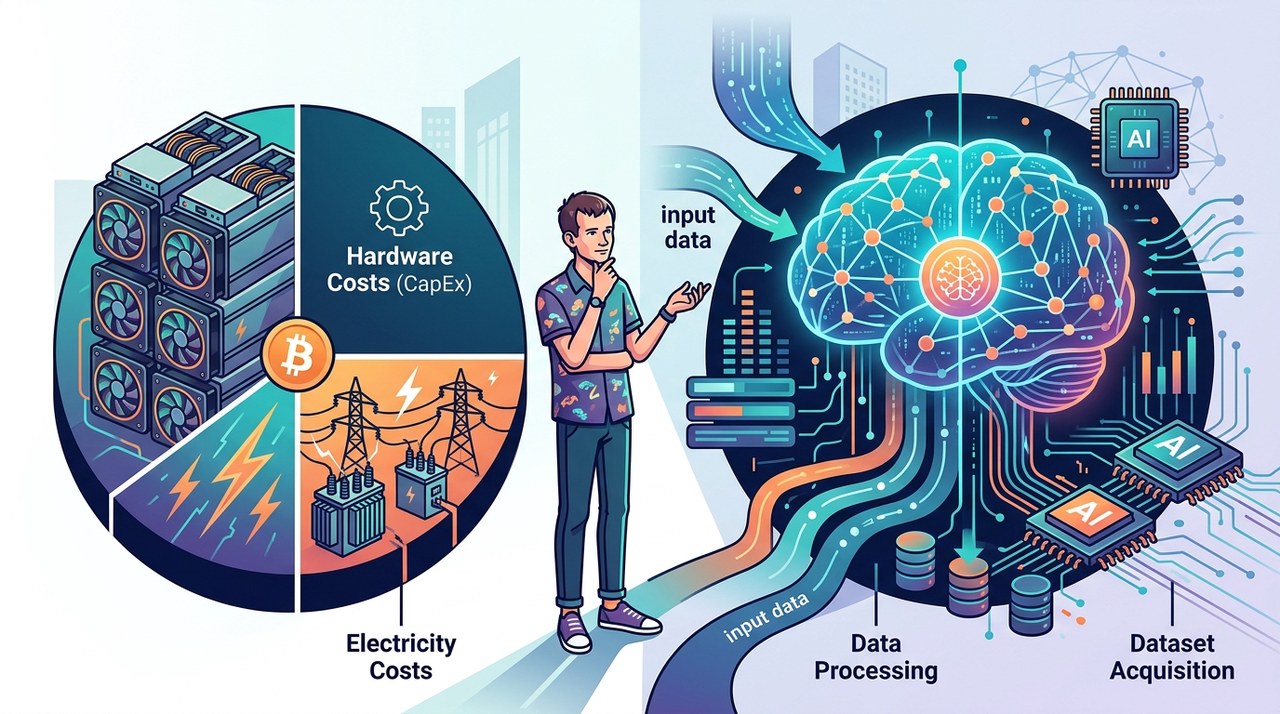
According to Buterin, the cost of running a Bitcoin mining operation is split almost evenly down the middle:
- Hardware Costs (CapEx): About 50% of a miner's budget goes toward purchasing specialized mining machines known as ASICs.
- Electricity Costs (OpEx): The other 50% goes directly to paying utility bills to keep those high-powered machines running 24/7.
Because energy makes up half of their total cost, Bitcoin miners are always hunting for cheap electricity. If power prices spike in one area, a mining business can quickly become unprofitable unless it relocates to a region with cheaper energy.
How AI Inference Differs From Bitcoin
Artificial Intelligence operates on a very different economic model, especially when we talk about AI inference.
AI inference refers to the phase where a fully trained AI model answers user prompts, generates text, or creates images. Every time you ask a chatbot a question, an AI system is performing inference.
Buterin highlighted that AI inference costs are dominated almost entirely by hardware investments. Buying powerful specialized chips and high-performance server infrastructure takes up the vast majority of the budget.
Unlike Bitcoin mining, which continuously burns massive amounts of power to maintain network consensus, AI inference relies far more heavily on having the sheer computing power ready to process millions of incoming requests instantly. The ongoing electricity cost represents a much smaller fraction of the total bill compared to the initial and hardware upgrade costs.
Comparing the Two Side by Side
Here is a simple summary comparing how these two computational powerhouses spend their money:
- Bitcoin Mining: Needs expensive equipment AND constant, cheap power to stay competitive. Costs are split roughly 50/50 between equipment and energy.
- AI Inference: Requires massive upfront and ongoing capital for cutting-edge hardware. Energy costs are lower by comparison.
"Bitcoin mining costs are split almost equally between computing hardware investments and electricity consumption, whereas AI inference costs are dominated almost entirely by hardware investments." - Vitalik Buterin
Why This Comparison Matters for Crypto and Tech
Understanding this distinction gives us valuable context for how energy grids and tech companies will evolve.
For Bitcoin miners, success comes down to efficiency and energy partnerships. They often build near renewable energy sources or stranded energy locations where electricity is cheap.
For AI companies, the primary bottleneck is chip availability and server rack space. It is all about securing access to the fastest processors on the market.
This difference also explains why some Bitcoin mining data centers have recently started repurposing part of their infrastructure to host AI hardware. They already have the land and power grid connections, giving them a head start in building high-density data hubs.
Key Takeaways
Vitalik Buterin's insights help us see that while both Bitcoin and AI are driving massive demand for computer power, their economic engines run differently.
As both industries continue to grow, understanding their unique resource needs will be essential for investors, energy planners, and tech enthusiasts alike.
Past performance of digital assets is not a guarantee of future returns. Digital asset markets carry risk, and readers should evaluate facts carefully before making decisions.
Latest blog posts

Apple's First Foldable iPhone Duo Sells Out in Minutes
Pre-orders for Apple's $1,999 foldable iPhone Duo sold out almost immediately, pushing delivery dates into late January for eager shoppers.


Circle Plans Expansion Into 40 Developing Markets
Circle CEO Jeremy Allaire revealed plans to expand stablecoin operations into 40 emerging markets across Southeast Asia, Latin America, Africa, and the Middle East.
|
Bloomberg Sees $10K Bitcoin While CryptoQuant Points to $30K Floor
Analysts hold contrasting views on Bitcoin's price floor, with Bloomberg predicting a possible drop to $10,000 if stocks tumble, while CryptoQuant points to a strong $30,000 floor backed by on-chain data.
|