
US Imports Bitcoin While Exporting Digital Dollars: Here's Why
An Unexpected Trade Dynamic in the Crypto World
Have you ever noticed how money moves across borders in unexpected ways? Right now, a fascinating trend is unfolding in the cryptocurrency market.
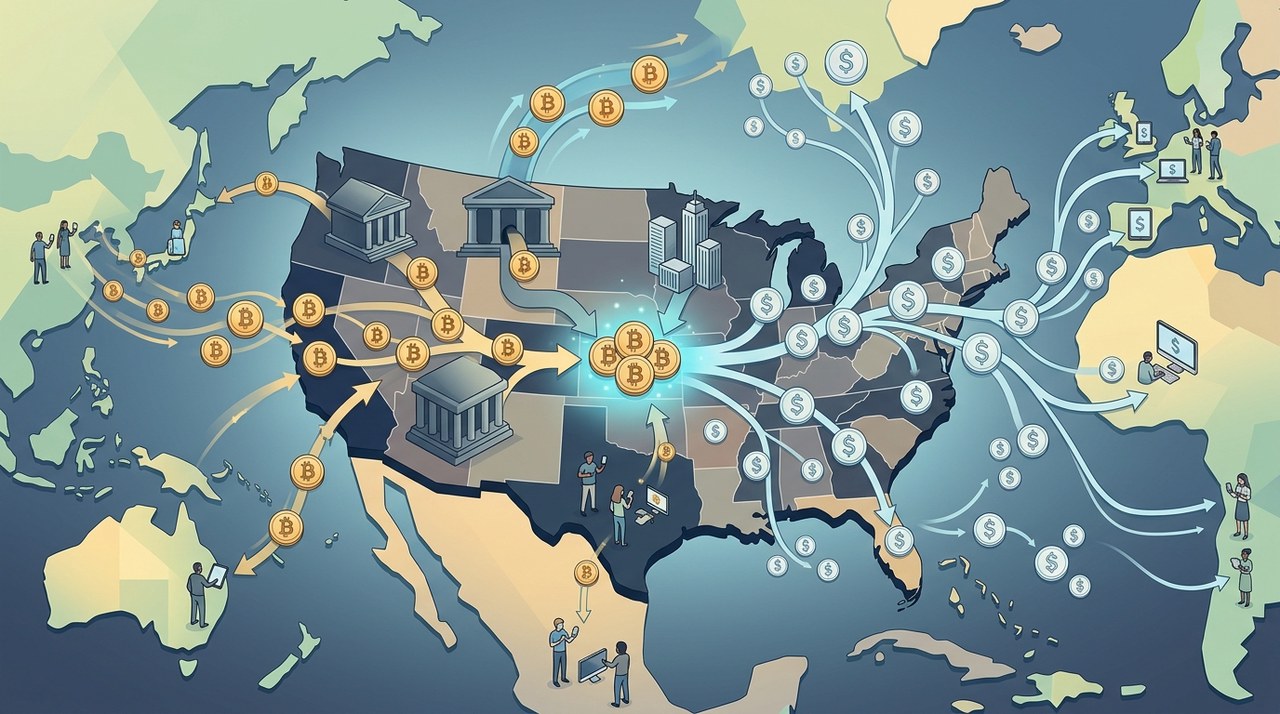
According to a recent report by blockchain analytics firm Chainalysis, the United States has officially become a net importer of Bitcoin. At the exact same time, America is sending massive amounts of dollar-backed digital assets out to the rest of the globe.
Think of it like a global trade swap. American financial institutions are pulling physical Bitcoin into the country, while everyday users around the world are eagerly adopting tokenized US dollars. Let's break down what is happening and why it matters to you.
American Institutions Are Hoarding Bitcoin
For the first time since 2022, more Bitcoin is entering the United States than leaving it. However, when you look closely at who is moving the money, the story gets even more interesting.
Smaller retail transfers under $10,000 are actually moving out of the US. Everyday individual users are sending their Bitcoin abroad or using international trading platforms.
On the flip side, massive institutional transfers are driving the opposite trend. Transactions worth $10 million or more brought an astounding 53,200 BTCBTC-0.83% into the country.
In simple terms, everyday users are sending smaller amounts of crypto out, while Wall Street titans are pulling massive stacks of Bitcoin in.
What Is Driving This Massive Bitcoin Inflow?
Why are American institutions buying up so much Bitcoin right now? The main engine behind this shift is the launch of spot Bitcoin exchange-traded funds (ETFs) in early 2024.
Spot ETFs give big hedge funds, pension funds, and corporate treasuries a regulated way to hold Bitcoin. As a result, North America's total share of global crypto activity has grown significantly.
As these institutional funds buy up coins, Bitcoin is migrating away from active trading exchange balances and into regulated vaults.
Chainalysis also pointed out that discussions around a potential US Strategic Bitcoin Reserve have created additional implicit demand from big buyers, even though a formal federal purchasing program is not active yet.
Keep in mind that while institutional inflows show growing interest, digital asset markets remain volatile and subject to fast shifts. Past performance of digital assets is not a guarantee of future returns. You can check current market prices on Bitkub Market.
Why the Rest of the World Wants Digital Greenbacks
While US institutions focus on accumulating Bitcoin, what is happening everywhere else? The rest of the world is hungering for financial stability, and they are finding it in digital US dollars.
Chainalysis found that 99.1% of all stablecoin order-book trading volume is tied to the US dollar.
Why are stablecoins so popular globally? For many people living outside the United States, opening a traditional US bank account is almost impossible.
Dollar-backed stablecoins give global users a fast and cheap way to store value in greenbacks. It protects their savings from local currency inflation without needing an American bank.
Digital Dollars Are Backing US Government Debt
Here is where the financial loop closes in a very interesting way. When international users buy stablecoins, that capital actually flows back into US financial markets.
To keep their tokens backed 1-to-1 with the dollar, stablecoin issuers keep their reserves in short-dated US government debt, known as Treasuries.
This trend extends beyond basic stablecoins into the rapidly growing market for Real-World Assets (RWAs).
- Total RWA Market Size: The global real-world asset market exceeded $36 billion in Q2 of this year.
- Rapid Growth: The sector jumped by 135% compared to the previous period.
- Tokenized US Treasuries: Tokenized Treasuries alone reached $15.42 billion, accounting for almost 43% of the entire RWA market.
Tokenized US Treasuries have quickly become one of the largest and fastest-growing niches in the market, bridging traditional government debt with blockchain technology.
The Big Picture for the Crypto Market
When you put all these pieces together, a clear picture emerges.
Foreign users want easy digital access to the world's reserve currency and reliable yields from US debt. Meanwhile, American institutions are treating Bitcoin as a strategic digital store of value worth accumulating.
This dual dynamic highlights how the crypto industry is maturing. It serves as a practical everyday alternative for international user savings, and as a modern treasury asset for major financial institutions.
Latest blog posts



Black Monday Explained: Will Wall Street Crash on Oct 19?
Traders are buzzing about Black Monday as October 19 approaches. Here is the history, current market fears, and what it means for Bitcoin.
|
Ethereum Tests Key Support: What Is Next for ETH?
Ethereum dropped 7% over the past week and is testing a critical support zone near $2,360. Here is a clear breakdown of the key levels and liquidation risks.
|


Spot XRP and Solana ETFs Face Outflow Streak
Spot XRP ETFs ended a 13-week positive streak while Solana funds hit record weekly outflows. Here is a clear breakdown of the numbers and market context.
|