


Standard Chartered and 4 Key XRP Ledger Updates
Market Price vs On-Chain Reality
When you look purely at price charts, XRP might seem like just another cryptocurrency following Bitcoin's broader movements. However, if you peek under the hood at the underlying XRP Ledger, a completely different story unfolded over the past week.
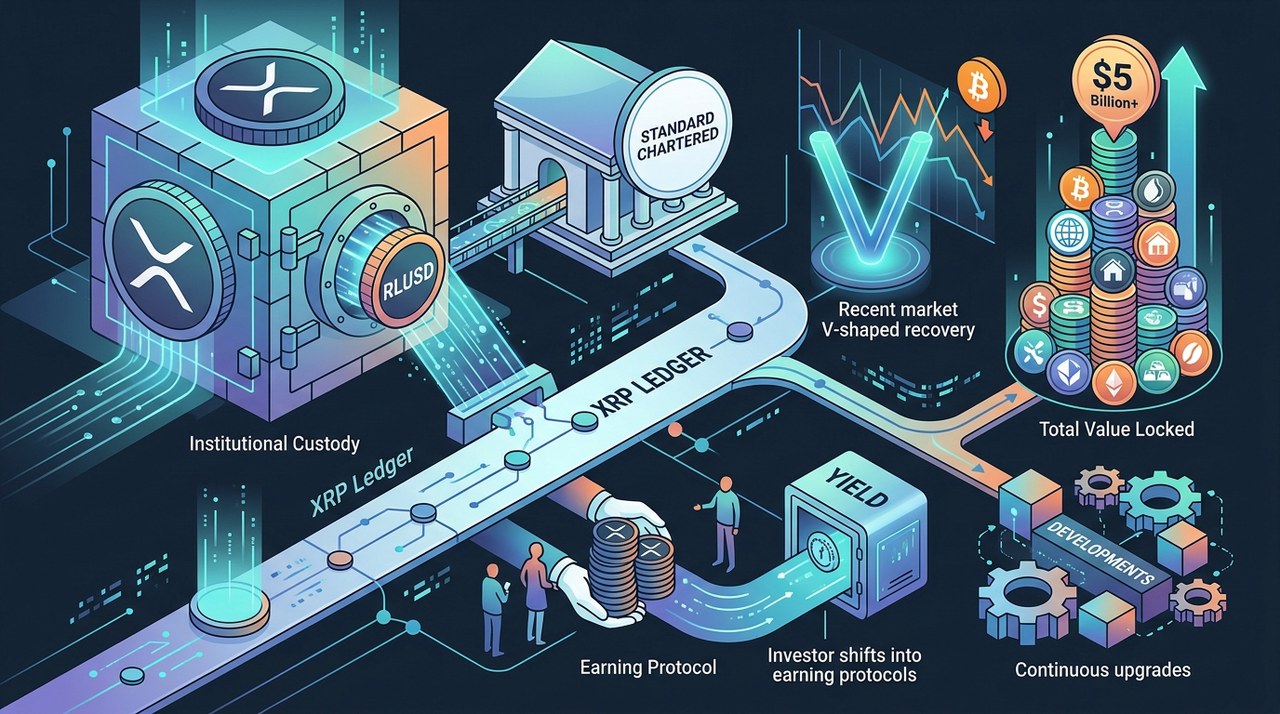
In a single seven-day window, a major international bank introduced institutional custody for RippleXRP-0.07%'s stablecoin, the total value of tokenized assets on the network crossed $5 billion, and XRP investors shifted tens of millions of dollars into earning protocols.
On the market side, XRP recently dipped to a low of $1.30 following a broader pullback led by Bitcoin. Soon after, XRP staged a rapid V-shaped recovery to trade around $1.37. During this same period, Bitcoin was trading near $83,500 in what market analysts described as a healthy price retracement.
It is worth remembering that past performance of digital assets or past operational results are not indicative of future returns or operational performance. Cryptocurrency markets remain subject to rapid price shifts and short-term volatility.
Standard Chartered Brings RLUSD Custody to the XRP Ledger
The most prominent institutional milestone came from Standard Chartered, a global banking heavyweight and an early backer of Ripple. In an official announcement on October 12, the bank confirmed it now offers institutional custody services for RLUSD, Ripple's US dollar-denominated stablecoin issued on the XRP Ledger.
This service is being handled through Standard Chartered's branch in the Dubai International Financial Centre (DIFC), which operates under the regulatory oversight of the Dubai Financial Services Authority (DFSA). The bank specified that custody will be accessible to select institutional clients who satisfy specific criteria, though exact client qualification details were not publicly disclosed.
To make the service even more practical for financial institutions, Standard Chartered partnered with trading venue operator LMAX Group. This setup allows institutional clients to trade using their RLUSD tokens held safely in bank custody without needing to move the underlying backing assets back and forth across venues.
By integrating our capabilities with Ripple and LMAX, we can help clients incorporate digital assets more confidently into their broader financial activities.
Following this institution-focused push, blockchain analytics platform Santiment reported that the total supply of RLUSD expanded from approximately $2.4 billion to around $2.5 billion. Growing stablecoin supply often reflects increasing utility and demand within a blockchain network, though market participants should note that digital asset utility does not guarantee overall token price appreciation.
XRP Ledger Claims Top 6 Rank for Tokenized Real-World Assets
Beyond stablecoins, the XRP Ledger is cementing its position in the rapidly growing sector of Real-World Asset (RWA) tokenization. RWA tokenization refers to placing traditional financial instruments—such as government bonds, private credit, or physical property—onto a blockchain network as digital tokens.
According to tracking data from a major tokenized asset platform, the XRP Ledger now ranks as the sixth-largest blockchain for tokenized assets globally. The network boasts $5.046 billion in total real-world asset value and $4.55 billion in represented asset value. Of that total represented value, roughly 9.8% is actively distributed across users and applications.
For broader market context, the institutional Canton network currently holds the leading position in tokenized asset rankings, representing over $27.7 billion in real-world assets. Nevertheless, securing the sixth spot highlights how legacy enterprise networks and public blockchains like XRPL are increasingly competing for institutional settlement volume.
Holders Move Idle XRP into Yield Vaults
While global institutions build infrastructure on the XRP Ledger, everyday investors and long-term holders are changing how they manage their digital assets. Historically, many XRP holders kept their tokens dormant in cold storage wallets or central exchange accounts.
That trend appears to be shifting. Doppler Finance recently reported that its dedicated XRP yield vault has surpassed 90 million XRP tokens held in its protocol. At current market valuations, that deposit represents approximately $125 million worth of digital assets.
By moving idle tokens into yield-generating products, holders attempt to earn on-chain returns. However, participants should be aware that decentralized finance protocols and yield vaults involve unique risks, including smart contract vulnerability and fluctuating reward rates. Past yields achieved within DeFi applications do not guarantee future performance.
A New Economic Role: Using XRP to Insure DeFi Markets
Decentralized finance (DeFi) developers are also exploring novel ways to integrate tokens that previously played little to no role in yield generation. Speaking on an episode of 'The Wolf of All Streets' podcast, industry researcher Jesus Rodriguez outlined how non-yield assets could fundamentally transform decentralized lending.
Rodriguez explained that digital assets like XRP and StellarXLM-2.92%—which traditional blockchain designs did not natively equip with on-chain staking rewards—can serve a critical economic purpose by acting as backstop capital or insurance for major money markets like AaveAAVE-0.88% and MorphoMORPHO+5.43%.
Historically, major decentralized lending protocols used EthereumETH-0.53% as an insurance mechanism to protect ETH-based lending pools. Rodriguez pointed out that using native ETH to insure native ETH markets 'never made sense' from a risk management standpoint, because an economic shock affecting ETH would simultaneously impair both the underlying protocol and its insurance pool.
By tapping into large, liquid non-EVM digital assets like XRP, lending protocols can diversify their safety reserves across uncorrelated token economies, offering a more resilient safety net during market stress.
Global Governance: Japan's Finance Minister and the IMF
Rounding out recent developments is an intriguing crossover between international financial regulation and the broader XRP community. Reuters reported that Japan's Finance Minister, Satsuki Katayama, has been appointed to chair the World Bank-IMF Joint Development Committee.
This appointment marks a significant historical milestone, as Katayama becomes the first Japanese finance minister to head the influential committee since its establishment in 1974.
The connection caught the attention of market observers because Katayama previously delivered a video address at the XRP Tokyo 2026 conference earlier this year. While her appointment to the IMF development committee is entirely rooted in sovereign international finance, her familiarity with digital asset discussions reflects how traditional policymakers are increasingly engaging with Web3 topics.
Summary of Key Highlights
- Price Rebound: XRP recovered from a low of $1.30 to around $1.37, while Bitcoin traded near $83,500.
- Bank Custody: Standard Chartered launched custody for Ripple's RLUSD stablecoin via its Dubai DIFC branch, partnering with LMAX Group.
- RLUSD Growth: Stablecoin supply grew from $2.4 billion to $2.5 billion according to Santiment data.
- RWA Ranking: The XRP Ledger reached 6th place globally in tokenized assets, holding $5.046 billion in total real-world asset value.
- DeFi Expansion: Doppler Finance's XRP yield vault crossed 90 million XRP ($125M), while researchers proposed using XRP as insurance collateral for lending platforms like Aave and Morpho.
- Policy News: Japan Finance Minister Satsuki Katayama, who spoke at XRP Tokyo 2026, became the first Japanese official to chair the World Bank-IMF Joint Development Committee since 1974.
As institutional adoption and infrastructure updates continue to develop across the crypto landscape, investors should evaluate both technological advancements and market risks carefully before making financial decisions.
Latest blog posts

Bitcoin Rebounds to $83.5K as Market Mood Calms
Bitcoin recovered to $83,591 after dipping below $81,000, as traders weigh upcoming economic reports and shifting sentiment.
|

Tesla Holds Nearly $1B in Bitcoin: A Look at the Data
Tesla's Bitcoin holdings are valued at nearly $960 million. Here is a breakdown of how the electric carmaker's crypto stash evolved over the years.
|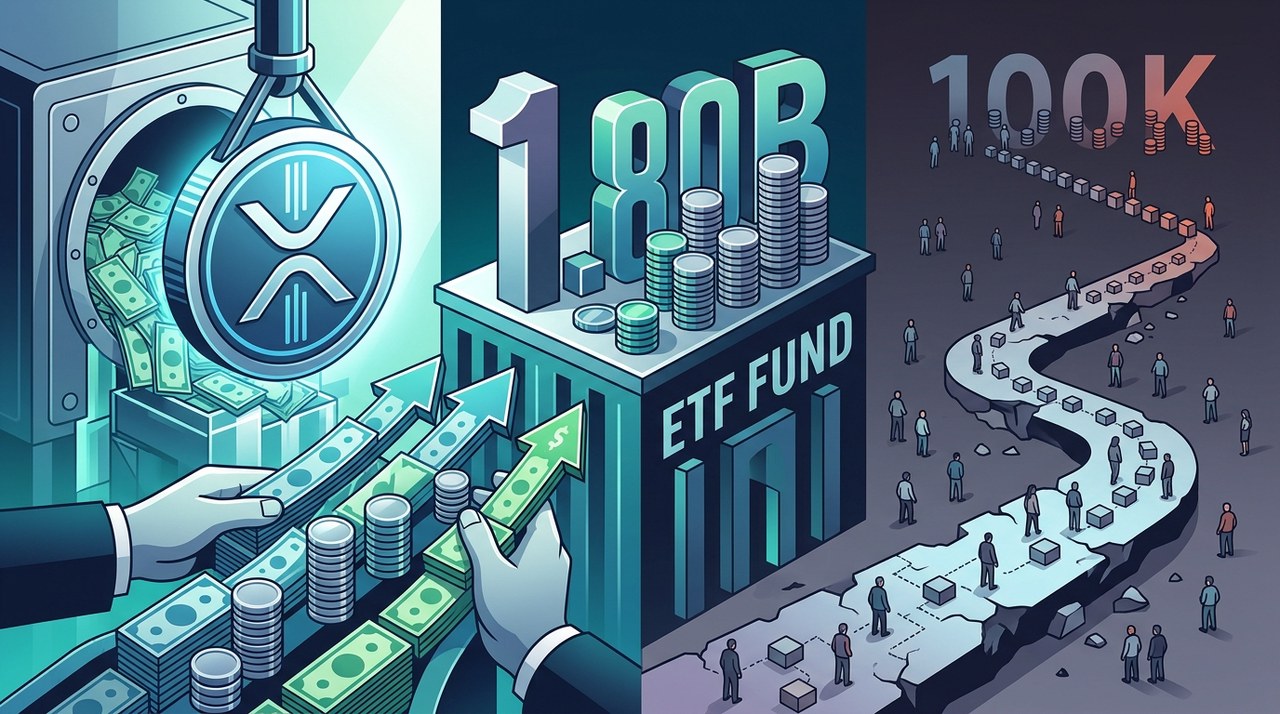
XRP ETFs Hit $1.80B Inflows as Active Users Slip Below 100K
XRP ETFs accumulated $1.80 billion in cumulative net inflows by October 12, even as daily active users dropped below 100,000.
|