
Stablecoins and Licensing: Do You Still Need an MTL?
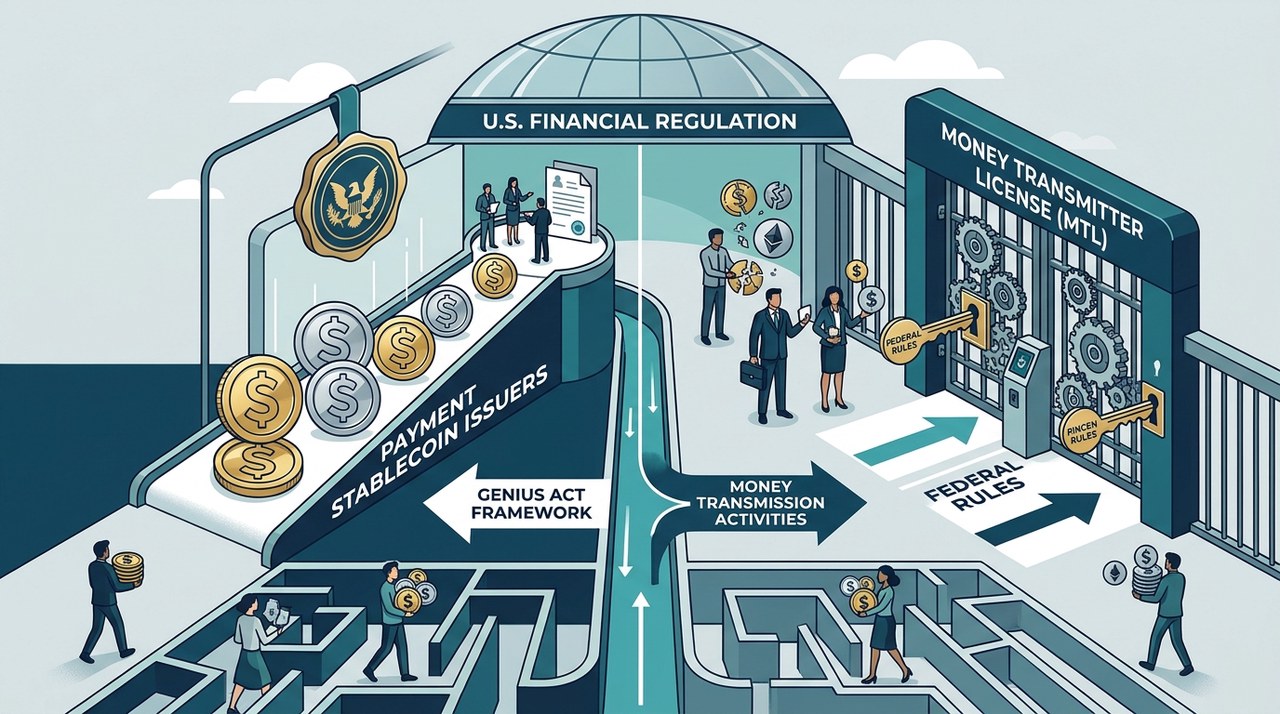
If your business works with digital assets, you have likely been following the updates around the GENIUS Act. This landmark legislation creates a clear federal framework for issuing payment stablecoins in the United States.
However, a common misconception is growing in the industry. Many founders assume that using a regulated stablecoin automatically exempts their business from money transmission rules. Unfortunately, regulatory compliance is rarely that simple.
In this guide, based on an analysis by Michael Handelsman from digital asset law firm Kelman Law, we break down why money transmitter licenses (MTLs) and Financial Crimes Enforcement Network (FinCEN) rules still apply to most crypto services.
Issuing Stablecoins vs. Transmitting Money
To understand your legal obligations, you must separate token issuance from money transmission. The GENIUS Act focuses primarily on who can issue a payment stablecoin, establishing requirements for reserve assets, redemption mechanisms, and federal supervision.
Money transmission laws focus on what a business does with customer funds. If your company accepts money or digital value from one party and transfers it to another, you are likely engaging in money transmission.
Under FinCEN guidance, convertible virtual currencies (CVCs) act as substitutes for fiat currency. Administrators and exchangers that handle convertible virtual currencies are generally treated as Money Services Businesses (MSBs), unless a specific legal exemption applies.
Because of these distinct definitions, every digital asset business must answer three independent questions:
- Is your company issuing a payment stablecoin and required to become a permitted issuer?
- Is your company a Money Services Business (MSB) subject to Bank Secrecy Act (BSA) rules and FinCEN registration?
- Does your company need state-level money transmitter licenses in the jurisdictions where your customers reside?
Satisfying one tier of regulation does not satisfy the others. For example, federal FinCEN registration is not a substitute for state-level licensing.
GENIUS Act Preemption: What Is Covered and What Isn't?
The GENIUS Act includes state-law preemption, but its scope is strictly defined. Under 12 U.S.C. § 5904(h), state licensing requirements are preempted for federal qualified payment stablecoin issuers or approved subsidiaries of insured depository institutions and credit unions.
This preemption applies specifically to the approved issuer. It does not automatically extend to third-party exchanges, distributors, non-custodial wallets, payment gateways, or contractors working alongside the issuer.
In October 2026, the Office of the Comptroller of the Currency (OCC) released its final GENIUS Act rule. Industry commenters asked the OCC to clarify if preemption extends to third-party service providers. The OCC declined to adopt a broad interpretation, clarifying that preemption for third parties must be evaluated individually based on specific facts.
The OCC also specified January 18, 2027, as the effective date for both the Act and its primary OCC rule. Businesses cannot abandon current state licensing obligations today based on upcoming regulatory changes.
State-qualified issuers operate under a different legal provision. Under 12 U.S.C. § 5906, qualifying state issuers operating under certified state regimes receive protection from duplicate host-state licensing. Meanwhile, 12 U.S.C. § 5915(d) lets state-chartered depository institutions conduct cross-state transmission through issuer subsidiaries under strict capital rules. Non-bank fintechs cannot rely on this bank-specific structure.
How Licensing Applies to Common Crypto Business Models
Whether a business requires an MTL depends on its operational control over customer assets. Here is how the rules apply across common crypto business structures:
1. Digital Asset Exchanges
Exchanges that buy, sell, convert, hold, or transfer stablecoins for customers must evaluate their own operational model. The fact that the stablecoin itself was created by a fully compliant issuer does not relieve the exchange from registering as an MSB or obtaining state licenses.
2. Wallet Providers
Hosted wallet services that control customer funds and execute transfers clearly differ from pure software distributors. If a non-custodial wallet provider maintains key recovery powers, integrated swap features, or admin controls, regulators may consider it a money transmission service.
3. Remittance Services
Swapping traditional wire networks for stablecoins does not alter the fundamental nature of remittance: accepting value from a sender to deliver it to a receiver. Legal reviews must assess every step, including fiat collection, token conversions, cross-border transfers, and local cash-out options.
4. Payment Processors
Payment gateways must carefully review FinCEN exemptions. Exemption conditions require that processing supports payments for goods or services through settlement systems restricted to BSA-regulated entities.
A gateway that collects customer stablecoins into a central wallet, deducts fees, and forwards the remainder to merchants performs money transmission. That setup requires a different legal evaluation than pure checkout software that displays a merchant's address for direct peer-to-peer payments.
Navigating State Licensing and FinCEN Requirements
State laws in the U.S. vary significantly. Some states regulate crypto under traditional money transmission statutes, while others enforce dedicated virtual currency frameworks.
New York offers a clear example. The Department of Financial Services (DFS) notes that many stablecoin activities trigger BitLicense requirements. A firm handling both fiat transmission and virtual currencies may need both a BitLicense and an Article 13-B money transmitter license. DFS also emphasizes that federal FinCEN registration does not exempt a company from obtaining a BitLicense.
Simultaneously, FinCEN rules are evolving under 12 U.S.C. § 5903(a)(5). Permitted payment stablecoin issuers will be categorized as financial institutions under the Bank Secrecy Act.
This classification requires robust Anti-Money Laundering (AML) programs, customer identification procedures, transaction monitoring, and sanctions screening. Although FinCEN's specialized issuer rules remained proposed as of November 3, 2026, companies must maintain active compliance under existing BSA rules.
Steps to Review Your Company's Legal Status
Legal experts recommend that crypto companies follow a structured compliance process:
- Create clear transaction flow diagrams for all fiat and crypto movements.
- Identify which entity holds custody and controls wallet private keys.
- Determine who directs transfers, converts tokens, and bears financial responsibility if settlement fails.
- Examine partner contracts to verify which entity carries official regulatory authorization.
- Evaluate federal MSB status, state MTL rules, and GENIUS Act requirements independently.
Frequently Asked Questions
Does partnering with a regulated issuer eliminate our licensing requirements?
No. Working with a regulated stablecoin issuer does not automatically cover your platform. If your company accepts, holds, exchanges, or transmits customer funds, you must conduct a separate legal review.
Does FinCEN registration replace state licenses?
No. FinCEN registration is a federal requirement under the Bank Secrecy Act. State money transmitter licenses are separate authorizations governed by state laws.
Does a non-custodial wallet need a money transmitter license?
It depends on actual operational control. Simply distributing open-source software differs from managing active swaps, taking temporary custody, or executing settlement functions.
Can an existing MTL authorize stablecoin issuance under the GENIUS Act?
No. A standard state Money Transmitter License does not confer status as a permitted payment stablecoin issuer. Issuers must obtain specific approvals under the GENIUS Act framework.
Latest blog posts


Bitcoin Drops Below $73K Ahead of Anthropic's Tech IPO
Bitcoin recently dipped below $73,000 as AI giant Anthropic prepares to list on Nasdaq. We explore whether mega-IPOs pull liquidity from crypto markets.
|
Crypto Firms and CFTC Team Up on Perpetual Futures Rules
Crypto firms and the CFTC have found common ground in court twice, arguing that perpetual futures contracts should not be legally defined as swaps.


US Inflation Surges Beyond Forecasts as Fed Hike Risks Rise
Higher-than-expected October inflation numbers in the US have raised expectations of a half-point Fed rate hike in December, creating potential short-term headwinds for crypto markets.
|