

US Inflation Surges Beyond Forecasts as Fed Hike Risks Rise
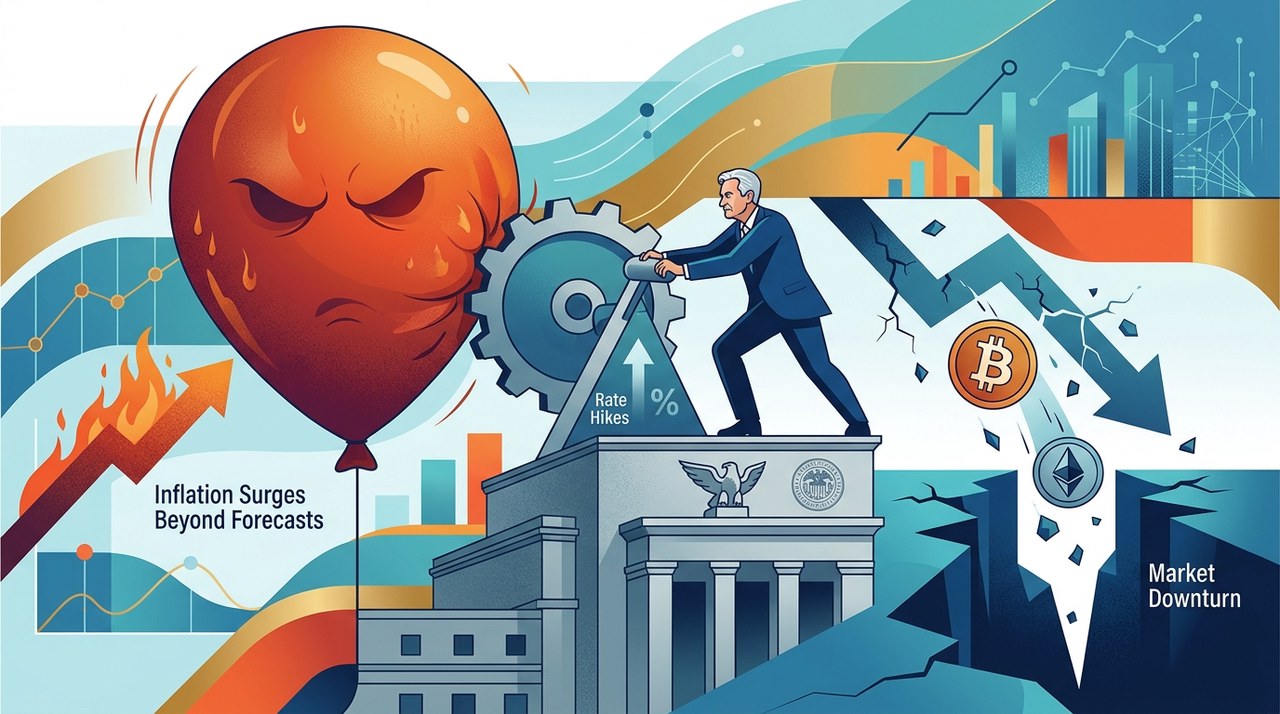
Higher US Inflation Puts Interest Rate Hikes Back in Focus
October inflation figures in the United States came in higher than market analysts originally expected. This unexpected rise in consumer prices is reshaping expectations for federal monetary policy over the coming months.
Following the latest data release, traders and economists are increasing their forecasts for a larger interest rate hike at the Federal Reserve meeting in December. Specifically, market odds now favor a half-point (0.50%) rate increase.
This sudden shift in macroeconomic expectations has sparked renewed concern among cryptocurrency investors. Many are now evaluating how prolonged monetary tightening could impact digital asset prices.
Understanding Inflation and Federal Reserve Policy
To understand why digital asset markets react strongly to US economic reports, it helps to examine how central bank decisions work in the broader economy.
Think of the national economy as an engine. Inflation acts like a temperature gauge indicating that the engine is running too hot. When inflation rises faster than normal, everyday goods and services become noticeably more expensive.
The Federal Reserve acts as the economic operator tasked with cooling down the system. Its primary tool for managing inflation is adjusting benchmark interest rates.
How Interest Rate Hikes Cool the Economy
When the Fed raises interest rates, borrowing money becomes more expensive across the entire financial system. This policy affects several key economic areas:
- Higher Consumer Borrowing Costs: Credit cards, auto loans, and personal lines of credit become costlier to maintain.
- Slower Real Estate Activity: Mortgage rates rise, reducing overall buyer demand in the housing market.
- Reduced Corporate Expansion: Businesses cut back on borrowing capital for expansion, slowing down business investments.
By increasing borrowing costs, overall consumer and business spending tends to cool down. Over time, this slowdown helps bring consumer prices back toward target levels.
Why Does US Monetary Policy Impact Crypto Markets?
Decentralized networks like BitcoinBTC-1.52% and EthereumETH-3.84% run on global, permissionless software code. However, the capital trading these assets is deeply connected to global financial conditions.
When global liquidity conditions shift, digital asset valuations often react in step with traditional financial markets.
The Capital Rotation Between Risk-On and Risk-Off Assets
Global financial markets generally divide assets into two distinct risk profiles:
- Risk-On Assets: Technology stocks, growth equities, and cryptocurrencies that offer higher potential upside but experience higher price volatility.
- Risk-Off Assets: US Treasury bonds, cash deposits, and defensive instruments that offer modest yields with strong capital preservation.
When interest rates remain close to zero, traditional fixed-income savings offer very low returns. Under these low-yield conditions, institutional and retail investors often seek higher yields in risk-on markets like digital assets.
Conversely, when the Federal Reserve pushes benchmark interest rates higher, risk-free assets like government debt begin paying attractive returns. Capital frequently rotates out of volatile growth sectors and flows back into safe-haven cash equivalents.
December Federal Reserve Scenarios and Market Impact
Market participants are now closely monitoring upcoming economic reports to gauge what action the central bank will take in December. Below are potential scenarios and their underlying assumptions.
Scenario A: A Half-Point (0.50%) Rate Increase
If inflation data remains persistent and the Fed implements a 0.50% rate hike, monetary conditions will tighten further. Borrowing costs will rise, and US dollar strength could increase.
Under this high-rate scenario, speculative liquidity across risk markets could remain constrained in the short term. Crypto valuations may experience downward pressure as liquidity dries up. However, if inflation drops rapidly following this hike, market confidence could recover faster than expected.
Scenario B: A Quarter-Point (0.25%) Rate Increase
If upcoming employment or retail figures show signs of economic cooling, central bankers might opt for a smaller 0.25% adjustment instead.
Under a smaller hike scenario, market sentiment could temporarily improve, easing pressure on risk assets including Bitcoin. However, if inflation bounces back later in the year, the central bank might re-accelerate rate hikes, triggering sudden market corrections.
Historical Insights and Managing Market Risks
Looking back at previous macroeconomic cycles reveals how sensitive digital asset liquidity is to broad monetary shifts. Periods of active Federal Reserve tightening have historically coincided with lower market liquidity and extended price consolidation phases.
Past performance of digital assets is not an indication of future results.
Understanding macroeconomic cycles helps investors maintain perspective during choppy market conditions. While macro developments influence short-term price discovery, long-term industry growth depends on technological developments, user adoption, and regulatory clarity.
Key Lessons for Navigating Macroeconomic Shifts
Rising inflation and interest rate adjustments are regular features of global economic cycles. Here are a few important principles to remember when following macroeconomic updates:
- Track broad liquidity: Central bank policy controls money supply, which influences how much speculative capital flows into growth assets.
- Prepare for volatility: Higher interest rate environments generally lead to bigger price swings across speculative markets.
- Maintain a balanced perspective: A single monthly inflation report provides valuable context, but broad trends unfold over multi-quarter horizons.
Staying educated on economic fundamentals helps market participants make measured, thoughtful decisions as financial conditions evolve.
Latest blog posts

Bitcoin Drops Below $73K Ahead of Anthropic's Tech IPO
Bitcoin recently dipped below $73,000 as AI giant Anthropic prepares to list on Nasdaq. We explore whether mega-IPOs pull liquidity from crypto markets.
|
Crypto Firms and CFTC Team Up on Perpetual Futures Rules
Crypto firms and the CFTC have found common ground in court twice, arguing that perpetual futures contracts should not be legally defined as swaps.

Why Bitcoin, Ethereum, and XRP Are Falling Today
A hotter-than-expected US inflation report sparked fears of Federal Reserve rate hikes, driving Bitcoin below $73,000 and pulling down ETH and XRP.
|