SpaceX Dominates Orbit with 80% of Global Payload
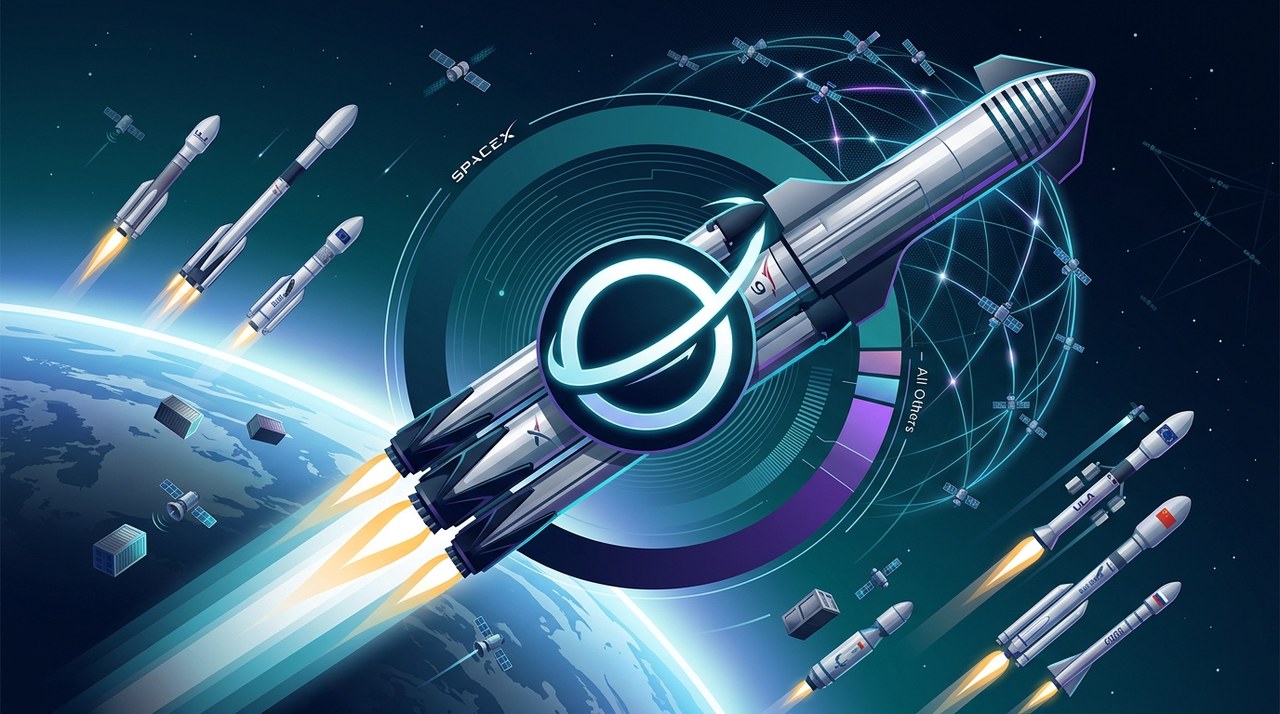
SpaceX Leaves Competitors in the Dust
SpaceX has transported around 1,950 tonnes of material into Earth orbit so far in 2026. That impressive figure represents roughly 80% of all payload launched globally this year.
Responding to these staggering numbers, company founder Elon Musk described SpaceX as an anomaly in the matrix on the social media platform X.
While many industry followers count individual launch events, looking at total weight sent into space reveals an even bigger gap between SpaceX and the rest of the world.
Breaking Down the 2026 Space Launch Numbers
Data from space tracking platform ooinsights reveals that space operators worldwide have launched 2,396 tonnes into orbit across 236 successful missions in 2026.
Interestingly, this total global mass sits about 4.7% lower compared to the exact same point in 2025.
Despite the slight dip in global figures, SpaceX continues to claim the lion's share. If you add up the payload delivered by the next seven largest launch providers combined, they still lifted less than one-quarter of SpaceX's total mass.
Who is Keeping Up?
A Tesla investor recently highlighted these launch numbers, noting that only one entity is attempting to match SpaceX's pace.
That rival is China's state-owned aerospace giant, the China Aerospace Science and Technology Corporation (CASC).
However, counting raw flights doesn't present the complete story. When measuring actual weight carried into orbit, SpaceX's lead expands dramatically.
The Starship Difference: Heavy Lifting at Scale
Why is the gap in payload weight so massive? A major part of the answer comes down to one vehicle: Starship.
Starship is SpaceX's massive super-heavy rocket designed to carry gigantic loads into space.
Data from ooinsights shows that just three Starship missions alone carried a massive 120 tonnes of payload per flight.
Think of standard rockets like delivery vans, while Starship operates like an ocean cargo ship. That immense capacity allows SpaceX to pull ahead at an unprecedented rate.
What Does An Anomaly in the Matrix Mean?
Reacting to a chart showing SpaceX's market dominance, Elon Musk posted a brief reply on X on October 18, 2026.
SpaceX is an anomaly in the matrix— Elon Musk (@elonmusk) October 18, 2026
The phrase borrows from the iconic sci-fi film The Matrix. In the movie, an anomaly is an unexpected glitch or element that the system cannot explain or control.
In the aerospace sector, traditional economics suggest multiple competitors should split the market relatively evenly. SpaceX's single-handed control of 80% of global orbital mass completely defies normal industry patterns.
Tesla, SpaceX, and Elon Musk's Broader Vision
Musk's comments about SpaceX came shortly after he shared thoughts on Tesla's long-term trajectory.
In an online discussion, another Tesla investor encouraged critics to look past short-term Roadster sales and picture a potential merger between Tesla and SpaceX.
Musk pushed back against the merger idea, clarifying where he believes Tesla's future financial valuation will originate.
Optimus and Cybercab to Drive Tesla's Value
Musk explained that Tesla's ultimate valuation will not come primarily from consumer electric cars.
Instead, he expects Optimus—Tesla's humanoid robot—and Cybercab—its autonomous driverless taxi—to comprise the vast majority of the company's long-term worth.
Optimus and Cybercab will be the vast majority of Tesla's value. The only things that will scale to incredible size (K2 and beyond) economically are super intelligence, robots, solar power and mass to space. And, of course, if you have the first two, the rest will follow.…— Elon Musk (@elonmusk) October 18, 2026
Reaching for a K2 Civilization
In his post, Musk referenced building businesses that scale to K2 and beyond. But what does K2 actually mean?
K2 refers to a Type II civilization on the Kardashev scale. Scientists use this scale to categorize a civilization's technological level based on how much energy it harnesses.
A Type I civilization uses all energy available on its home planet. A Type II (K2) civilization harnesses the total energy output of its host star, such as our Sun.
Musk has noted in the past that Earth's current economy is microscopic compared to a full-fledged K2 economy.
Four Pillars of the Future Economy
Musk identified four critical pillars that can scale economically to Kardashev Type II levels:
- Superintelligence: Highly advanced artificial intelligence capable of rapid problem-solving.
- Robots: Autonomous machines like Optimus handling physical tasks.
- Solar Power: Capturing massive quantities of energy directly from the sun.
- Mass to Space: Transporting enormous payloads off Earth reliably and efficiently.
Out of these four transformative industries, SpaceX's mass-to-orbit capability is currently the only one operating at a true commercial scale today.
The $100 Trillion Horizon and What Investors Should Watch
Despite prioritizing artificial intelligence and robotics, Musk confirmed that Tesla will still build the floating Tesla Roadster, calling the vehicle super cool.
However, heavy-lift launch capacity remains central to his long-term narrative for both enterprises.
With Musk previously floating a potential $100 trillion valuation target for SpaceX, tracking total mass sent into orbit has become a key metric for analysts and investors.
While extreme long-term valuations reflect big futuristic ambitions, actual performance depends on technical execution, regulatory approvals, and economic conditions. As space activity grows, launch tonnage will remain a vital measure of progress.
Latest blog posts



Why Real-World Assets and Onchain Credit Drive XRP Demand
Institutional adoption and new lending tools on the XRP Ledger could create lasting demand for XRP despite recent market pullbacks.
|


 +2
Analysts Pick Hyperliquid Above Solana and Bitcoin Amid Drop
Despite dropping 15% in a month, Hyperliquid (HYPE) remains the top-rated altcoin among crypto analysts, driven by strong buyback mechanics.
|
Crypto Market Cap Jumps 39% in Q3, Ending Losing Streak
The crypto market gained $840 billion in Q3, breaking a three-quarter decline despite lower overall spot trading volume.
|