


Scammer Scammed: Ledger Tampering Causes $4.8M BTC Loss
A Surprising Twist in Crypto Security
You usually hear about online fraudsters running away with innocent people's funds. However, in a major twist, one online scam operator just experienced the exact same thing from the victim's side.
According to research from blockchain analytics firm Chainalysis, an operator behind a widespread task scam lost more than 60 Bitcoin (BTCBTC-0.52%). That stash was worth roughly $4.8 million at the time it vanished from their control.
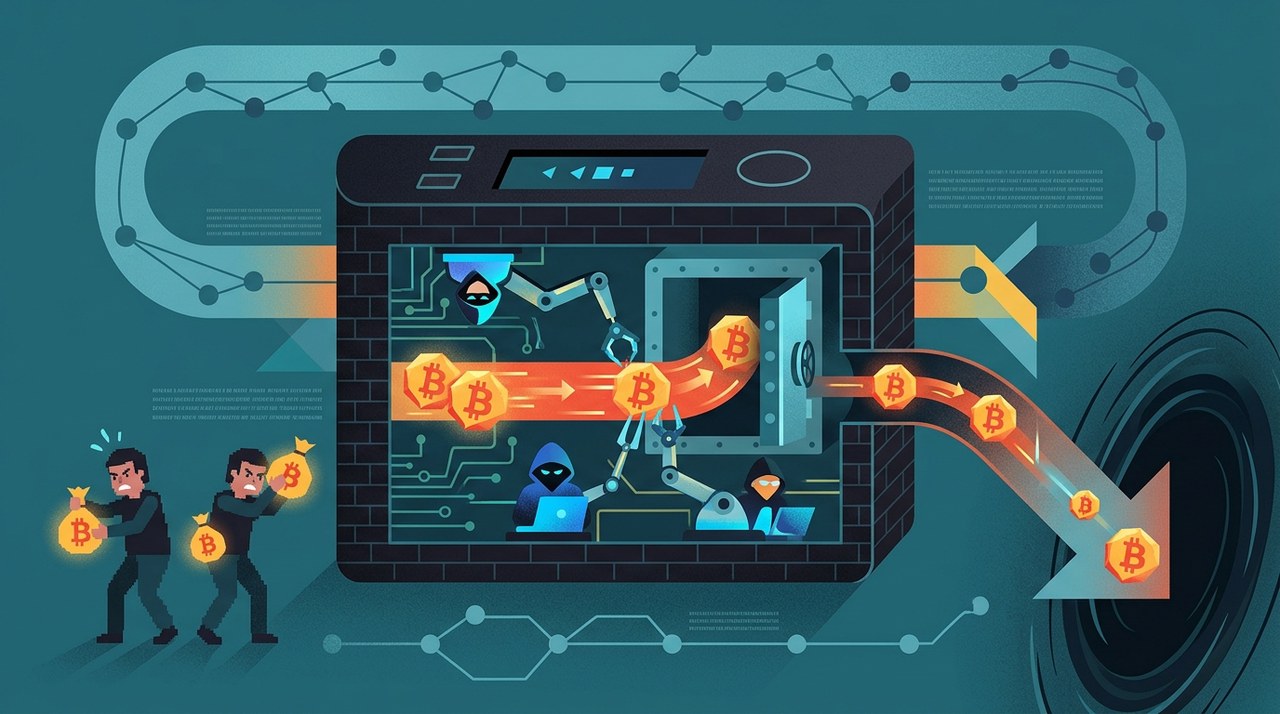
How did a fraudster lose such a massive amount of money? It turns out the scammer stored their illicit earnings on physical hardware wallets that had been modified by hackers before the devices were even delivered.
Tracking the Money: How $4.8 Million Disappeared
Because public blockchains record every transfer on an open ledger, researchers can track funds step-by-step as they move across addresses. Chainalysis published a detailed flow chart outlining how this high-profile theft took place.
The sequence began on September 22, 2026. The scam operator consolidated their earnings and transferred them into three separate Ledger wallet addresses.
Chainalysis traced these funds directly back to a primary consolidation wallet fed by three known fraud accounts. The largest single scam wallet sent $1.36 million into this central hub across 106 separate transactions.
Once the scam operator divided their proceeds into three Ledger addresses, each address held approximately $1.64 million. But those funds did not stay safe for long.
On October 9, 2026, unknown thieves executed a swift drain. In a single transaction per address, all three Ledger wallets were completely emptied. Every coin flowed directly into a single target address that has now been flagged on-chain as containing stolen assets.
How Task Scams Tricked Victims
To understand where this money originated, it helps to look at how task scams trick unsuspecting job seekers.
In these schemes, workers are recruited to complete simple online tasks. Typically, these tasks involve writing fake product reviews or generating false sales entries for real items to make e-commerce stores look more popular.
At first, workers see an increasing balance in their platform account. But soon, the system intentionally displays a negative balance. Operators tell victims they must deposit their own money—usually in cryptocurrency—to clear the negative balance before they can withdraw their earnings.
Once victims send their crypto, the scammers block access and pocket the deposits. This fraud model has spread rapidly around the world.
In a December 2024 report, the U.S. Federal Trade Commission (FTC) revealed that task scams made up nearly 40% of all reported job scams in 2024.
"Cryptocurrency is the payment of choice for these scams," the FTC noted in its report.
The FTC added that reported cryptocurrency losses tied specifically to job scams reached $41 million during just the first half of 2024.
The Physical Hardware Hack: How the Implant Worked
Storing crypto offline in hardware wallets is generally considered one of the best ways to protect digital assets. However, hardware security can still be compromised if the physical supply chain is breached.
While Chainalysis did not state where the scammer purchased their devices, wallet manufacturer Ledger linked every confirmed loss from the incident to signers sold through CryptoBilis, an authorized reseller in Southeast Asia.
On October 10, Ledger discovered a physical hardware implant hidden inside a device owned by one of the victims.
Ledger's Donjon security research team carefully analyzed the modified device and explained how the attack functioned behind the scenes:
- Screen Capture: The modified internal chip reads the device screen during the initial setup process.
- Key Interception: As the user sets up their wallet, the chip records the secret 24-word recovery seed phrase displayed on the screen.
- Cellular Transmission: The implant uses a built-in eSIM to send those 24 secret words over an LTE cellular network directly to the attackers.
Because the attackers received the recovery phrase during setup, they simply waited until the wallet held millions of dollars before sweeping the funds remotely.
Total Industry Losses Pass $86 Million
The task scam operator was far from the only person impacted by this supply chain breach. On-chain analyst Specter estimates that total losses linked to the CryptoBilis hardware wallet tampering exceed $86 million across Bitcoin (BTC), EthereumETH-2.24%, and TRONTRX-0.71%.
"We have not confirmed the total number of affected users or the total value lost," Ledger stated regarding the incident.
To prevent further losses, Ledger advised anyone who set up a device purchased from CryptoBilis to immediately move their assets to a secure wallet using a fresh recovery phrase.
Key Takeaways for Managing Hardware Wallet Safety
This case highlights essential safety lessons for anyone holding cryptocurrency. Cold storage remains a solid choice for security, but device origin matters just as much as key management.
To reduce supply chain risks, users should purchase hardware wallets directly from the original manufacturer whenever possible. It is also important to verify device integrity, check for signs of tampering, and generate recovery seed phrases securely offline.
Past performance of digital assets is not a guarantee of future performance. As blockchain tracking tools improve, identifying illicit flows becomes easier, but protecting physical devices remains vital for keeping private keys safe.
Latest blog posts

Wall Street Hit by Extreme Fear as AI Stock Bets Liquidate
Wall Street sentiment plunged to extreme fear as tech stocks fell, leading to $52 million in weekend leveraged AI liquidations.


A $98M Bitcoin Bet on Hyperliquid Near Liquidation
A high-leverage Bitcoin trader on Hyperliquid is sitting on a $98 million position that could get liquidated if prices drop just 1.59%.
|
MapQuest App Now Exposes License Plate Readers
MapQuest added a new map layer showing driver surveillance cameras across the US. Here is what you need to know about the feature and the debate around it.
|