


OpenAI Says 'ETH' Is False — But Ethereum Is Fine
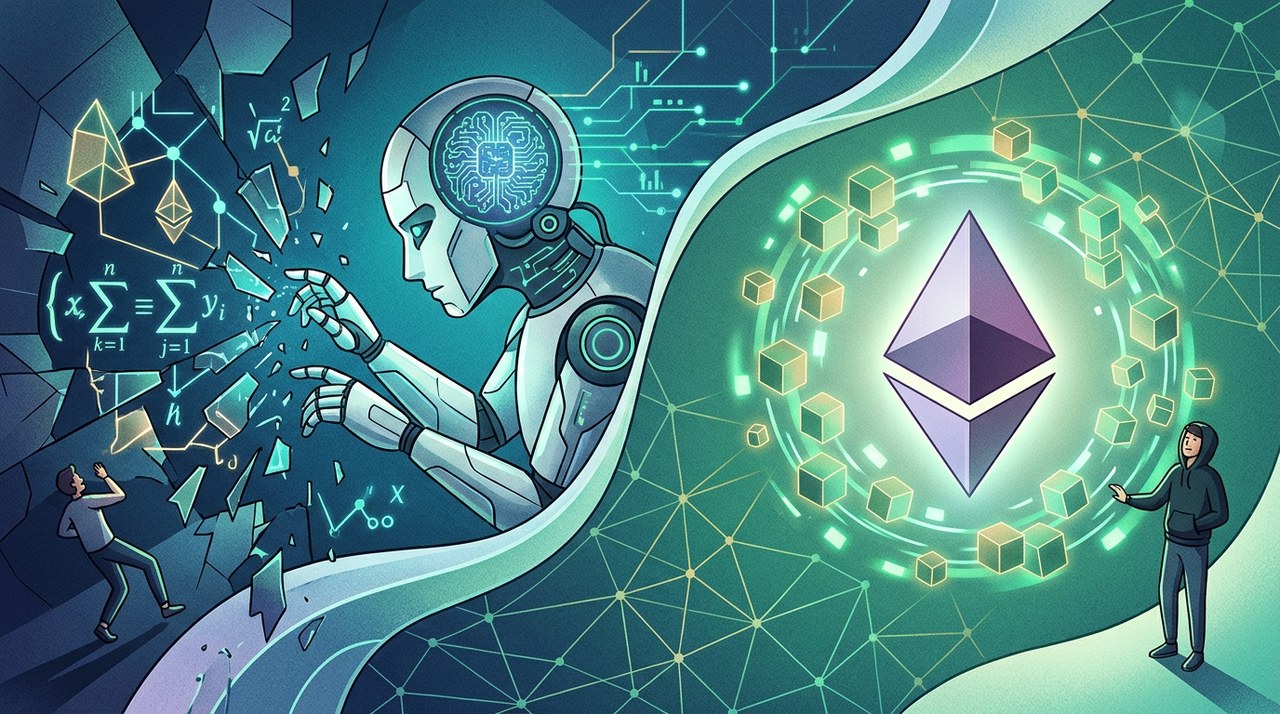
Did OpenAI Just Break EthereumETH+1.15%?
If you glanced at social media recently, you might have seen a startling headline: OpenAI claims it has proven ETH is false.
Crypto Twitter immediately went into overdrive. Traders began cracking jokes and posting memes about the potential demise of the second-largest cryptocurrency.
A popular X user named Takumi joked, 'Damn algoALGO-3.07% traders just slaughtered $ETH.' Another user, Andrew Jiang, quipped, 'Vitalik has been real quiet since this came out.'
If you hold Ethereum, you can breathe a deep sigh of relief. The 'ETH' OpenAI disproved has nothing to do with Ethereum, its price, or creator Vitalik Buterin.
Instead, OpenAI is talking about the Exponential Time Hypothesis, a famous math and computer science conjecture introduced back in 1999.
What Is the Exponential Time Hypothesis?
To understand what happened, we need to take a quick trip into the world of theoretical computer science.
Back in 1999, computer scientists Russell Impagliazzo, Ramamohan Paturi, and Francis Zane proposed the Exponential Time Hypothesis (ETH).
The hypothesis revolves around a classic logic puzzle called 3-SAT. Imagine a complex digital puzzle with hundreds of true-or-false switches governed by rules grouped in threes.
ETH proposed that there is no shortcut to solving 3-SAT. Computers would essentially have to guess and test almost every possible combination.
Because computers could not shortcut this process, the work required grows exponentially as the puzzle gets larger.
For 25 years, hundreds of academic research papers relied on ETH as a foundational truth. Scientists used it to show that hard problems in biology, geometry, database management, and graph theory could never be solved quickly.
OpenAI now claims its AI model has rewritten that map.
How OpenAI's AI Cracked the Challenge
OpenAI published a detailed 67-page research paper outlining its breakthrough. The paper was first dated October 17 and revised on October 25.
According to the paper, OpenAI's AI discovered a deterministic algorithm—meaning an algorithm that operates without any randomness—that counts solutions to 3-SAT puzzles in subexponential time.
Subexponential time means the computational work grows significantly slower than an exponential curve as variables increase.
Counting every valid solution is actually harder than just finding a single working solution. By mastering the harder job, the AI solved the easier task for free.
The timeline of the breakthrough moved remarkably fast:
- October 16: OpenAI's AI model discovered the disproof.
- October 17: The mathematical proof was verified mechanically using Lean, a software tool that checks logical statements line by line.
- October 25: OpenAI released an updated version of the manuscript on GitHub.
OpenAI published the proof on GitHub alongside 722 other math manuscripts. Out of those 722 papers, only 162 included main results verified mechanically by computer.
What Experts and Independent Researchers Are Saying
Evaluating a major claim in theoretical computer science requires rigorous external validation. The original creators of the hypothesis are leading the independent review.
Russell Impagliazzo and Ramamohan Paturi, along with MIT computer scientist Ryan Williams, are currently examining the AI-generated proof.
However, the trio urged caution in an open letter regarding their review process.
Our involvement should not be taken as certification of the claim. A result of this significance requires careful, independent scrutiny and an understanding that others can reconstruct, question, and build upon.
OpenAI is taking steps to ensure full transparency during this review process:
- External researchers signed no non-disclosure agreements (NDAs).
- Participating scientists are working independently and unpaid.
- OpenAI committed to publishing all raw data publicly.
- OpenAI is funding an academic conference dedicated to scrutinizing the result.
Does This Solve the Famous 'P vs NP' Problem?
When news of this breakthrough broke, many wondered if AI had finally solved P versus NP—one of the most famous unsolved problems in mathematics.
In simple terms, P refers to problems that computers can solve quickly and efficiently. NP refers to problems where checking a proposed solution is easy, but finding the solution might take forever.
The big question in P vs NP is whether every problem with an easy-to-check answer also has an easy way to solve it.
OpenAI clarified that its paper does not solve P vs NP. The paper shows that 3-SAT can be solved faster than previously assumed, but it does not prove that every hard problem can be solved in subexponential time.
Practical real-world applications are also still far away. Turning theoretical math advances into everyday software speedups will require years of additional research.
The AI Math Race: Anthropic Enters the Arena
OpenAI is not the only AI lab pushing mathematical boundaries. Competition in automated math discovery is heating up rapidly.
On October 26, rival AI company Anthropic published a paper credited to its Claude AI model, titled A 2^o(n) Time Algorithm for 3-SAT.
Anthropic stated that an internal research version of Claude discovered an algorithm targeting the same ETH problem. However, Anthropic noted the result is purely theoretical and does not apply to practical software yet.
This is not Claude's first math milestone. In September, Claude successfully formalized Fermat's Last Theorem inside the Lean proof verification software.
Fields Medalist and mathematician Terence TaoTAO-0.12% recently noted how rapidly AI is altering mathematical research.
We have now seen that even the rumor of someone working on a problem can trigger a massive amount of AI-powered effort to flatten it before the original research project has time to reach its full potential.
To support this expanding field, OpenAI contributed $5 million to the Simons Foundation. The grant will fund workshops, programs, and conferences to help mathematicians verify and expand upon AI-generated results.
Market Context and Final Thoughts
While Crypto Twitter had its fun with the headline, Ethereum continues to operate completely unaffected by computer science hypothesis updates.
During the period around this announcement, major cryptocurrencies like BitcoinBTC+0.31% traded around $80,678, demonstrating standard market movement.
Past performance of digital assets is not a guarantee of future performance.
This episode serves as a reminder to always look past dramatic headlines in tech and crypto. While Ethereum token holders can rest easy, theoretical computer science may be entering a brand new era driven by artificial intelligence.
Latest blog posts

 +2
CCE.Cash Partners With Swapzone for Crypto Exchanges
CCE.Cash has integrated with exchange aggregator Swapzone, allowing crypto users to compare rates, fees, and processing speeds across multiple providers.
|

Cancore Raises $7.2M Seed Funding at $60M Token Valuation
Canton-based trading platform Cancore has raised $7.2 million in seed funding at a $60 million token valuation to bridge institutional assets with public crypto liquidity.
|
Jason Calacanis Claims Bitcoin Will Never Hit New Highs
Tech investor Jason Calacanis predicts Bitcoin will fall 28% to $57,000 as AI capital captures investor focus.
|