
Microsoft Drops U.K. AI Deal with Crypto Miner Over Power Delay
A Major Bump in the Road for Crypto's AI Ambitions
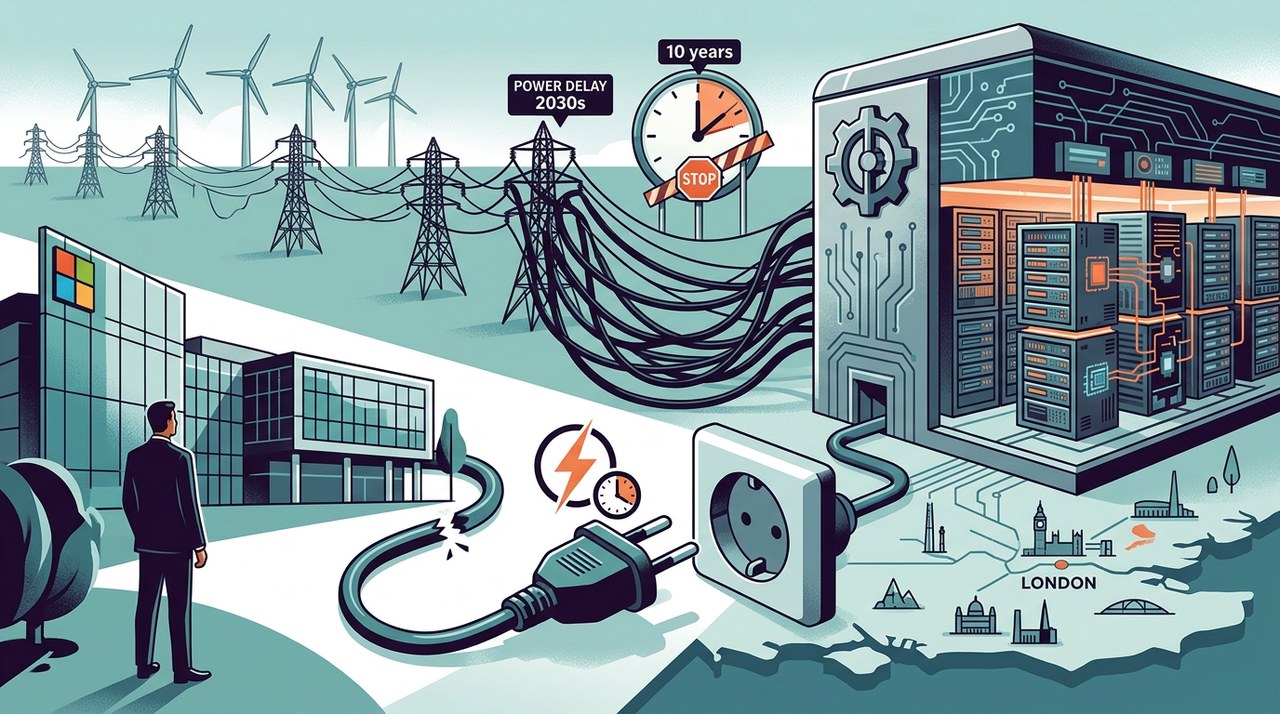
Imagine ordering a state-of-the-art electric sports car today, only to be told that the charging station near your house will not have power for another ten years. That is essentially what just happened to a high-profile artificial intelligence data center project in England.
Tech giant Microsoft has walked away from a planned U.K. AI data center contract with Nscale. Nscale is a fast-growing tech infrastructure company that originally grew out of the Bitcoin mining industry.
The reason for the sudden deal cancellation comes down to a fundamental electricity issue. The local power grid operator warned that it might not be able to deliver enough electricity to the facility until the early-to-mid 2030s.
Inside the Essex AI Hub Plan
The affected data center facility is located in Loughton, Essex, which sits about six miles northeast of London. It was designed to be a heavy-duty supercomputing hub.
Plans called for the location to house 23,040 high-performance Nvidia graphics processing units (GPUs). Together, these advanced chips were expected to supply 50 megawatts of computing capacity directly into Microsoft's Azure cloud ecosystem by early 2027.
The ambitious project made headlines last year when Nscale announced it alongside big tech industry players, including Microsoft, Nvidia, and OpenAI.
However, turning physical land into an operational supercomputing facility requires huge amounts of steady electricity. When reporters visited the Essex location earlier this year, it was still operating as a working scaffolding yard.
Although Nscale has since cleared the property, local power grid operator UK Power Networks delivered a sobering reality check. They informed Nscale that sufficient electrical grid capacity would likely not be available for the site until the early-to-mid 2030s.
What Happens Next for Nscale?
Despite this major snag at the Essex location, Nscale is not stepping away from the project entirely. The company publicly stated that it is currently exploring alternative ways to source energy for the cleared property.
Furthermore, Nscale clarified that its other separate infrastructure contracts with Microsoft remain fully active and are unaffected by this regional grid delay.
Nscale's business roots trace back to Arkon Energy, an organization that built industrial facilities for Bitcoin mining. Its founder, Josh Payne, leveraged that early experience in securing land rights and power connections to pivot into selling massive computing power to artificial intelligence firms.
The Big Pivot: Why Bitcoin Miners Are Turning to AI
Nscale is far from alone in making this strategic shift. Over the past year, many publicly listed Bitcoin mining companies have started using the exact same playbook.
Bitcoin mining is an intensely competitive and energy-heavy business. When operational expenses rise or digital asset prices experience sudden sharp declines, profit margins can shrink very quickly.
Past performance of digital assets is not a guarantee of future results. Digital asset markets involve significant volatility, and historical price movements should not be used as an indicator for future market performance.
For example, in late 2025, the average cash cost for public miners to produce a single Bitcoin climbed toward $80,000. Around the same time in early 2026, Bitcoin was trading near $70,000. This created a scenario where many mining operations were spending more money to mint a coin than the market price offered.
To adapt, miners realized that their most valuable assets were not just specialized crypto mining hardware. Their true competitive advantage lay in owning real estate with high-voltage transformers and heavy electrical connections already attached.
By upgrading those power-ready locations into AI data centers, miners could secure predictable multi-year contracts with well-funded technology corporations like Microsoft, Meta, or Amazon.
The Financial Numbers Behind the AI Shift
The monetary scale of this industrial transition is substantial. Publicly traded Bitcoin mining firms have announced more than $70 billion in contracts dedicated to AI and high-performance computing (HPC) projects.
To fund these expensive infrastructure upgrades, mining companies have sold off sizeable portions of their crypto reserves. Major public miners reduced their combined Bitcoin holdings by over 15,000 BTCBTC+0.61% from peak levels, using the proceeds to help finance AI construction.
You can monitor live digital asset valuations and historical market trends anytime on Bitkub Market.
Mining vs. AI: Comparing Costs and Requirements
Converting a Bitcoin mining warehouse into a modern AI data center involves much more than simply swapping out computer hardware. The technical requirements and capital expenditures are vastly different.
- Construction Costs: Building a standard Bitcoin mining facility costs around $700,000 to $1 million per megawatt. By comparison, an AI-ready facility costs between $8 million and $15 million per megawatt.
- Uptime Expectations: Bitcoin miners can temporarily shut down their machines during peak energy pricing hours to cut costs. AI supercomputers are expected by customers to remain online 24 hours a day, 7 days a week.
- Cooling Infrastructure: AI hardware generates intense thermal loads, requiring liquid cooling systems, backup diesel generators, and multi-layered power backup setups.
The Gap Between Signed Contracts and Revenue
While announcing massive AI partnerships generates strong headlines, converting those announcements into steady earnings takes considerable time.
According to research from fund manager CoinShares, public crypto miners have secured over 4 gigawatts of contracted AI capacity across various deals.
However, out of that total, only about 550 megawatts of computing capacity was actively operational and generating active bills for clients at the time of the report.
While the total backlog of signed AI deals exceeded $100 billion across the sector, actual annualized revenue from active AI operations stood at just over $1 billion. This highlights a clear gap between signing an agreement and completing the physical power infrastructure.
The Power Grid Bottleneck in Great Britain
The unexpected delay experienced by Nscale in Essex reflects a wide grid congestion problem across the United Kingdom.
Energy regulator Ofgem reports that connection requests from proposed data center projects in the U.K. total approximately 73 gigawatts of electricity demand.
To put that number in perspective, 73 gigawatts represents a power figure roughly equal to the peak electricity consumption of the entire British power grid during a cold winter evening.
Because grid connection queues operate on a first-come, first-served basis, speculative projects often apply for hookups long before securing property or financing. These inactive proposals can sit in line for years, clogging up the queue for active developers.
To solve this issue, Ofgem is weighing stricter rules. The regulatory body aims to clear inactive applications from the queue so that fully funded, ready-to-build data center projects can gain access to the grid much faster.
Looking Ahead at Crypto and AI
The story of Nscale and Microsoft illustrates the real-world physical hurdles facing the ongoing crossover between cryptocurrency infrastructure and artificial intelligence.
Securing capital, securing specialized microchips, and signing contracts are crucial steps, but facilities still require energization to function. Without physical electricity flowing from the grid, high-tech server rooms cannot run.
Unless Nscale can arrange alternative microgrid power solutions or the regional grid upgrades move ahead of schedule, the cleared land in Essex could remain vacant for years. Transitioning energy infrastructure from crypto mining to high-level artificial intelligence requires navigating heavy real-world power constraints every step of the way.
Latest blog posts



Ripple Swell 2026: AI Tech and XRP Ledger Security
Ripple's flagship Swell event kicks off in New York next week, focusing on artificial intelligence and XRP Ledger security.
|

Bitcoin Hits $83K Before Pulling Back as Oil and Chips Shift
Bitcoin briefly touched $83,000 before giving back gains due to Middle East geopolitical alerts and shifting energy prices.
|
UK Trio Jailed After Failed Crypto Home Invasion
Three men in England have been sentenced to prison after breaking into a home and violently demanding cryptocurrency from a local resident.