
Heatbit Unveils Bitwater: A Bitcoin Mining Water Heater
What Is Bitwater? A Water Heater Element That Mines BitcoinBTC-0.12%
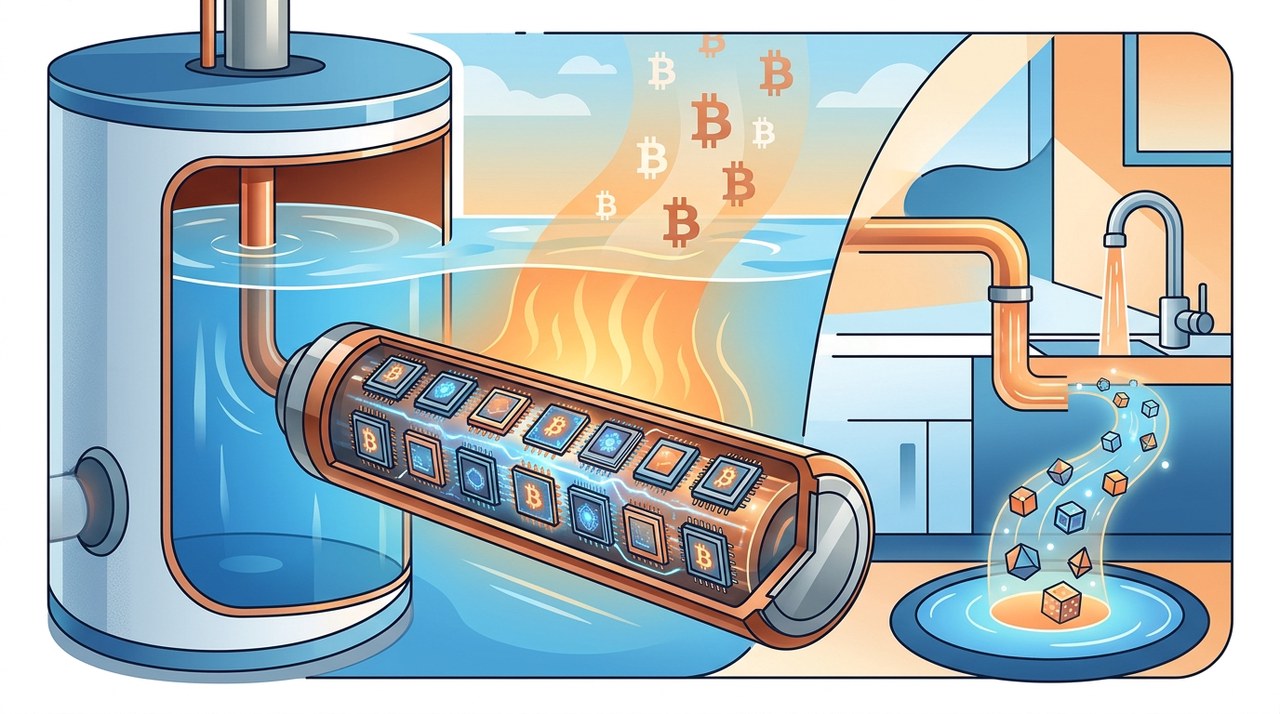
Heatbit, a company known for building home heating devices equipped with Bitcoin mining hardware, has officially announced its newest product: Bitwater. Unveiled via a announcement on social media, Bitwater is an electric water heater element designed to replace the standard resistance heating element inside regular household hot water tanks.
Instead of using traditional wire coils that convert electricity into heat, Bitwater uses 20 specialized Bitcoin mining chips. As these microchips calculate cryptographic puzzles to secure the Bitcoin network, they generate thermal energy. That heat is transferred directly into the surrounding tank water, effectively turning household water heating into a dual-purpose activity.
Heatbit summarizes its value proposition simple core concept: household electricity is already being expended to heat water every day, so routing that energy through computing chips allows homeowners to capture potential digital asset rewards without consuming additional thermal energy beyond what the household already requires.
Inside the Tech: How Does Bitwater Work?
Under the hood, Bitwater is built around 20 BM1370 ASIC chips manufactured by Bitmain. These chips give the unit a maximum computing capacity, or hashrate, of up to 34 terahashes per second (TH/s).
Key technical specifications provided by Heatbit include:
- Hashrate: Up to 34 TH/s
- Power Consumption: Up to 600 watts
- Energy Efficiency: 12 joules per terahash (J/TH)
- Acoustics: Totally silent operation due to direct water cooling with zero internal fans
Because the surrounding water absorbs heat directly from the chips, the unit requires no active fan cooling. This eliminates the loud whirring sounds typically associated with industrial Bitcoin mining hardware, making it suitable for indoor residential use.
The power profile of Bitwater also differs significantly from standard electric water heaters. Most traditional heating elements in North America draw roughly 4,500 watts, turning on for short bursts to heat water rapidly before shutting off. In contrast, Bitwater operates at a steady draw of up to 600 watts. This lower power draw allows it to run for longer stretches throughout the day to warm the water gradually. If hot water demand spikes suddenly, the water tank's secondary upper heating element acts as a backup to supply extra heat.
DIY Installation and Tank Compatibility
Heatbit has designed Bitwater as a self-installation kit that fits into existing plumbing systems without requiring major retrofits or specialized electrical upgrades.
The installation process involves a few basic steps:
- Turn off the power supply at the circuit breaker.
- Drain the water tank to empty the chamber.
- Unscrew the existing element using standard tools.
- Thread in the Bitwater element using the custom wrench provided in the package.
The device features a standard one-inch male pipe thread port, making it compatible with most standard 30- to 80-gallon electric water heaters used across the United States and Canada. Heatbit confirmed compatibility with major tank manufacturers, including A. O. Smith, Rheem, Bradford White, Whirlpool, and General Electric (GE).
App Control, Mining Options, and Setup
Users can manage and monitor their Bitwater element through a companion smartphone application. The dashboard provides real-time data on key system metrics:
- Water Temperature: Monitoring hot water levels inside the tank
- Hashrate Performance: Checking computing output in terahashes per second
- Earnings: Tracking daily and total Bitcoin rewards accrued
The system gives users the flexibility to choose their preferred mining configuration. Homeowners can either participate in pool mining (combining computing power with other users to receive regular payouts) or opt for solo mining (attempting to solve a block independently). All earned Bitcoin is deposited directly into a self-custodial wallet address specified by the user.
Pricing, Preorder Batches, and Testing
Heatbit has opened preorders for its initial production run, labeled the Genesis batch, at an introductory price of $899 per unit. Preorders for this initial run are fully refundable, with global shipping scheduled to begin in the first quarter of 2027. Subsequent retail batches are projected to cost up to $1,299.
Before launching preorders, Heatbit conducted real-world field trials over the winter season. Testing was performed in households of four and five people located in New York and Florida to observe performance under varying regional temperatures and water usage patterns. Additionally, the company teased development of a related heating solution tailored for homes with gas-powered water heaters.
Understanding Potential Earnings and Economic Factors
When assessing potential mining revenue, actual returns depend directly on several shifting market conditions, including the spot price of Bitcoin, network difficulty, and local residential electricity rates. Heatbit notes that the element is designed to operate continuously for over 80% of the day under typical home thermal cycles.
To offer baseline context, Heatbit shared external modeling estimates indicating potential gross revenue of roughly $1.00 to $1.25 worth of Bitcoin per day under baseline network conditions. Based on benchmark network figures from Hashrate Index—where the prevailing hashprice stood around $36.73 per petahash per second per day—a unit producing 34 TH/s could generate approximately $1.25 daily, or roughly $455 annually in gross digital asset value.
Note on Earnings Scenarios: All output projections depend on continuous operating parameters, prevailing Bitcoin network difficulty, and market prices. If global network difficulty increases or Bitcoin market prices fall, gross daily rewards will decrease. Conversely, if network difficulty falls or market prices rise, daily revenue values can expand. Net profitability is strongly tied to local utility rates; if household electricity costs per kilowatt-hour exceed the market value of generated coins, operating net returns may become negative.
Historical market movements or past mining difficulty trends do not guarantee future performance or financial returns.
The Vision: Decentralized Home Mining vs. Industrial AI Pivot
Heatbit positions Bitwater not just as an appliance, but as an effort to redistribute network hashrate back to residential users. The company highlighted energy data indicating that global residential water heating consumes approximately 300 terawatt-hours (TWh) of power each year—nearly double the roughly 170 TWh consumed annually by the entire Bitcoin network.
This product launch comes as large industrial mining facilities increasingly pivot away from pure cryptocurrency validation toward artificial intelligence (AI) and high-performance computing infrastructure.
Research data from investment firm Bernstein reveals that industrial miners executed 17 major infrastructure deals valued at over $110 billion over a two-year period. These contracts reallocated approximately 6 gigawatts (GW) of electrical capacity to technology firms like Google, Amazon, Microsoft, Nvidia, and CoreWeave. Bernstein projects AI sector revenue for major institutional miners to expand from $1.2 billion in 2026 to $10.7 billion by 2030.
Grid Balance: How Bitcoin Mining and AI Differ
Industry observers point out fundamental operational differences between AI data centers and Bitcoin mining hardware. Bitcoin mining hardware can be powered down nearly instantaneously in response to grid strain or elevated electricity demand without corrupting ongoing calculations.
In contrast, AI training workloads require continuous, uninterrupted power uptime. Speaking on this dynamic in early 2025, Shanon Squires of Compass Mining noted that Bitcoin miners act as interruptible loads that offer electrical grids flexible demand management, whereas traditional AI computing facilities must remain operational 100% of the time.
Heatbit's Growing Line of Dual-Purpose Appliances
Bitwater represents the second major dual-purpose hardware release from Heatbit. In 2023, the company launched a smart space heater featuring integrated mining hardware priced at roughly $700.
At the time of that initial launch, Heatbit founder Alex Busarov emphasized the core economic logic behind dual-purpose heat generation. Because a traditional electric heater converts electrical energy directly into thermal warmth without secondary utility, routing that same energy through computing microchips allows users to capture functional computational output alongside space or water heating.
As home appliances continue to evolve, products like Bitwater highlight how distributed hardware could redefine routine energy consumption in households across the globe.
Latest blog posts


XRP Ledger Payment Volume Jumps 119.6% as Activity Surges
XRP Ledger payment volume surged 119.6% in 24 hours to 770.6 million XRP. Here is what the metrics mean for the network and price.
|
Has Bitcoin Broken Its Midterm Election Pattern?
Historically, Bitcoin hits bear market bottoms right after U.S. midterm elections. In 2026, the floor arrived much earlier.
|

 +2
Bitcoin Holds Near $81,700 as Pepe Leads Altcoin Rebound
Bitcoin stabilized near $81,700 after a brief dip, while Pepe jumped 13% to lead a broader recovery across altcoins.
|