
Has Bitcoin Broken Its Midterm Election Pattern?
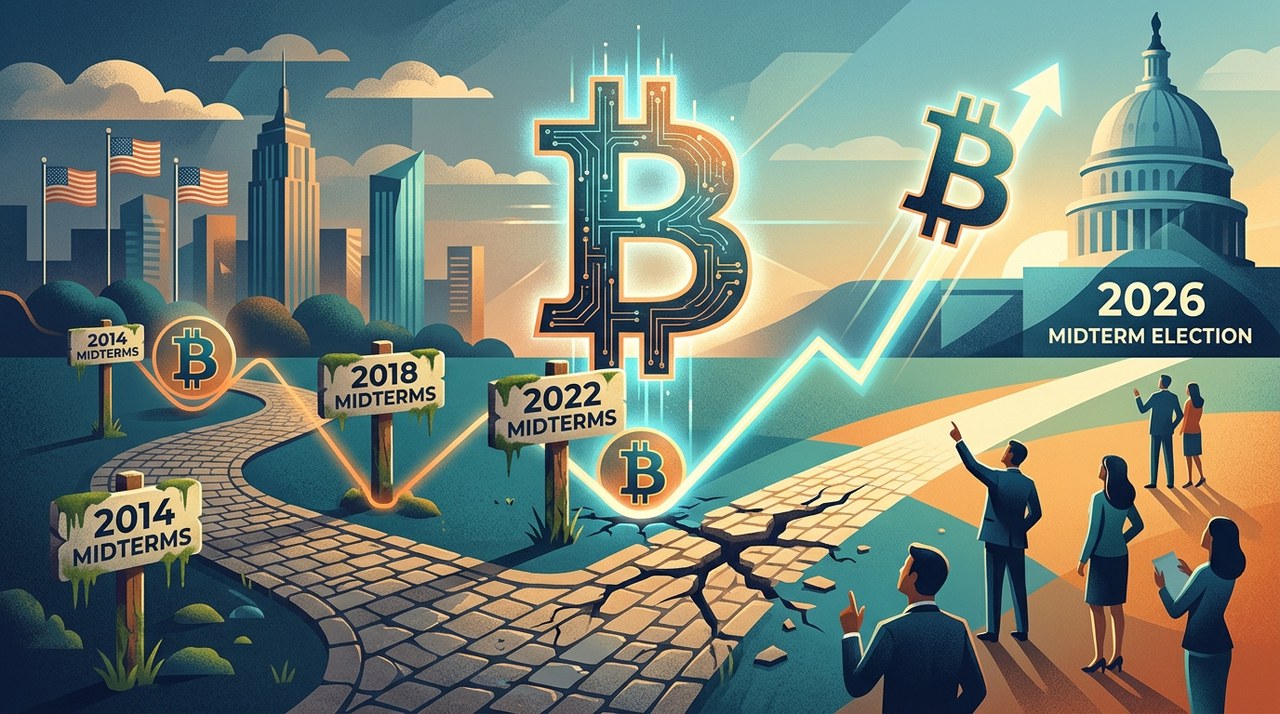
A New Trend for Bitcoin's Price Cycle
If you follow crypto trends, you might know that U.S. midterm elections have historically coincided with major Bitcoin bear-market bottoms.
With the U.S. midterm election set for November 3, 2026, many traders expected a market floor around this time. However, Bitcoin appears to have decoupled from this historical pattern.
How Bitcoin Behaved in Past Midterm Elections
In previous market cycles, Bitcoin reached its lowest points shortly after voters went to the polls.
After the 2014 midterms, Bitcoin bottomed in January 2015, about 71 days post-election. Following the 2018 midterms, the bottom arrived in December 2018, roughly 38 days later. In 2022, the floor hit in November 2022, just 13 days after Election Day.
Pre-election periods were historically tough as well. Bitcoin fell about 29% in the six months leading up to the 2018 midterms, and dropped 37% ahead of the 2022 vote.
Past performance of digital assets is not a guarantee of future returns.
Why 2026 Is Looking Quite Different
This year, the low point arrived much earlier than usual. Bitcoin touched a low of $57,850 on July 1, 2026—a full 125 days before Election Day.
By October 22, Bitcoin recovered to around $81,455, representing a bounce of roughly 40% from its July floor. While BTCBTC-0.24% experienced a 6% pull-back over the 30 days prior to late October, it remained up 26% over a 90-day period.
This early recovery suggests that Bitcoin's movements may be steering away from traditional political timelines. However, readers should keep in mind that digital asset markets remain subject to rapid price fluctuations.
Comparing Bitcoin to Traditional Tech Stocks
Traditional markets also see pre-election volatility. To see if this is a broader trend, analysts often look at the Invesco QQQ Trust, which tracks major tech stocks.
Tech stocks show a less consistent midterm pattern compared to crypto. For instance, QQQ dropped around 23% from late September to its December 2018 low. It also fell 17% in the three months before the 2022 vote.
On the flip side, QQQ actually gained 17% in the six months ahead of the 2014 midterms. More recently, QQQ fell about 6% over 30 days following an all-time high of $762.86 on October 6, posting a modest 3% gain over 90 days.
Crypto Cycles vs. Political Timelines
Comparing Bitcoin and stock index performance shows that crypto's midterm weakness is likely linked to its own internal market cycle rather than political events.
While elections create a general economic backdrop, Bitcoin's unique supply mechanics and four-year halving rhythm remain key factors shaping its price trajectory.
Latest blog posts


 +2
Bitcoin Holds Near $81,700 as Pepe Leads Altcoin Rebound
Bitcoin stabilized near $81,700 after a brief dip, while Pepe jumped 13% to lead a broader recovery across altcoins.
|

Cardano Dijkstra Testnet Goes Live Ahead of Major Upgrade
Cardano ecosystem group Intersect announced the launch of the public Dijkstra testnet, marking the first phase of testing for protocol version 12.
|

HSBC Launches Red Coin Stablecoin to Over 3 Million Users
HSBC has introduced its first Hong Kong dollar stablecoin, Red Coin, bringing digital payments to more than 3.3 million Pay Me app users.
|