
Heatbit Bitwater Turns Your Hot Shower Into Bitcoin Mining
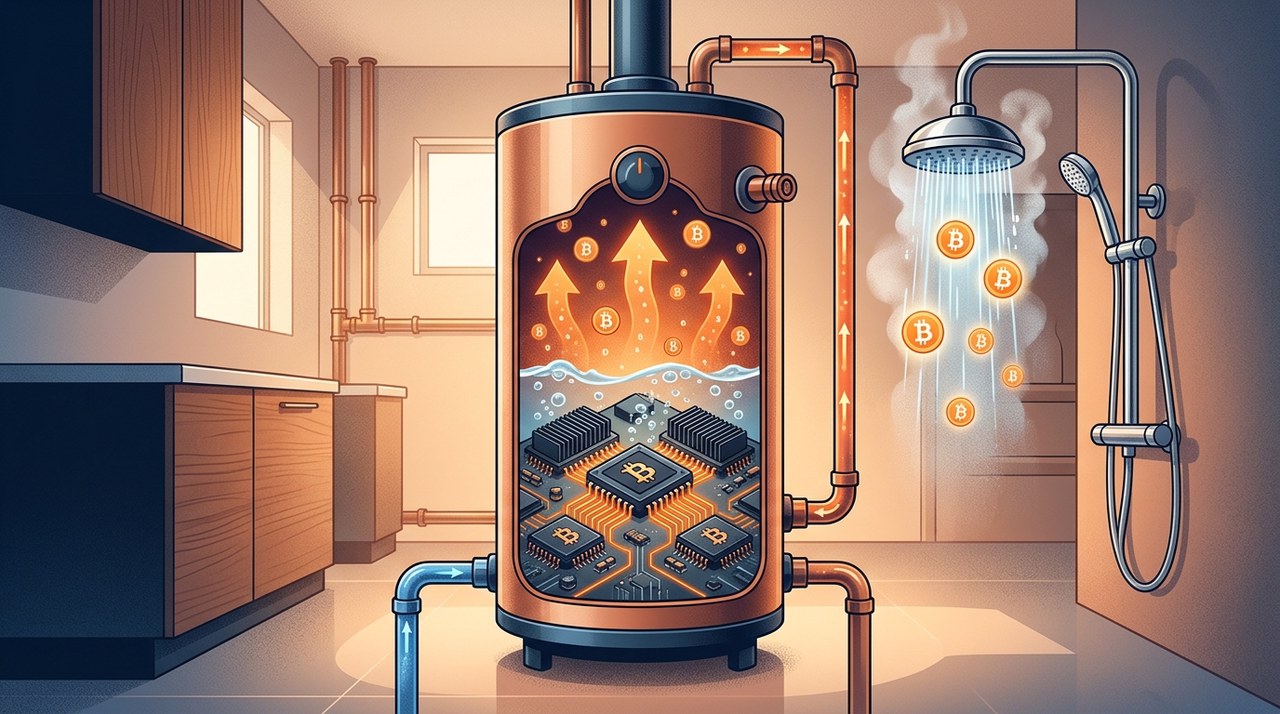
Turning Hot Showers Into BitcoinBTC-0.34%: Heatbit Unveils the Bitwater Device
Imagine waking up, taking a warm shower, and earning Bitcoin while your household water heats up. Hardware manufacturer Heatbit is aiming to make that scenario a reality with its latest home appliance attachment.
Heatbit recently announced a novel retrofit device called the Bitwater. Priced at $899 for its initial preorder batch, this attachment replaces the lower heating element in compatible electric water tanks with specialized computer chips that mine Bitcoin while warming your home's water.
What Is Bitwater and How Does It Work?
Standard electric water heaters operate using straightforward heating rods. When electricity flows through these metal rods, electrical resistance generates heat, warming the surrounding water in the storage tank.
Bitwater approaches this task with a high-tech twist. Instead of a simple heating element, it installs 20 Bitmain BM1370 Application-Specific Integrated Circuit (ASIC) chips. These microchips perform complex SHA-256 cryptographic calculations for the Bitcoin network.
Because computing chips generate substantial heat during heavy workloads, Bitwater transfers that thermal output directly into the surrounding water. Instead of allowing that heat to be wasted into the air, the device uses it directly for daily household needs.
Key Technical Specifications
- Mining Hardware: Features 20 Bitmain BM1370 ASIC chips optimized for Bitcoin's SHA-256 consensus mechanism.
- Processing Power: Delivers a computing hash rate of up to 34 terahashes per second (TH/s).
- Power Draw: Consumes approximately 600 watts of electrical power during operation.
- Acoustic Profile: Operates silently without cooling fans by relying entirely on direct water immersion cooling.
- Tank Requirements: Designed for standard 30-gallon to 80-gallon residential electric storage tanks.
Analyzing the Financial Math and Revenue Estimates
Conventional water heaters consume electricity purely as a utility expense. Bitwater attempts to offset that ongoing cost by capturing crypto rewards from the same electrical footprint.
According to Heatbit, the Bitwater unit can generate estimated daily mining rewards between $1.00 and $1.25 under favorable operating conditions. Over a full year, this translates to an estimated gross return of approximately $365 to $455 in Bitcoin.
When evaluated against the $899 introductory price tag for the Genesis preorder batch, Heatbit projects a theoretical payback period of roughly two to 2.5 years. However, this payback timeline depends on several fluctuating market assumptions.
Variables Affecting Mining Returns
Crypto mining economics are dynamic and subject to ongoing changes. Key factors influencing final profitability include:
- Bitcoin Market Value: If the market price of Bitcoin decreases, the dollar-denominated value of daily rewards drops.
- Network Difficulty: As global mining competition increases, the total Bitcoin earned per terahash decreases.
- Electricity Tariffs: Net earnings depend heavily on local electric rates per kilowatt-hour relative to mined crypto value.
- Hot Water Demand: The device operates actively when heating water, meaning run-time depends on actual household water consumption.
Under ideal scenarios with stable crypto prices and low energy tariffs, the device may partially offset water heating expenses. Conversely, if Bitcoin prices fall, network difficulty rises, or local electricity costs are high, net mining revenues will decline, extending the payback timeline.
System Installation and Tank Compatibility
Heatbit designed Bitwater to serve as an add-on component rather than requiring a full water heater replacement. The unit screws into standard heating element ports found on common residential electric tanks.
Supported vs. Unsupported Systems
- Compatible: Standard electric storage water heaters with 30- to 80-gallon capacities utilizing standard screw-in element ports.
- Incompatible: Gas-powered heaters, tankless on-demand water heaters, and heat-pump hybrid systems.
Heating Recovery Speed Considerations
Standard electric heating elements in residential tanks typically draw 4,500 watts of power. Because Bitwater operates at 600 watts, it warms water at a substantially slower rate on its own.
To ensure homes do not run out of hot water during periods of heavy usage, the tank's existing upper heating element remains fully operational to handle high demand.
The complete package ships with an electronic controller, a dedicated water leak sensor, mounting hardware, and a powered titanium anode aimed at minimizing tank corrosion over time.
Software Control and Pool Operations
Users can monitor and adjust Bitwater through Heatbit's mobile application. The interface displays real-time operational statistics, including water temperature, computing performance, energy usage, and accumulated Bitcoin rewards.
The device defaults to solo mining mode out of the box, giving users a statistical chance at independently solving a block. Alternatively, users can configure the software to join traditional mining pools for more frequent and predictable payout distributions.
Company Context: Heatbit's Product Evolution
Founded in 2020 by Alex Busarov, Heatbit focuses on converting computational heat waste into practical household energy solutions.
Prior to introducing the Bitwater system, the company developed space heaters and air purifiers powered by embedded ASIC chips. The Bitwater attachment represents an effort to apply this concept to year-round water heating applications.
Preorder Details and Practical Considerations
Heatbit opened preorders around October 22, 2026. The introductory Genesis batch is listed at $899, with subsequent production runs planned at prices reaching $1,299. Initial product deliveries are projected to begin in the first quarter of 2027.
Key Points to Note Before Ordering
- Unverified Product Field Data: As a newly announced preorder item, Bitwater currently lacks independent third-party reviews and verified real-world operational logs.
- Installation Costs: Projected payback calculations do not account for potential third-party plumbing or electrical installation fees.
- Market Volatility: Historical crypto mining returns and past token performance do not guarantee future earnings outcomes.
While the device will consistently output heat to warm domestic water, its actual long-term financial yield remains linked to the shifting dynamics of Bitcoin network difficulty and market pricing.
Latest blog posts



Mastercard Praises Ripple's RLUSD Stablecoin at XRPL Event
Global payment giant Mastercard gave a public nod to Ripple's RLUSD stablecoin during the XRP Ledger Hackathon in New York City.
|
Will Bitcoin Hold $80,000 Amid US-Iran Tensions?
Donald Trump noted potential military strikes or a deal with Iran as Bitcoin hovers around $80,000. Here is how past geopolitical events affected crypto markets.
|
Russia Hits 270,000 Digital Ruble Accounts in CBDC Launch
Russia's digital ruble has reached 270,000 accounts shortly after its official launch, driven by strong interest from small businesses.
|