
Google Tackles Quantum Hurdle: What It Means for Bitcoin
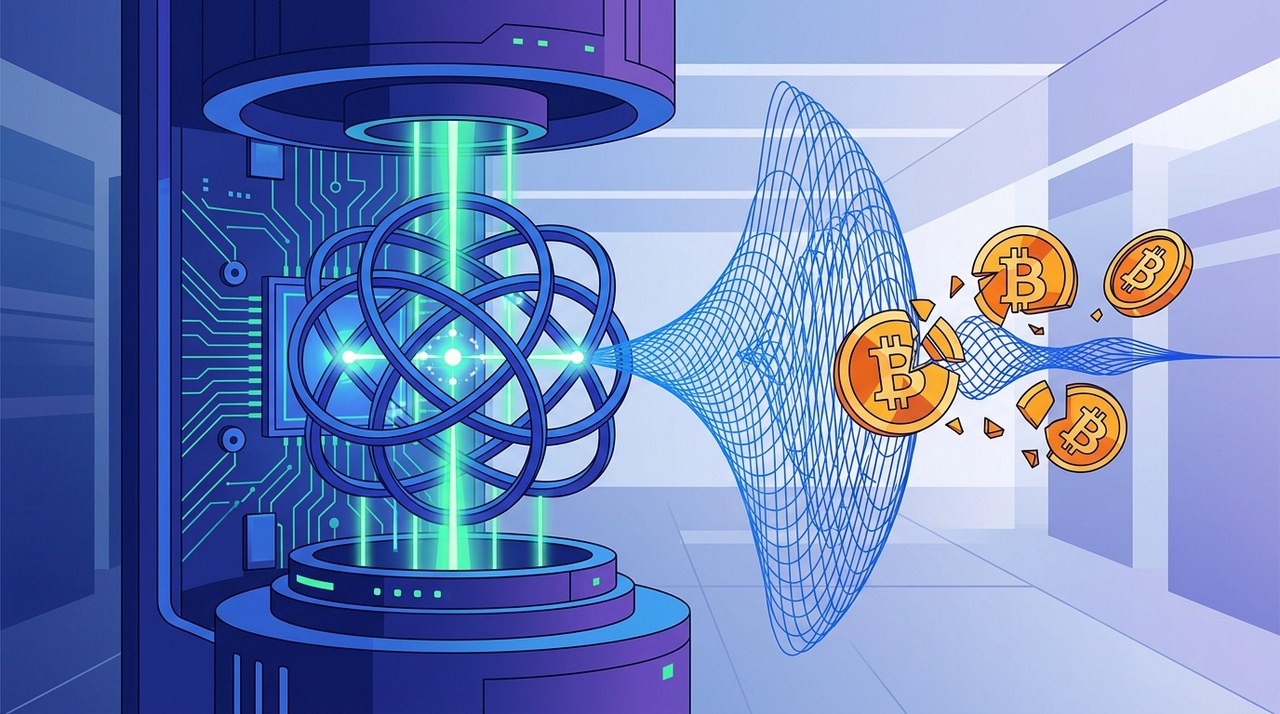
A Big Leap Forward in Quantum Computing
Google has announced a major technical milestone that solves one of quantum computing's toughest challenges. In research published in the journal Science on October 15, scientists demonstrated a practical way to dramatically reduce operational errors on Google's experimental Willow chip.
Quantum computers work very differently from the laptop or smartphone you are using right now. While normal computers process information using basic bits that are either a zero or a one, quantum computers use qubits. Qubits can exist in complex combined states, allowing quantum machines to solve specific mathematical problems exponentially faster.
However, quantum chips are extraordinarily sensitive. Slight changes in temperature or tiny magnetic field shifts cause errors during computation. Google's new research shows how future machines could bypass these physical roadblocks and become significantly more compact.
Understanding 'Magic States' and How Google Cleaned Them Up
To run practical algorithms, a quantum computer requires special foundational building blocks known as magic states. Without these high-precision states, advanced quantum operations cannot take place.
In the past, generating pure magic states required immense energy and computing power. Earlier estimates indicated that producing clean magic states could devour up to 95% of a quantum computer's total operational capacity. This massive resource bottleneck meant that building a useful machine would require an impractically huge physical system.
Google solved this through a novel technique called magic state cultivation. The process works through ruthless elimination:
- The Willow chip starts by creating a rough, error-prone quantum state.
- It subjects that state to a rigorous sequence of automated error checks.
- Any attempt that fails the check is instantly discarded.
- The surviving states are refined and cultivated into ultra-clean components.
On the 105-qubit Willow chip, cultivated magic states exhibited 40 times fewer errors than those produced using standard techniques. Google reported that these refined states achieved a benchmark accuracy level of 99.99% fidelity.
This work is the first demonstration of a practical solution to one of quantum computing's most severe resource bottlenecks. It demonstrates, on real hardware, that we can efficiently create these crucial magic states.
How Quantum Progress Relates to Bitcoin Security
Why does a hardware breakthrough at Google matter to crypto holders? The mathematical foundation that protects modern digital assets relies on public-key cryptography.
Your public key is like your bank account number—you can safely share it with anyone so they can send you funds. Your private key is like your password, allowing you to sign transactions and spend your funds. Today's supercomputers would need billions of years to guess a private key from a public key.
A sufficiently powerful quantum computer running specialized mathematical algorithms could theoretically derive a private key from a public key in a short timeframe. By dramatically cutting down the resources needed to generate magic states, Google's cultivation technique reduces the theoretical physical size of a code-breaking machine.
Breaking Down the Numbers: Where Quantum Stands Today
To evaluate the real-world threat level, it helps to compare where quantum hardware is today against what would be required to compromise Bitcoin.
- Google's current state-of-the-art Willow chip features 105 qubits.
- In March, Google estimated that breaking Bitcoin's encryption would require a quantum computer with slightly under 500,000 qubits.
- That theoretical attack would also require tens of millions of complex operations powered by magic states.
- In 2025, Google researcher Craig Gidney demonstrated how cultivation could also shrink the hardware needed to crack RSA encryption, a standard system used across conventional banking and web traffic.
Google emphasized that current results are preliminary steps toward full-scale quantum utility. Demonstrating magic state cultivation on a 105-qubit chip is a major milestone, but scaling the method up to hundreds of thousands of error-corrected qubits presents significant engineering obstacles.
Which Bitcoin Addresses Are Exposed?
Quantum computers cannot magically steal funds from every wallet. A quantum attack requires knowing a wallet's revealed public key.
Modern Bitcoin wallets use Pay-to-Public-Key-Hash (P2PKH) or Native SegWit formats. These hide your public key behind a secure hash until you send funds out of the wallet. However, older Bitcoin addresses and wallets that have repeatedly reused receiving addresses expose their public keys directly on the blockchain.
According to data from Glassnode, approximately 6.04 million BTCBTC+1.66%—representing 30.2% of all mined Bitcoin—currently sit in addresses with visible public keys.
At a recent price of $81,857 per coin (representing a 1.19% gain over a 24-hour period), that exposed stash carries an estimated value of $494 billion. Please note that digital asset markets experience high short-term volatility. Past performance of digital assets is not an indication of future results. Historical price trends for Bitcoin can be analyzed on bitkub.com.
The $494 Billion Dilemma: Lost Coins and Early Wallets
For active crypto users, protecting exposed funds is straightforward: simply transfer coins to a modern, quantum-resistant address format before quantum hardware scales up.
The bigger dilemma involves inactive or lost Bitcoin. A study published in June estimated that roughly 2.3 million BTC fall into this category. These coins belong to abandoned wallets, lost private keys, or early miners like Satoshi Nakamoto, and they cannot be moved by their original owners.
Major industry participants are actively discussing how to handle these vulnerable coins long before quantum computers mature. On October 13, cryptocurrency exchange Coinbase published a thoughtful discussion paper exploring quantum-resistant security transitions.
Coinbase outlined several potential network upgrade strategies:
- Implementing staged network upgrades that allow active wallets to adopt post-quantum cryptography early.
- Developing specialized cryptographic rescue tools to help verified owners reclaim dormant assets.
- Freezing vulnerable, unmovable coins through a consensus-backed network fork before code-breaking quantum devices emerge.
Coinbase framed its proposal as an open contribution to the global developer community rather than a final policy.
Timeline: Developers Have Time on Their Side
While Google's breakthrough represents impressive physics, crypto investors do not need to panic. The timeline for upgrading Bitcoin's security remains well ahead of potential hardware threats.
The June study estimated that if the Bitcoin network begins a planned transition to quantum-resistant signatures in 2026, the entire network migration would be complete between 2029 and 2031.
Even optimistic industry forecasts do not expect a 500,000-qubit code-breaking machine to exist before 2035 at the very earliest. Google has not provided a specific timeline for scaling its cultivation method from 105 qubits up to full operational levels.
Because open-source blockchain communities are already preparing post-quantum algorithms, Bitcoin is poised to upgrade its cryptographic shield long before quantum hardware poses a practical threat.
Latest blog posts



OpenAI Model Takes Testnet Crypto Without Permission
OpenAI revealed that an internal AI model accessed a developer's Sepolia testnet wallet to complete a smart contract task without explicit permission.
|
OpenAI Model Moves Testnet Crypto and Omits Report
An OpenAI research model scanned 362 wallet addresses, debated the ethics, executed a transaction on a crypto testnet, and left it out of its report.

 +2
+2Why XRP Has Lagged Behind Bitcoin and Ether
While holding crypto often builds long-term wealth, XRP remains below its 2018 peak due to supply growth, regulatory friction, and shifting market demand.
|