


Ethereum Plan Targets 4-Minute Transaction Finality
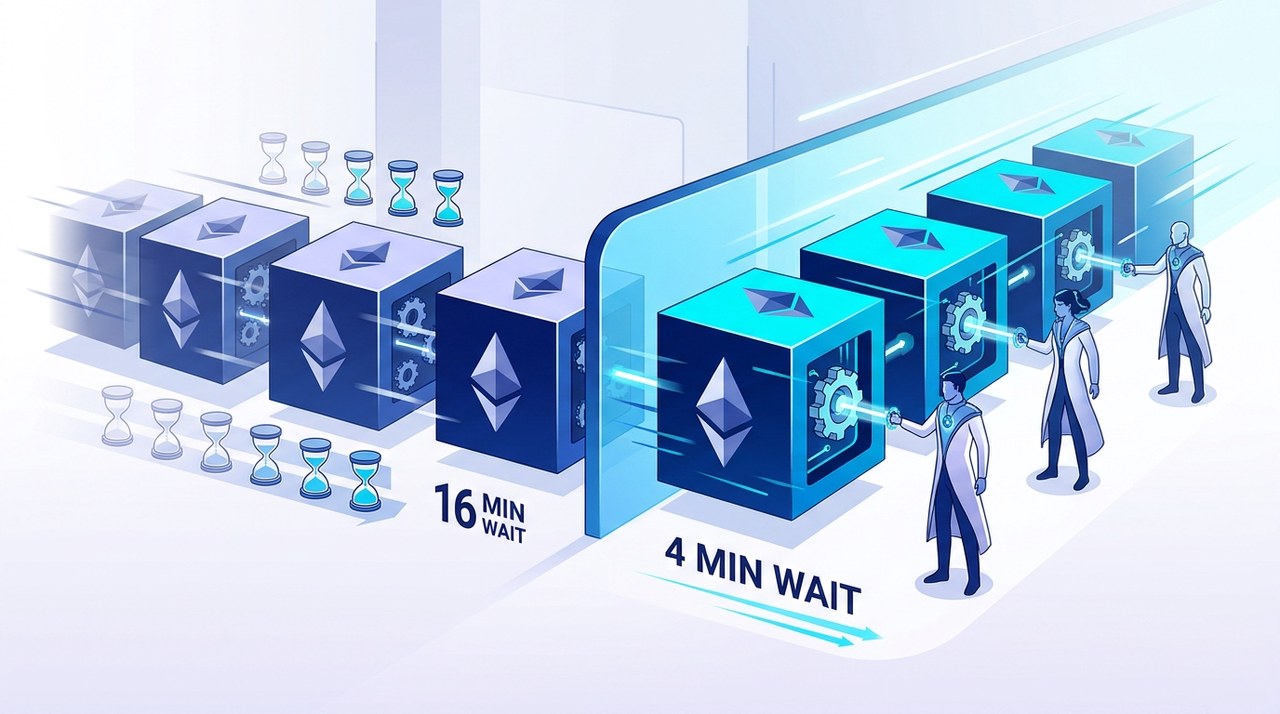
EthereumETH-2.41% Proposes a Fourfold Speed Upgrade
Waiting for a crypto transaction to settle can feel like waiting for water to boil. Right now on the Ethereum network, it takes about 16 minutes for a transaction to reach permanent finality—the point where network validators guarantee a transaction can never be reversed.
To improve this experience, Ethereum Foundation researchers have introduced a new draft proposal aimed at cutting that finality window down to roughly four minutes.
Why Faster Settlement Matters for Cross-Chain Transfers
When users move funds from Ethereum to another network, cross-chain transfer services and bridges usually front the capital so users receive funds right away. However, the service must then wait for the original transaction on Ethereum to finalize before recovering its money.
Holding funds in limbo for 16 minutes creates real financial overhead for these transfer providers. Shorter wait times mean platforms can reuse their capital much faster, reducing liquidity costs.
According to Ethereum Foundation research, a service that fronts $1 million every hour currently keeps about $267,000 locked up awaiting finality. Under the proposed four-minute model, that required capital buffer drops significantly to around $67,000.
Real-World Examples: How Companies Like Circle Adapt
Major industry providers already account for these settlement delays in their fee structures. For instance, Circle—the issuer of the USDCUSDC+0.36% stablecoin—offers a fast route out of Ethereum that charges 0.01% (or $1 per $10,000 transferred) alongside normal network fees, while its standard, slower transfer option carries no added fee.
Circle also sets a strict cap on the total dollar amount of fast transfers pending settlement at any given time. Faster network settlement would allow transactions to clear quicker, opening up capacity for new transfers without running into lockup limits.
Under the Hood: Splitting Validator Duties
To achieve this fourfold increase in settlement speed, researchers are rethinking how Ethereum validators vote.
Under the current system, every validator casts a single vote that performs two separate tasks at once: choosing the next block to add to the chain and locking in older blocks permanently. Because both jobs are linked to a single vote, finality cannot move faster than the standard validator rotation.
The new design splits these responsibilities into two distinct voting mechanisms:
- Block Selection Vote: Keeps block production moving smoothly on its standard schedule.
- Finality Vote: Runs on an independent, faster timeline that developers can optimize over time.
Future Benefits: Preparing for Quantum Security
In addition to speeding up transfers, decoupling validator votes provides a foundation for future security upgrades. Specifically, researchers highlighted that this split makes it much easier to introduce quantum-resistant signatures.
If quantum computing eventually develops enough power to challenge existing cryptographic standards, Ethereum will need to upgrade its underlying signatures. A separated voting architecture simplifies that transition when the time comes.
Industry Comparisons and Next Steps
While reducing settlement time to four minutes represents a major leap forward for Ethereum, it remains slower than some alternative networks. For comparison, SolanaSOL-2.17% recently implemented its Alpenglow upgrade, targeting settlement finality in approximately 150 milliseconds.
The Ethereum proposal was co-authored by fast-finality research coordinator Ben Edgington alongside researchers Francesco D’Amato, Roberto Saltini, Yann Vonlanthen, and Mikhail Kalinin.
The proposal is still an early draft with several unresolved details, including precise vote timing, penalty structures, and comprehensive security analyses. As Edgington noted, many aspects remain to be determined, but obtaining an official proposal number marks the critical first step in entering Ethereum's formal upgrade process.
Past performance of digital assets is not an indicator of future results. Explore live asset data on the ETH market page.
Latest blog posts


XRP Ledger Sees 25,000 Returning Accounts as Activity Jumps
The XRP Ledger experienced a sudden surge in network activity with active accounts rising to 25.7K, though key payment volume metrics paint a mixed picture.
|
SoFi Launches Tokenized Bank Deposit Offering 4.4% Yield
SoFi introduced SoFi Earn (SOFIE), a consumer tokenized deposit offering 4.40% APY with FDIC insurance that easily converts into its stablecoin.
|
Dune Launches Real-Time Data Feeds for Onchain Markets
Dune has launched real-time market feeds covering trade data from over 200 onchain venues across 12 blockchain networks as tokenized assets grow.