

DTCC Brings $30 Trillion Wall Street Assets to Blockchain
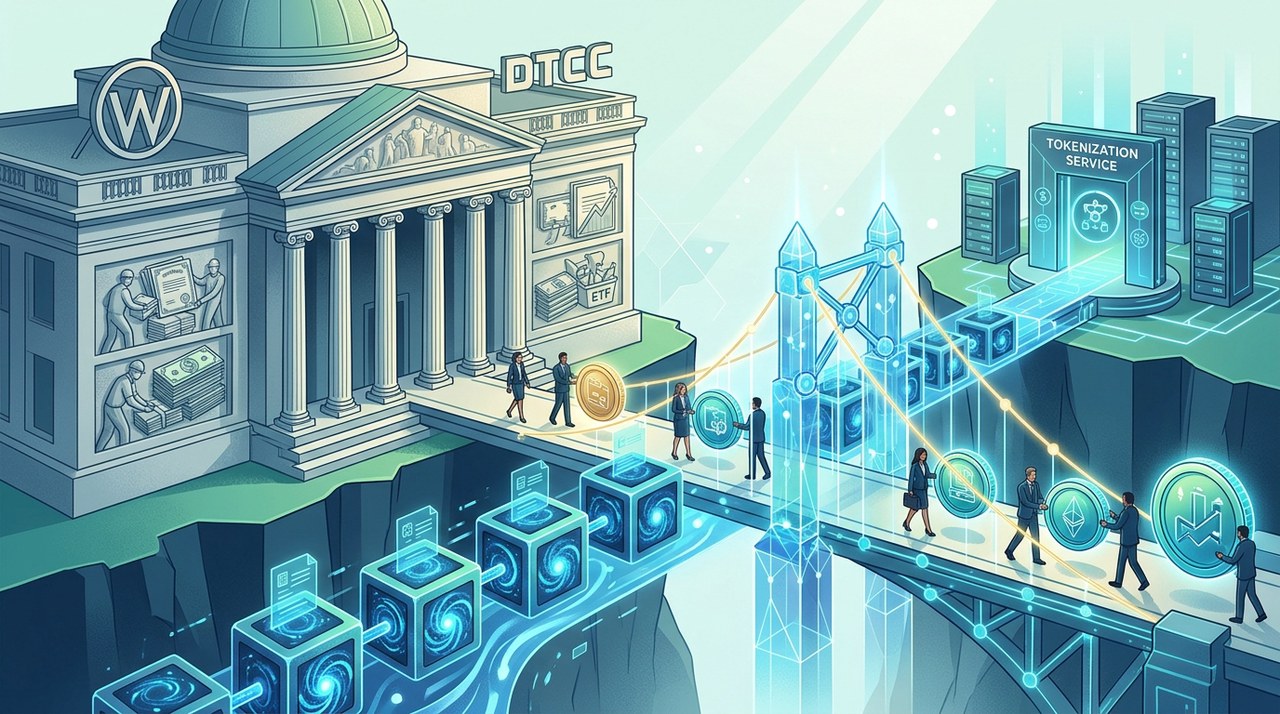
Imagine the massive machine that keeps Wall Street running behind the scenes. Every time someone buys a stock or a government bond in the United States, a central entity handles the clearing, settlement, and record-keeping. That financial backbone is the Depository Trust & Clearing Corporation, better known as the DTCC.
Now, that very same financial titan is taking a massive leap into the world of blockchain technology. DTCC has officially launched its new tokenization service, bringing traditional financial assets onto blockchain infrastructure.
This move connects traditional Wall Street securities directly with public and private distributed ledger networks. It marks one of the most significant steps toward merging conventional finance with modern blockchain tech.
What Assets Are Being Tokenized?
At launch, DTCC’s new service focuses on high-value, highly liquid traditional assets. The platform initially supports 34 eligible securities representing roughly $30 trillion in total market value.
These assets include several major categories of traditional investments:
- Select large-cap U.S. stocks featured in the Russell 1000 index
- Popular exchange-traded funds (ETFs)
- U.S. Treasury bills, notes, and bonds
The tokenization service is operating on two primary blockchain environments at launch: the public Canton NetworkCC-2.76% and DTCC’s private deployment of Hyperledger Besu.
Which Wall Street Giants Are Participating?
A project of this scale requires serious institutional support, and Wall Street’s biggest names have already signed up. Twenty major financial institutions have entered into agreements to access the platform.
The list of early participants includes key global institutions:
- JPMorgan Chase
- Citigroup
- Morgan Stanley
- Bank of America
- UBS
- Barclays
- Fidelity Investments
- Citadel Securities
- State Street
DTCC indicated that additional banks, brokers, and institutional players will join the network over time as operational workflows expand.
How Does the Tokenization Service Actually Work?
Understanding tokenization can sound complicated, but the core setup is straightforward. DTCC acts as the central custodian holding the original physical or electronic securities.
When an eligible institution wants to tokenize an asset, the process works through clear steps:
- Conversion: During regular business hours, approved firms request to mint digital tokens against real securities stored at DTCC's subsidiary, the Depository Trust Company (DTC).
- Speed: DTCC aims to process these conversion requests in 15 minutes or less.
- Backing: Every digital token issued on the blockchain maintains a strict 1-to-1 backing with the underlying security held safely in DTC custody.
- 24/7 Movement: Once minted, these tokens can move between verified, registered blockchain wallets around the clock, subject to regulatory compliance checks.
This setup differs fundamentally from synthetic stock tokens. Synthetic tokens merely track share prices without granting actual legal rights. In contrast, DTCC’s tokens represent direct claims on real underlying securities held in custody, preserving shareholder protections and corporate governance rights.
Why DTCC's Involvement Matters So Much
Many institutions have run limited blockchain pilots over the past decade. However, DTCC is unique because of its central position in global finance. Its subsidiaries hold over $114 trillion in assets in custody.
When DTCC integrates blockchain into its infrastructure, tokenization shifts from a peripheral experiment into core market technology.
Today marks the culmination of years of work to bring tokenized securities into a regulated framework supported by trusted market infrastructure. By extending DTC's resiliency, governance and operational standards into digital markets, we are establishing the foundation for responsible institutional adoption at scale.
That quote from Frank La Salla, President and CEO of DTCC, highlights the goal: giving institutions the speed of blockchain alongside the safety of traditional oversight.
Market Growth Predictions and Industry Impact
Financial research teams view tokenization as a long-term evolution for global capital markets. Analysts at Citi previously projected that tokenized securities could grow into a $5.5 trillion market by 2030.
However, achieving such forecasts depends heavily on factors like regulatory updates, institutional onboarding rates, and technical integration across global borders. If adoption encounters regulatory delays or market downturns, expansion rates could adjust accordingly.
The main benefits driving institutional interest include:
- Faster settlement times, moving closer to real-time execution
- Greater liquidity efficiency by allowing 24/7 transfers
- Improved collateral management for trading and lending
- Reduced administrative friction in corporate actions
Future Roadmap: What Comes Next in 2027?
This initial rollout is just step one in DTCC's broader multi-year strategy. The organization has already outlined upcoming additions scheduled for next year.
In 2027, DTCC plans to expand its network support by integrating StellarXLM+1.40% and Circle Internet’s upcoming Arc blockchain. These additions will widen the choices available to participating institutions.
Furthermore, DTCC intends to launch digital cash tools designed for automated on-chain transaction settlement. They also plan to roll out features that allow institutions to post tokenized securities as collateral instantly.
The Broader Competitive Landscape
DTCC’s service launch follows regulatory clarity established by a U.S. Securities and Exchange Commission (SEC) no-action letter issued last December, which permitted DTCC to tokenize specific asset classes under clear boundaries.
Other major market exchanges are pursuing similar blockchain initiatives. Exchanges such as Nasdaq and the New York Stock Exchange (NYSE) are currently building their own tokenized trading venues.
Meanwhile, Intercontinental Exchange (ICE), the owner of NYSE, is partnering with crypto platform OKX to establish a blockchain-based trading infrastructure under special regulatory sandbox frameworks.
Together, these developments show that mainstream financial rails and blockchain technology are converging rapidly, opening a new era for modern security markets.
Latest blog posts

DTCC Unit Launches Tokenization Services for Securities
DTCC's unit has launched tokenization services, creating a practical path for financial institutions to adopt tokenized securities.


Ripple Forecasts $900M Revenue Run Rate by 2026
Ripple projects its annualized product revenue run rate to hit $900 million by the end of 2026, driven by growing payment volumes and RLUSD adoption.
|


 +1
Crypto Whales Move $10M in PEPE Closing Gap with SHIB
Two long-dormant whale wallets transferred 2.27 trillion PEPE tokens, triggering a 10.8% price jump and closing the market cap gap with Shiba Inu to $1.06 billion.
|