


Dogecoin Devs Defend DOGE's Unique Role in Crypto
What Is the Dogecoin Development Debate About?
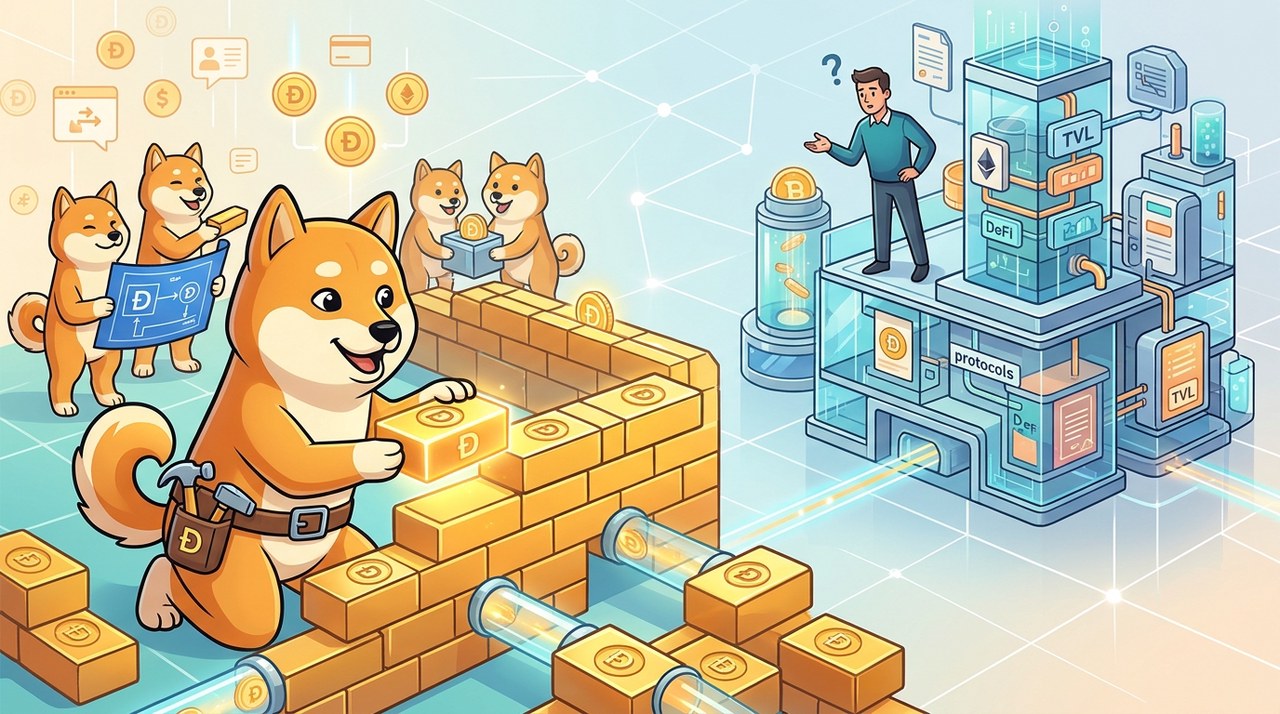
On October 28, 2026, a lively debate erupted across crypto social media regarding Dogecoin and its overall development ecosystem. The conversation began on X when an executive questioned whether enough building is happening on the Dogecoin network.
Buidr J, the Chief Strategy Officer at DogeDOGE+1.60% OS, claimed that despite having over 10 million holders, Dogecoin has almost no active builders compared to its size. This assertion quickly caught the attention of prominent Dogecoin developers and community contributors.
Community members immediately stepped in to defend the original vision of Dogecoin, highlighting that simple peer-to-peer payment networks operate very differently from complex smart contract platforms.
The Numbers: Comparing DOGE, EthereumETH-0.17%, and SolanaSOL+0.34%
To support his argument, Buidr J pointed to statistics around Total Value Locked, commonly known as TVL. In crypto, TVL measures how much capital users deposit into decentralized finance protocols.
At the time of the debate, Dogecoin maintained a market capitalization of $12.3 billion. However, it had roughly $11 million deposited in on-chain financial applications, which represents under 0.1% of its total market cap.
By comparison, Ethereum boasted $46.4 billion in DeFi applications, representing about 16% of its market cap. Solana held $5.7 billion in DeFi, accounting for approximately 10% of its market cap.
Buidr J described this contrast as a 100x gap compared to other major blue-chip digital assets. He claimed that a lack of native on-chain utility limits Dogecoin's ability to build locked value.
Dogecoin Builders Push Back
The claim that nobody builds on Dogecoin stirred up strong reactions from developers who actively maintain the network. Core developer Chromia X responded directly, noting that such statements erase the real work being done behind the scenes.
Dogecoin has a long history of open-source maintenance. Co-creators Billy Markus and Jackson Palmer launched the project in 2013, with Markus acting as a solo developer for early software releases.
After both creators left the project in 2014, a dedicated development team took over maintenance. Today, a group of maintainers continues to coordinate updates and keep the core blockchain secure.
Why Simplicity Is Dogecoin's Greatest Asset
Prominent Dogecoin contributor Mishaboar provided a detailed response explaining why comparing DOGE to Ethereum or Solana misunderstands its purpose.
DOGE was never meant to be Ethereum or Solana. It grew up (for some) with the promise of being a funny decentralized, permissionless currency. Others saw (and still see it) as something worth hoarding.
Mishaboar argued that simplicity is a strength rather than a deficiency. He noted that TVL is not a valid benchmark for measuring how well a currency functions for ordinary users.
Locking tokens into high-risk financial applications can expose everyday users to smart contract exploits and unwanted risks, which does not necessarily make the underlying currency more useful.
What Dogecoin Truly Needs to Succeed
Rather than focusing on speculative applications, Mishaboar outlined what he considers essential for Dogecoin's long-term health and usability:
- Rigorous code reviews: Continuous security audits to keep the core protocol safe.
- Open-source node options: Accessible network infrastructure for anyone running a node.
- Trust-minimized light wallets: User-friendly wallet software vetted by security engineers.
- Privacy protection: User interfaces that respect personal data and financial security.
By prioritizing robust core development over complex financial apps, Dogecoin aims to remain a accessible peer-to-peer digital currency for millions worldwide.
Past performance of digital assets does not guarantee future results. To review market conditions and asset data, visit bitkub.com/th/market/DOGE.
Latest blog posts

Stellar Secures Tokenization Deal with Securitize
Securitize plans to integrate its regulated technology with Stellar, expanding options for tokenized asset management.
|

Ripple CEO Brad Garlinghouse Highlights Crypto Resilience
Despite a quiet October for XRP, Ripple CEO Brad Garlinghouse expressed strong confidence in the crypto industry's long-term momentum during Ripple Swell in New York.
|
Crypto Braces for Shifts in US Congressional Oversight
Following the Clarity Act debate, the crypto sector is preparing for major changes in US Congressional oversight as midterm elections reshape the political landscape.