

Could AI Break the Math Protecting Crypto Wallets?
The Code Protecting Your Crypto
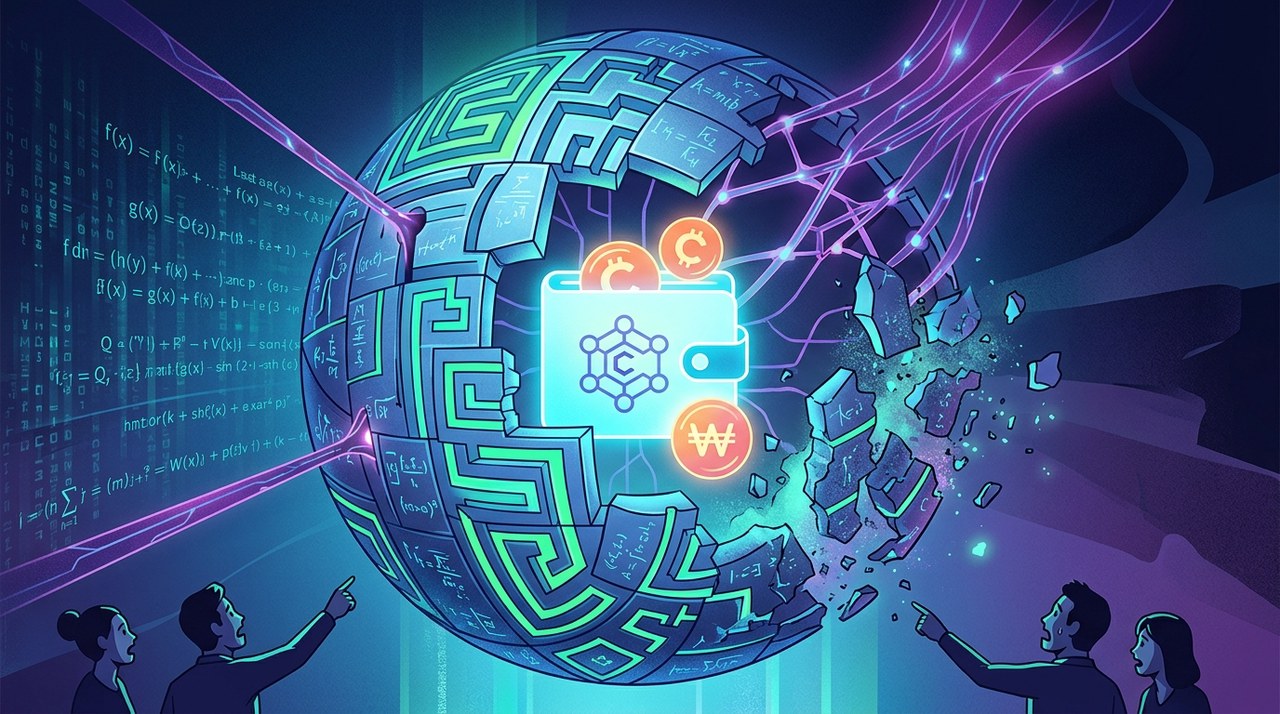
Have you ever wondered what actually keeps your BitcoinBTC+0.88% and EthereumETH-1.38% safe? It is not a digital padlock or a physical vault. It is complex mathematics.
For decades, these mathematical codes have been virtually uncrackable. However, top researchers are now asking an important question: What happens if artificial intelligence finds a shortcut?
If AI learns to solve these math problems faster than humanly expected, the security protecting our crypto wallets might need a major upgrade.
OpenAI's Surprising Math Progress
The recent debate started after a major announcement from OpenAI on October 6. They revealed that an unreleased AI model tackled roughly 4,000 unsolved mathematical problems.
The model generated 722 mathematical manuscripts covering 372 groups of results. While researchers are still evaluating these findings, the sheer volume of output surprised many experts.
This milestone caught the attention of Matthew Green, a respected cryptographer at Johns Hopkins University.
On October 8, 2026, Green shared a blunt thought on social media regarding the future of online security.
I think we might lose public key cryptography.
Green later clarified his statement. He confirmed that he knows of no imminent cryptographic breakthrough that breaks crypto right now.
Instead, his concern is about the long term. Humans have spent decades searching for weaknesses in these math codes. An advanced AI might discover hidden shortcuts that human researchers completely missed.
How AI Could Threaten Bitcoin and Ethereum Wallets
Both Bitcoin and Ethereum rely on a system called elliptic-curve cryptography to protect transactions. This system creates two connected keys for every user: a public key and a private key.
Your public key works like your bank account number, while your private key acts like your secret password.
The underlying math makes it practically impossible to work backward from a public key to figure out the private key. Under normal conditions, a standard computer would need millions of years to guess it.
But if AI finds a much faster mathematical shortcut, attackers could potentially recover private keys and steal funds.
Bitcoin wallets with exposed public keys would be particularly vulnerable. Ethereum accounts that have signed past transactions could face similar risks.
This issue extends far beyond digital assets. The exact same public-key encryption protects online banking, secret messages, and secure internet browsing.
Understanding Security Bits and Math Weaknesses
Modern cryptographic systems are designed around extremely high security standards. Most standard setups target what experts call 128-bit security.
Green suggested AI-driven discoveries might reveal that systems believed to offer 128-bit security actually provide only 96 or 108 bits.
That drop might sound small, but every bit represents exponential strength. A reduction of 20 bits makes breaking an encryption code roughly one million times cheaper for an attacker.
Even with that reduction, pulling off a real-world attack could still be far too expensive for practical use.
One obvious fix is to increase key sizes to make the math harder again. However, Green pointed out a practical dilemma.
But crank them up to what?
Without knowing how powerful AI math shortcuts will become, security experts will struggle to decide how large those key sizes need to be.
Is Post-Quantum Cryptography Safe?
Many developers expected quantum-resistant algorithms to protect us from future computing threats. In 2024, the US National Institute of Standards and Technology (NIST) approved new post-quantum standards.
These new algorithms, including ML-KEM and ML-DSA, rely on complex lattice-based mathematics rather than traditional elliptic curves.
However, if AI proves capable of solving complex mathematical problems, it might find shortcuts against lattice math as well. If that happens, planned industry upgrades may require further changes.
Industry Leaders Push Back with Alternative Solutions
Not everyone in the crypto industry views the threat with the same urgency. Adam Back, CEO of Blockstream, described the warning as "dubious."
Blockstream researchers have already been developing alternative defenses, such as SHRINCS. This is a hash-based signature system built on SHA-256 mathematics.
SHRINCS features compact signatures starting at just 324 bytes and has been demonstrated on Bitcoin's Liquid sidechain.
To adopt this technology on the main Bitcoin network, developers would need to approve a soft fork or protocol upgrade.
It is also worth noting that hash-based signatures cannot directly replace public-key encryption and key exchange. They are mainly used to sign transactions.
How Investors and Experts Are Reacting
Despite differing opinions, some industry veterans are taking early precautions. Charles Edwards, founder of Capriole Investments and member of the BeInCrypto Market Intelligence Expert Council, shared his approach.
Edwards stated that he has stopped using decentralized finance (DeFi) protocols altogether. He has also consolidated his funds into fewer wallets and accounts.
If AI compromises mainstream encryption in any way, there will be chaos.
As of today, there is no publicly demonstrated AI attack capable of breaking Bitcoin or Ethereum's core cryptography.
The ultimate question is whether the blockchain industry can upgrade its mathematical security fast enough if AI eventually finds a real vulnerability.
Latest blog posts


Money Market Funds Grab $166 Billion: Why Investors Fled
A massive $166.4 billion rushed into money market funds in one week as surging bond yields spooked traditional and crypto markets alike.
|


DWF Labs Subsidiaries Sue BitGo for $141 Million Over Token Lock-Up
DWF Labs subsidiaries are suing crypto custodian BitGo in London, claiming broken lock-up terms caused major token price crashes.
|

F2Pool Co-Founder Swaps $19M Bitcoin for Ether
A wallet linked to F2Pool co-founder Wang Chun swapped 235.5 WBTC for 7,848.5 ETH following a recent market pullback.
|