


Bitcoin Price Slips to $81,500 as Hot Inflation Hits
Bitcoin Price Slippage: What Happened on October 14?
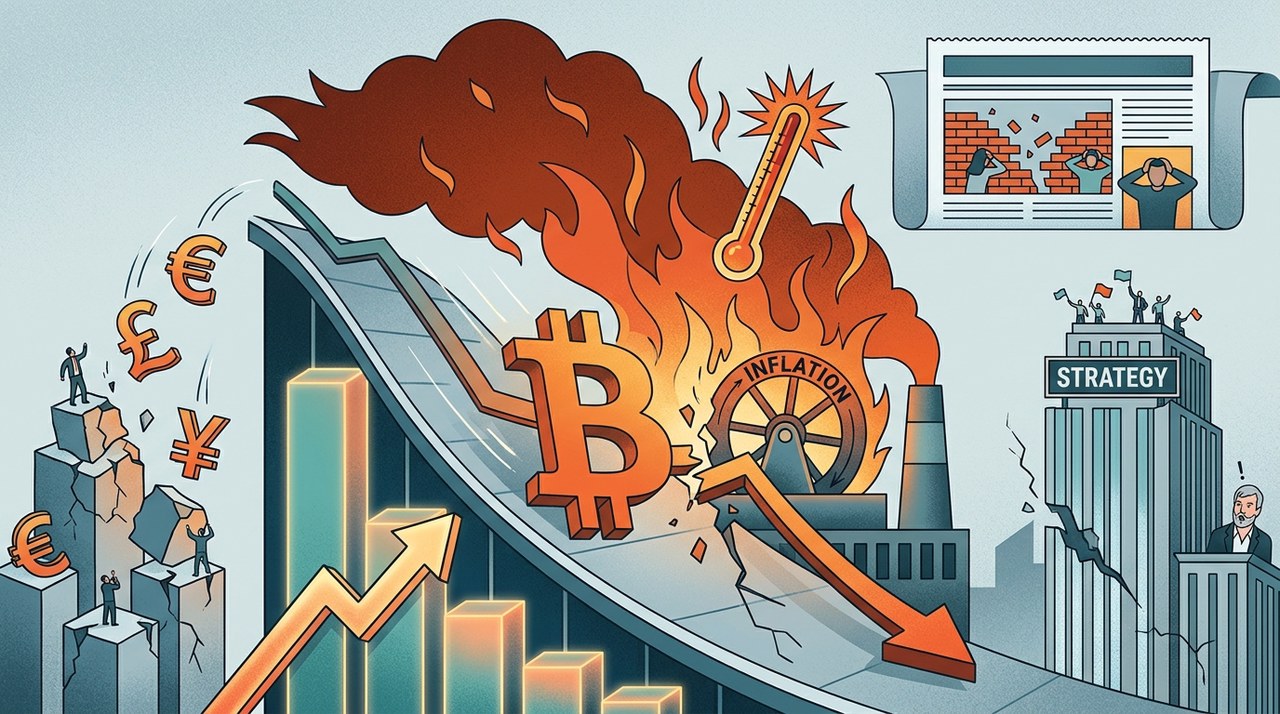
Bitcoin experienced a sudden drop on Wednesday, October 14, 2026, falling to an intraday low of $81,500 per coin. The drop was sparked by fresh U.S. inflation data that came in higher than expected, rattling both traditional and digital asset markets.
This unexpected dip shook financial markets and triggered a wave of forced liquidations across trading platforms. Over $331 million in derivative positions were wiped out within a 24-hour window.
The sell-off happened just one day after Strategy Chairman Michael Saylor announced that the crypto bear market was officially over. The sudden price drop highlighted the ongoing tension between long-term institutional optimism and short-term macroeconomic realities.
Why Higher U.S. Inflation Impacted Crypto Prices
The main driver behind Wednesday's market reaction was the September U.S. Consumer Price Index (CPI) report. The data showed annual inflation rising to 3.7%, beating economists' forecasts of 3.6% and increasing from August's 3.4% reading.
Core inflation, which excludes volatile food and energy costs, also came in hotter than anticipated. This complicated expectations for future monetary policy, raising concerns that the Federal Reserve might keep interest rates higher for longer.
When inflation runs hot, central banks typically maintain tight monetary policies. This pushes up yields on traditional risk-free assets and strengthens the U.S. dollar, making risk-on investments like cryptocurrencies less attractive in the short term.
Following the CPI release, traditional equity and commodity markets felt immediate pressure:
- The 10-year U.S. Treasury yield climbed toward 5.3%.
- The S&P 500 index declined by approximately 1%.
- The Nasdaq Composite dropped over 1%, putting renewed pressure on tech stocks.
- Crude oil prices hovered near $95 per barrel, adding another inflationary headache.
Bitcoin broke from the mid-$83,000 range shortly after the release, touching $81,500 before pulling back slightly toward $81,950. By 1:30 PM Eastern Time, Bitcoin traded at $81,758 per coin, eventually sitting near $81,555 by 1:51 PM EDT. EthereumETH-2.72% also fell by 2.73%, trading around $2,430.
Unpacking the $331 Million Liquidation Cascade
When price drops happen abruptly, traders using high leverage—borrowed funds used to magnify trade sizes—often face forced sell-offs. As Bitcoin broke through key support levels between $82,000 and $83,000, automated liquidations compounded the downward momentum.
According to data from Coinglass, approximately $331.03 million in crypto positions were liquidated over a 24-hour period. A massive $288.32 million of those liquidations took place within just a 12-hour span.
Nearly 88,886 individual traders had their positions forcibly closed. Bullish traders holding 'long' positions—bets that prices would rise—absorbed roughly 82% of total losses.
Here is how liquidations spread across major digital and traditional trading assets:
- Bitcoin (BTCBTC-1.53%): $69.95 million in total liquidations (80.9% long positions)
- Ethereum (ETH): $64.33 million in total liquidations (82.6% long positions)
- Silver derivatives (XAG): $16.86 million in total liquidations
- Zcash (ZEC): $12.17 million in total liquidations
- SolanaSOL-2.91%: $12.06 million in total liquidations
- Gold derivatives (XAU): $8.72 million in total liquidations
Binance represented roughly 49% of all exchange liquidations. The single largest individual wipeout occurred on Binance, involving a $7.03 million ETHUSDT long position.
Michael Saylor's Bull Market Call vs. Market Reality
The timing of this downturn created a noticeable contrast. On October 13, during a Bloomberg Television interview at DC Fintech Week, Strategy Chairman Michael Saylor stated that Bitcoin's bear market had officially ended.
We think we're at the beginning of a bull market. I think we hit the bottom around slightly below 60,000. I think we bounced off it. Now, we are moving up into the 80s. I think we will march forward from here.
Saylor outlined a long-term perspective where Bitcoin could eventually reclaim $100,000 and achieve an average annual growth rate of 20% to 30% over the next two decades. His optimism relies on expanding institutional adoption, clearer U.S. regulations, bank participation, and digital credit market expansion.
It is worth noting that long-term price targets depend on specific market conditions. For Saylor's outlook to come to pass, continuous institutional capital inflows and favorable macroeconomic policies would be required. Conversely, if high interest rates persist or capital leaves the market, prices could face renewed downside pressure instead.
Prediction markets currently express a more conservative view, showing low probability for Bitcoin reaching six-figure levels in 2026. Nevertheless, Strategy remains committed to accumulating Bitcoin, maintaining total holdings of 848,250 BTC.
Key Technical Support Levels and Future Outlook
Bitcoin currently trades roughly 35% below its October 2025 all-time high of over $126,000. Past performance of digital assets is not a guarantee of future returns. You can view current market prices on Bitkub Market.
In the short term, traders view the $81,000 to $82,000 area as a critical support region. A sustained move below $81,000 could trigger further forced selling, whereas recovering above $83,000 would allow buyers a chance to rebuild upward momentum.
Bitcoin also faces ongoing headwinds from softer ETF inflows, persistent selling pressure, and competing yields from traditional bonds. Meanwhile, major industry custodial players like Coinbase—which protects roughly 5% of all circulating Bitcoin—continue working on long-term infrastructure and quantum security risks.
While long-term advocates view price dips as minor fluctuations within a larger adoption trend, active traders remain mindful of short-term volatility as macroeconomic data continues to drive daily price movements.
Latest blog posts

Standard Chartered Opens Crypto Trading in UAE
Standard Chartered now allows wealthy clients in the UAE to trade Bitcoin and Ethereum directly from their bank accounts under VARA regulation.
|
Bitmex Faces $26M Claim Over 1,053 Losing Bitcoin Trades
A British software engineer is suing Bitmex to recover $26 million in lost Bitcoin trades, claiming the exchange lacked UK regulatory approval.
|
OCC Report Mentions Crypto Debanking alongside Energy Sector
A new report from the US banking regulator highlights debanking efforts tied to crypto, oil, gas, and firearms, though specific examples were omitted.