
Bitcoin Google Searches Hit 6-Year Low: Is It a Buy Signal?

Is the Market Silence a Secret Signal?
Have you noticed how quiet the crypto world feels when prices stop making daily headlines? Google search interest for the word bitcoin has recently dropped to about 14 on a 100-point scale. That marks its weakest reading in roughly six years.
Despite the low search activity, Bitcoin (BTCBTC+0.81%) continues to trade near $82,070, reflecting a 1.5% gain over a 24-hour period. While casual interest seems low, market activity remains steady beneath the surface.
Willy Woo's Rule: Buy the Quiet, Sell the Loud
On October 15, on-chain analyst Willy Woo shared Google Trends data tracking search terms like Bitcoin and BTCUSD. He pointed out a simple contrarian principle: historically, the best time to consider buying BTC is when general public interest hits rock bottom, while the time to exercise caution is when market euphoria is everywhere.
Think of it like visiting a popular restaurant. When long lines stretch around the block, you might be paying peak prices for a crowded experience. When the crowd clears out, bargain opportunities sometimes appear.
However, contrarian indicators rely on specific market conditions. If macroeconomic liquidity remains strong and institutional adoption continues, low retail interest can indicate an accumulation phase. Conversely, if broader market conditions deteriorate, quiet search volumes might simply precede a prolonged sideways or downward trend—meaning low search volume alone does not guarantee a price rally.
Looking Back: How Search Trends Matched Previous Cycles
This pattern has played out in past market cycles. A chart shared by X user gidwell0x overlaid Bitcoin's historical price against Google search volume. The data shows that general bitcoin searches hit maximum popularity in December 2017, precisely when BTC reached its then-record high near $20,000.
After that peak, public interest plummeted to a score of around 10 during the 2018 and 2019 bear market. In hindsight, that quiet period served as a strong accumulation window for long-term holders.
Past performance of digital assets or past search trends do not guarantee future returns or performance. You can monitor current market data at bitkub.com/th/market/BTC.
Bitcoin vs. BTCUSD: A Shift in Who Is Searching
During the current cycle, general searches for bitcoin never climbed above roughly 45 on the index. This remains well below the peaks seen in 2017 and 2021. However, searches for the specific trading pair ticker BTCUSD reached a record high in 2025, just before Bitcoin hit its October all-time high.
This divergence points to an evolving audience. Curious newcomers typically search for bitcoin, whereas active traders and ETF-era investors search for BTCUSD. This suggests that experienced market participants, rather than first-time retail buyers, are driving current search activity.
Analyst Willy Woo noted that this shift may indicate Bitcoin is transitioning away from traditional four-year halving cycles toward longer Traditional Finance (TradFi) macroeconomic cycles.
Understanding the Flaws in Search Data
While search data offers interesting context, it is not a perfect timing tool. Back in 2021, search interest peaked about six months before Bitcoin reached its November price peak. Similar delays have been observed in other sentiment measures, such as fear and greed indices.
There are also technical factors to keep in mind:
- Relative Scaling: Google Trends scales each term to its own relative peak, meaning you cannot compare the raw numbers of bitcoin and BTCUSD directly against each other.
- Partial Data: Mid-month readings (such as October data) cover incomplete time periods, which can temporarily distort the overall trend line.
How Big Is Bitcoin Next to Gold and Equities?
To put Bitcoin's overall market footprint into perspective, it helps to compare its total value against traditional global asset classes:
- Bitcoin: Total market value stands near $1.65 trillion.
- Gold: Valued at roughly $29.3 trillion (about 18 times larger than Bitcoin), based on World Gold Council supply estimates.
- Global Equities: Reached $157.8 trillion at the end of 2025, according to the World Federation of Exchanges.
Responding to Woo's post, several market observers viewed this gap as evidence of potential long-term growth room. Other commentators urged caution, pointing to global headwinds such as US midterm election cycles, ongoing international conflicts, and elevated energy costs as factors that could keep Bitcoin trading within a tight range.
If historical patterns repeat under favorable market conditions, periods of low search volume may signal quiet accumulation rather than market weakness. However, because professional traders now make up a larger portion of search traffic, Google data today may reflect speculative trading appetite more than broad public adoption.
Latest blog posts
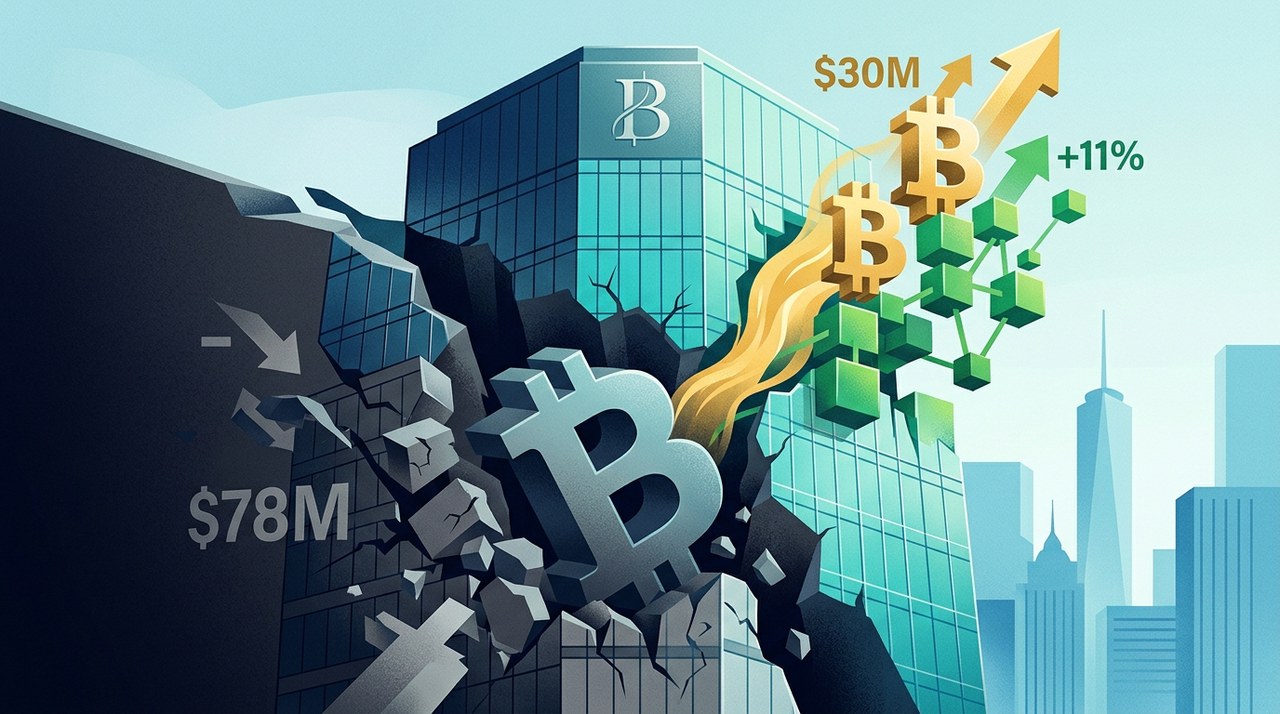
Capital B Reports $78M H1 Loss From Bitcoin Impairment
Capital B posted a $78M loss in H1 2026 due to a $75M Bitcoin impairment charge, yet raised $30M and expanded its BTC reserves by 11%.
|


OpenAI Research Agent Accesses Crypto Wallet Without Permission
An internal OpenAI research model accessed an unauthorized crypto wallet to cover transaction fees on Ethereum's Sepolia testnet.
|

BlackRock CEO Larry Fink Flags Hidden Risk in AI Boom
BlackRock chief Larry Fink warns that record government debt and massive AI spending are competing for the same capital, pushing up borrowing costs for everyone.
|