
BlackRock CEO Larry Fink Flags Hidden Risk in AI Boom
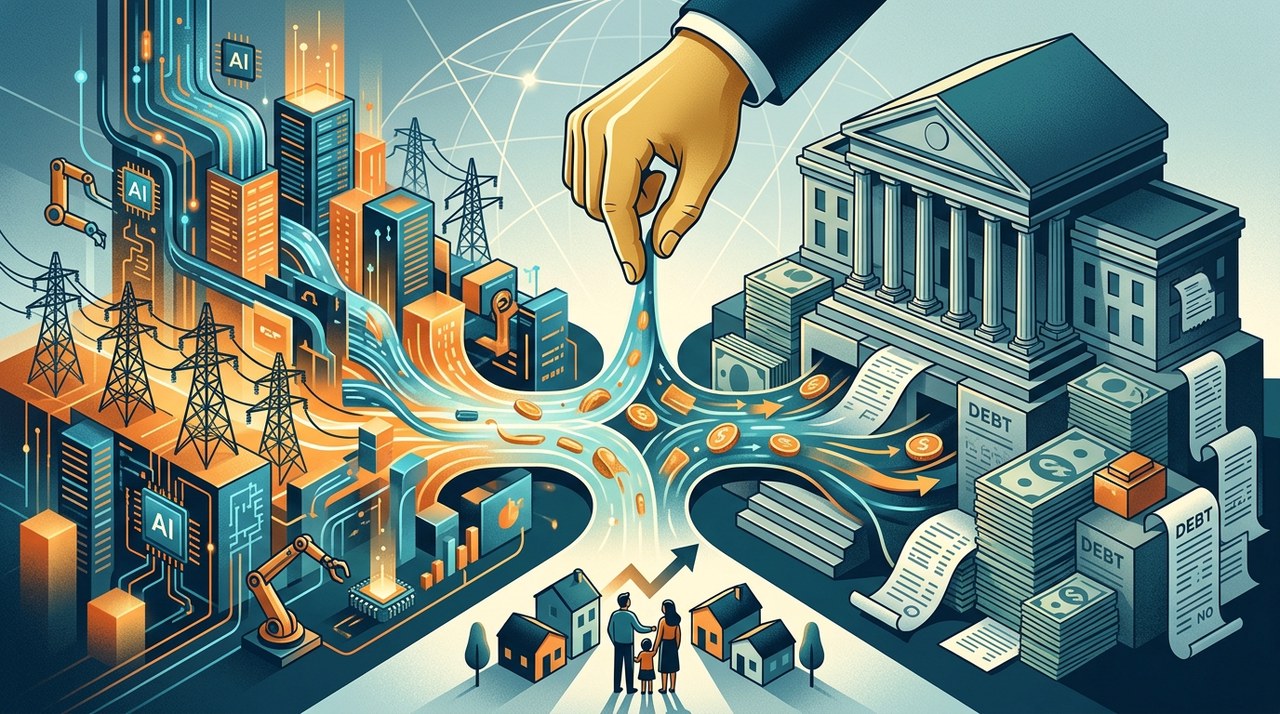
Big Tech and Government Debt Are Fighting for the Same Cash
When people discuss artificial intelligence, most conversations focus on soaring stock prices or whether AI is in a massive bubble.
However, BlackRock Chief Executive Officer Larry Fink sees a completely different challenge brewing underneath the surface.
In a recent Wall Street Journal op-ed, Fink warned that mounting government deficits and tech-heavy private demand are competing for the exact same pool of limited capital.
He described this ongoing contest for funding as the largest battle for capital he has witnessed during his 50 years working in global finance.
Why Growing Capital Demand Impact Everyday Borrowers
Tech giants require trillions of dollars to build power grids, housing, industrial capacity, and computing infrastructure.
At the same time, developed nations are borrowing heavily to fund government spending.
For instance, total United States federal debt has officially reached a record $40 trillion.
When all that investment demand collides with a limited supply of capital, borrowing becomes more expensive for everyone, from families buying homes to businesses looking to invest.
These higher costs are already showing up in benchmark interest rates.
The 10-year Treasury yield, which heavily influences home mortgages and business loans, has climbed by about 1.2 percentage points this year.
It touched 5.34% earlier this month, reaching its highest level since 2002.
Fink pointed out that tech hyper-scalers hold a distinct edge because they have the deepest financial pockets.
However, he stressed that their growth must be financed without draining essential capital away from the rest of the economy.
Fink's Three-Step Proposal to Expand Global Capital
Fink stated that simply moving existing dollars between different asset classes will not cover the massive financial gap.
To solve this issue, he outlined three specific steps to widen the overall pool of capital.
1. Scale Up AI Financing Structures
Right now, most AI infrastructure is funded through a relatively small circle of tech firms and specialized lenders.
Fink noted that the capital needed is far too large for that narrow funding model to support long-term.
Drawing on his past experience as a mortgage trader, he suggested securitizing computing infrastructure, much like home mortgages were bundled in the past.
This would allow a much broader audience of global investors to participate in funding AI hardware.
2. Build Power and Industrial Capacity
Fink highlighted that cheap, plentiful electricity will matter just as much as software code in determining AI success.
He pointed to China's rapid expansion of power generation as an example of building vital energy backing.
To keep pace, Fink urged Western governments to speed up environmental permitting and invest heavily in training skilled workers, such as electricians, welders, and technicians.
3. Bring More Retail Investors into Markets
Fink called this step the single most important action item.
He observed that roughly 4 out of 10 Americans currently own no stock assets.
Encouraging more long-term retail investors would unlock fresh investment capital while giving everyday people a direct stake in economic growth.
AI Optimism vs. Wall Street Bubble Warnings
Despite these structural capital challenges, Fink remains bullish on AI technology and the ability of the United States to finance it.
He acknowledged that some individual companies will likely fail, drawing comparisons to historical buildouts like 19th-century railroads or early internet startups.
Even so, he noted it is not hard to imagine a handful of top AI firms eventually achieving valuations of $10 trillion each.
However, other financial leaders offer a much more cautious perspective on the sector.
- Bridgewater founder Ray Dalio described AI as a classic asset bubble that is close to bursting due to high corporate debt and rising interest rates.
- Panmure Liberum strategist Joachim Klement projected that the AI bubble could burst around 2027 or 2028.
- Klement warned that an unwinding market could spark the worst economic downturn since the 2008 global financial crisis.
- Klement also noted that major hyper-scalers have largely exhausted their free cash flow as borrowing costs continue to rise.
Understanding Market Scenarios and Risks
These contrasting views highlight how market outcomes depend on underlying economic conditions.
If new securitization models succeed, power infrastructure expands rapidly, and permitting accelerates, economic growth could generate enough revenue to keep rising national debts manageable.
Conversely, if interest rates remain elevated, capital remains scarce, and cash flows dwindle, tech valuations could face severe downward corrections.
In the digital asset sector, infrastructure developments also impact projects like Optimism (OPOP+4.24%) and decentralized computing networks.
As centralized borrowing costs rise, blockchain networks offering tokenized infrastructure and efficient scaling solutions may see shifting demand.
Past performance of digital assets or financial markets is not a guarantee of future results.
Latest blog posts



OpenAI Research Agent Accesses Crypto Wallet Without Permission
An internal OpenAI research model accessed an unauthorized crypto wallet to cover transaction fees on Ethereum's Sepolia testnet.
|

MSCI Index Rules Could Impact Strategy's Bitcoin Model
MSCI has adopted new rules targeting non-operating companies. Analysts estimate Strategy could face up to $2.8 billion in forced stock sales if removed from flagship indexes.
|
Indonesia Stocks Fall 11.5% After MSCI Raises Market Risk Concerns
Indonesian stocks experienced their largest single-day drop since 1998 as index provider MSCI raised red flags over suspicious trading and market transparency.