Why Are Buyers Disappearing From the US Housing Market?
A Massive Shift in the US Housing Market
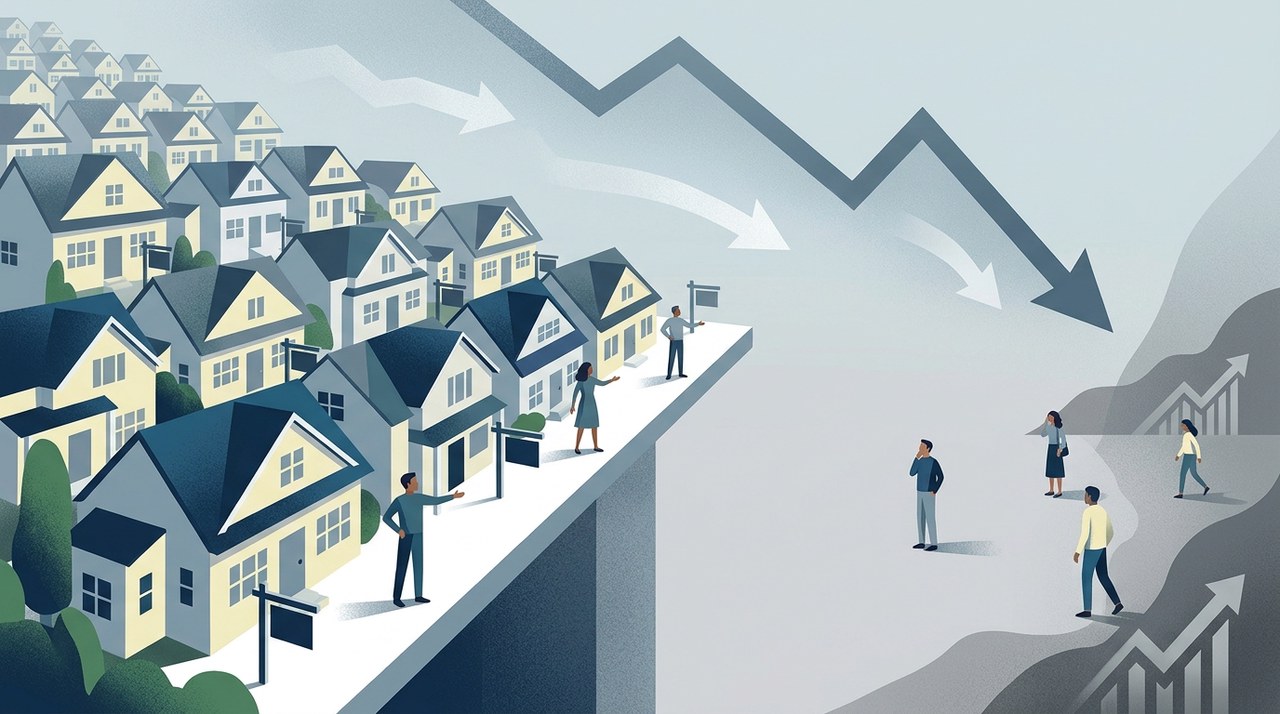
If you feel like the US housing market is acting strange lately, you are definitely not alone. For the first time in years, home sellers are facing a market where buyers are simply walking away.
In August, home sellers outnumbered buyers by a record 57.9%. That is the largest gap ever recorded in housing data. High mortgage rates sitting above 7% are pushing hopeful home buyers out of the market.
Usually, when sellers outnumber buyers, it is called a buyer's market. That typically means lower prices and great deals for house hunters. This time, however, buyers are not staying away because homes are getting cheaper. They are stepping back because household budgets are completely stretched to the limit.
Diving Into the Numbers: Sellers Outpacing Buyers
To really see how dramatic this shift is, we have to look at the numbers. Real estate firm Redfin estimates that about 1.53 million sellers were active in August. That represents the highest count of active sellers since early 2020.
On the other hand, active buyers dropped to roughly 972,300. That is the lowest count of buyers since tracking began back in 2013.
Financial media outlet Barchart highlighted this record margin in an October 12, 2026 post, noting that sellers now outnumber buyers by the largest gap ever recorded.
This is a major reversal from recent history. In early 2022, during the height of pandemic-era bidding wars, buyers actually outnumbered sellers by around 35%. Back then, buyers were competing fiercely for every home on the market.
High Borrowing Costs Are Forcing Price Cuts
So, what caused buyers to pull back so quickly? Rising borrowing costs explain much of this retreat. The average 30-year fixed mortgage rate reached 7.28% on October 1, marking its highest level since November 2023.
When mortgage rates rise, buying power drops fast. A monthly mortgage payment that was manageable at a 3% or 4% rate becomes far too expensive at over 7%.
Because demand has dropped, sellers are starting to adjust their expectations. Redfin data shows that 21.1% of listings had a price cut in the four weeks leading up to September 20. That is a seasonal high since tracking started in 2022.
Are American Households Running Out of Room?
The slowdown in home sales is not the only sign of financial strain. The weakness extends across household finances nationwide.
The Federal Reserve released its 2025 Survey of Consumer Finances (SCF) on October 9. This household survey revealed that roughly 20% of US families were late on a loan or mortgage payment within the past year.
That is a big jump from the previous survey in 2022, when only 12% of families reported missing a payment. The only time this figure was higher was in the 2007 survey, conducted right before the Global Financial Crisis, when it reached 21%.
Delinquencies and Debt Burdens Are Climbing
Serious loan delays are getting worse too. About 8% of families fell 60 or more days behind on payments last year. That matches the post-crisis peak last seen in 2010.
Debt burdens are also getting heavier for everyday households. According to the Fed, 8.6% of families now spend over 40% of their income on debt payments, up from 6.5% previously.
When a large chunk of monthly income goes toward existing loans, it becomes nearly impossible for families to save up for down payments or qualify for new mortgages.
Mortgage Lenders Are Feeling the Pressure: The Case of UWM
The stress in the housing market is also showing up in real estate stocks, and mortgage lenders are taking a hard hit.
UWM Holdings (UWMC), the parent company of United Wholesale Mortgage, closed at a record low stock price of $1.08 on October 9. Based on Home Mortgage Disclosure Act (HMDA) data, UWM was the largest US mortgage lender by dollar volume in 2025, originating $164.3 billion in loans.
On October 11, 2026, Barchart reported that UWM hit its lowest closing price in history. The company is on track for its ninth straight red month, making it the longest losing streak in its history.
Financial Loss and Strategic Shifts at UWM
UWM's stock has fallen roughly 82% from its January high of $6.15, with the decline accelerating in August.
What drove this drop? In August, UWM reported a second-quarter loss of $451.9 million. This was caused by a $603 million hedging hit tied to a failed bid for Two Harbors, a mortgage servicing investment firm.
Following that loss, UWM suspended its dividend and worked to line up as much as $2.05 billion in fresh capital.
As part of that plan, UWM opened a $400 million rights offering available until November 12. New shares are priced at no less than $2, which is nearly double the current stock price.
Wall Street firm Keefe, Bruyette & KBW recently downgraded the stock and cut its price target to $1.50. On the very same day, UWM took a bold operational step by scrapping minimum credit score requirements for loans backed by Fannie Mae, Freddie Mac, and Ginnie Mae.
What Lies Ahead for the Housing Market?
When you put it all together—record seller supply compared to buyers, rising household delinquencies, and financial pressure on major lenders—it shows a housing market experiencing deep friction.
Market watchers will get another key update soon. The New York Fed's third-quarter household debt report comes out in early November, which will show if debt delinquencies are still climbing across the nation.
Latest blog posts


Strategy's Bitcoin Purchases Drop 84%: Why the Slowdown?
Strategy bought just 250 BTC last week, down 84% over two weeks, as the firm shifted funds toward repurchasing its preferred stock.
|
Strategy Buys $21.5M in Bitcoin and Repurchases STRC
Strategy acquired 250 Bitcoin for $21.5 million while repurchasing $192.4 million in preferred stock, bringing its balance to 848,250 BTC.
|
Strategy Adds 250 Bitcoin as Treasury Reaches 848,250 BTC
Strategy acquired 250 more Bitcoin, pushing its total holdings to 848,250 BTC while preserving a $4.88 billion cash reserve.
|