
What is Peaq Network (PEAQ)?
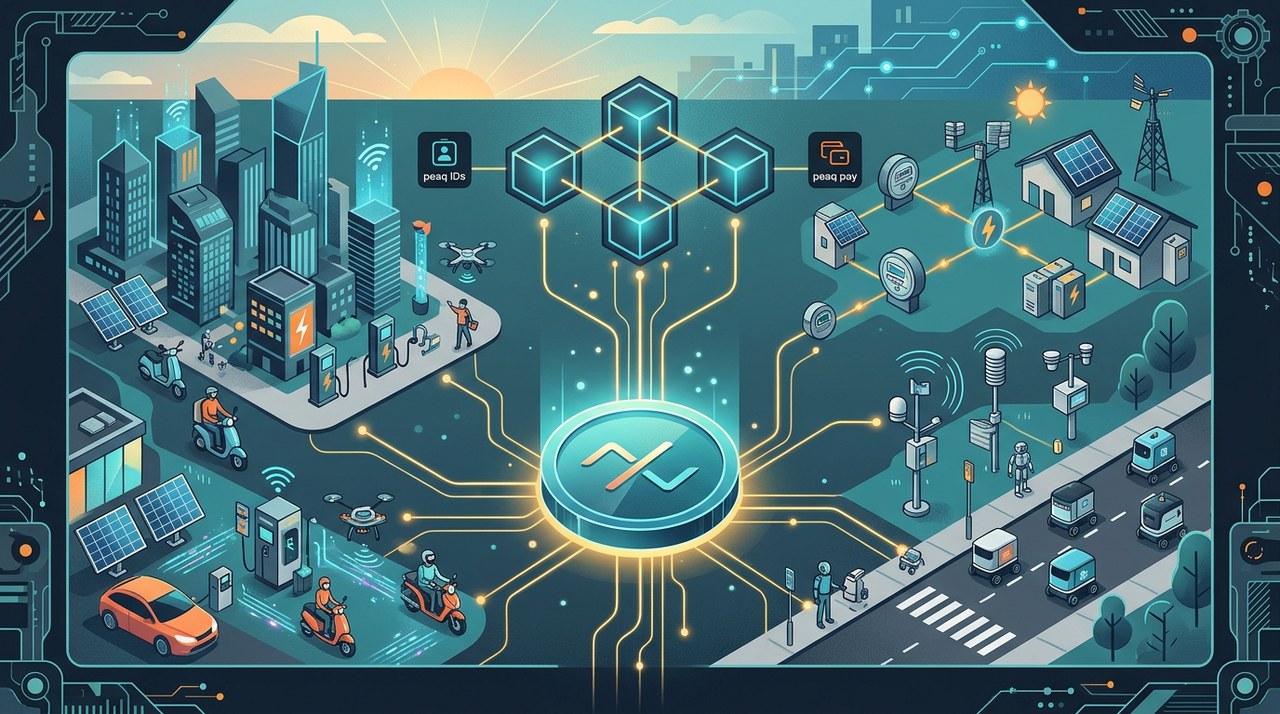
- PeaqPEAQ+0.00% Network is a purpose-built Layer-1 blockchain engineered for Decentralized Physical Infrastructure Networks (DePIN) and the Machine Economy.
- Offers modular DePIN functions including peaq ID (machine identity), peaq pay (micro-transactions), and peaq access (permission management).
- Supports both EVM and WASM smart contract environments with cross-chain compatibility via protocols like LayerZero and Wormhole.
- Powers real-world application cases spanning smart mobility, decentralized energy grids, environmental sensing, and autonomous device fleets.
- The PEAQ token provides utility for transaction gas fees, validator network staking, machine registration, and decentralized governance.
Introduction: What is PEAQ?
The rapid advancement of Web3 technology has traditionally focused on digital-native applications such as decentralized finance (DeFi), non-fungible tokens (NFTs), and blockchain gaming. However, a major technological shift is occurring as decentralized networks move beyond virtual assets into the physical world. This paradigm shift is known as Decentralized Physical Infrastructure Networks (DePIN), and at the forefront of this transformation is Peaq Network (PEAQ).
Peaq Network is a high-performance Layer-1 blockchain specifically engineered to power DePIN applications and the Machine Economy—often referred to as the Economy of Things (EoT). Unlike general-purpose Layer-1 blockchains that cater broadly to general smart contracts, Peaq is tailored specifically to meet the unique hardware, scaling, and data requirements of connected physical devices.
From electric vehicle charging stations and autonomous delivery drones to environmental sensors, smart solar panels, and decentralized wireless nodes, Peaq enables real-world machines to become autonomous economic agents. Through Peaq, physical devices can securely identify themselves, communicate peer-to-peer, render services, and process micro-payments directly on-chain without relying on centralized cloud providers or intermediaries.
History and Background of Peaq Network
The vision for Peaq originated from EoT Labs, a research and development organization founded by Till Wendler, Leonard Dorlöchter, and Max Thake. Recognizing that traditional Internet of Things (IoT) platforms suffered from severe centralization, privacy vulnerabilities, vendor lock-in, and high overhead costs, the founders envisioned an open, decentralized infrastructure layer built specifically for machine interactions.
Development of the Peaq framework began several years prior to the mainstream popularity of DePIN. The founding team initially leveraged the Substrate framework within the Polkadot ecosystem due to its modularity, cross-chain messaging capabilities, and high scalability. Over time, Peaq expanded its architecture to support multi-chain ecosystems, ensuring full EVM (Ethereum Virtual Machine) compatibility alongside WASM (WebAssembly) smart contract capability.
Throughout its growth phase, Peaq established strategic partnerships with leading automotive manufacturers, telecom pioneers, smart-city initiatives, and pioneering DePIN projects such as Silencio, MapMetrics, and Natix. To refine its network economics and test machine-to-machine interactions under realistic conditions, the team introduced its canary network, Krest, before launching the primary Peaq Layer-1 mainnet.
How Peaq Network Works: Technical Architecture Explained
To support millions of connected devices executing frequent micro-transactions, a blockchain must deliver high transaction throughput, minimal latency, negligible gas fees, and robust cryptographic identity verification. Peaq achieves this through a modular Layer-1 architecture built specifically for machine infrastructure.
1. Core DePIN Modular Functions (peaq Palette)
Peaq provides developers with pre-built modular functionalities—known as DePIN Functions—that eliminate the need to reinvent fundamental IoT blockchain logic from scratch. Key functions include:
- peaq ID (Self-Sovereign Machine Identities): Assigns a unique cryptographic identity (DID - Decentralized Identifier) to every physical device on the network. This allows hardware to prove its authenticity, ownership, and operational history on-chain.
- peaq access (Access Control): Enables secure permission management, allowing machine owners to determine who can operate, access, or consume data from a connected device.
- peaq pay (Micro-Payments Engine): Facilitates frictionless, peer-to-peer machine-to-machine (M2M) and human-to-machine payment processing with negligible transaction fees.
- peaq verify (Data Verification): Employs cryptographic attestations and zero-knowledge proofs to verify that real-world data generated by sensors and hardware has not been tampered with before reaching the smart contract.
2. Multi-Chain Interoperability and Smart Contract Engines
Peaq supports both EVM and WASM runtime environments. This dual capability allows Solidity developers from the Ethereum ecosystem to deploy existing smart contracts effortlessly, while Rust developers can build optimized, high-performance logic using WebAssembly.
Additionally, Peaq incorporates cross-chain communication protocols like LayerZero, Wormhole, and native Polkadot XCMP bridging. This cross-chain architecture ensures that machine identities and data streams residing on Peaq can interact with liquidity pools, dApps, and decentralized networks across Ethereum, Solana, and other major Layer-1 solutions.
3. Scalability and Proof-of-Stake Consensus
Peaq utilizes a delegated Proof-of-Stake consensus framework optimized for speed and sustainability. The architecture supports thousands of transactions per second (TPS) while maintaining sub-second block finality. This high throughput is vital for real-time machine operations, such as an autonomous drone negotiating airspace fees or a smart solar battery selling electricity back to the local grid in real time.
Key Features and Use Cases of Peaq
The versatility of Peaq enables an extensive array of decentralized physical infrastructure applications across diverse real-world industries.
1. Smart Mobility and Autonomous Fleets
In connected transportation, vehicles equipped with peaq ID can automatically navigate toll roads, pay for parking, and handle electric vehicle charging without manual user intervention or third-party payment gateways. Community-owned vehicle-sharing platforms can operate entirely on-chain, routing revenue directly to individual hardware owners.
2. Decentralized Energy Grids (DeEn)
Peaq allows residential solar panels, home battery storage units, and smart meters to form peer-to-peer energy networks. Surplus renewable power can be sold directly to neighboring homes or EV charging stations using peaq pay for seamless automated micro-settlements.
3. Environmental Sensing and Geospatial Mapping
DePIN projects leveraging Peaq deploy distributed networks of weather sensors, noise monitors, air quality meters, and dashcams. Contributors earn crypto rewards for providing real-time geographical data while maintaining data integrity through peaq verify.
4. Utility of the PEAQ Token
The native PEAQ token serves as the central economic engine of the ecosystem, supporting several key utilities:
- Transaction Fees (Gas): Used to pay for network processing fees, smart contract executions, and machine micro-transactions.
- Staking and Security: Token holders can stake PEAQ to validator nodes to help secure the consensus mechanism and earn staking rewards.
- Machine Identity Registration: Devices stake or consume small amounts of PEAQ tokens to generate verified Decentralized Identifiers (DIDs).
- Governance: PEAQ holders participate in network governance, voting on protocol updates, fee structures, and ecosystem treasury disbursements.
PEAQ in the Crypto Market: Analysis and Industry Context
The DePIN sector is widely recognized by industry analysts as one of the most promising growth sectors in Web3, bridging physical infrastructure assets with tokenized incentive models. By providing specialized infrastructure built explicitly for machine workloads, Peaq positioning itself as a core layer in this burgeoning ecosystem.
However, market participants should assess both opportunities and risks thoughtfully:
- Adoption and Growth Potential: Network adoption depends on the continued onboarding of active DePIN projects, physical hardware nodes, and real-world utility integrations.
- Hardware and Supply Chain Dependencies: Unlike purely software-based protocols, DePIN projects are subject to real-world logistics, chip availability, hardware maintenance, and regional regulatory compliance.
- Market Volatility: Like all digital assets, PEAQ token price dynamics are subject to market cycles, liquidity conditions, and broader macroeconomic factors.
Past performance of digital assets or past operational results do not guarantee future returns or operational outcomes.
How to Buy PEAQ on Bitkub
For users looking to gain exposure to Peaq Network, purchasing PEAQ on a licensed and regulated exchange like Bitkub offers a secure and straightforward method. Follow these simple steps to start trading:
- Register and Verify: Create an account on Bitkub and complete the identity verification (KYC) process.
- Deposit Funds: Deposit Thai Baht (THB) into your Bitkub account using instant mobile banking QR transfer or bank transfer.
- Locate the Market: Navigate to the trading section and search for PEAQ on the Bitkub Market Page.
- Place an Order: Select your preferred order type—Limit Order (setting your specific target price) or Market Order (executing instantly at current market prices)—enter the desired amount, and confirm your purchase.
- Store Securely: Once filled, your PEAQ tokens will be credited to your Bitkub wallet. You can securely hold them on the platform or transfer them to a compatible self-custody Web3 wallet.
Conclusion
Peaq Network represents a significant evolutionary step in the integration of blockchain technology with physical infrastructure. By offering purpose-built primitives like machine identities, automated access control, low-cost micro-payments, and cross-chain compatibility, Peaq provides a robust foundation for the emerging Machine Economy.
As the DePIN ecosystem expands into mobility, energy, sensing, and autonomous systems, platforms dedicated to underlying hardware needs will play an increasingly vital role. Investors and developers interested in the intersection of Web3 and real-world hardware can monitor Peaq's ongoing technical milestones, hardware integrations, and network adoption metrics.