
What is Flux (FLUX)?
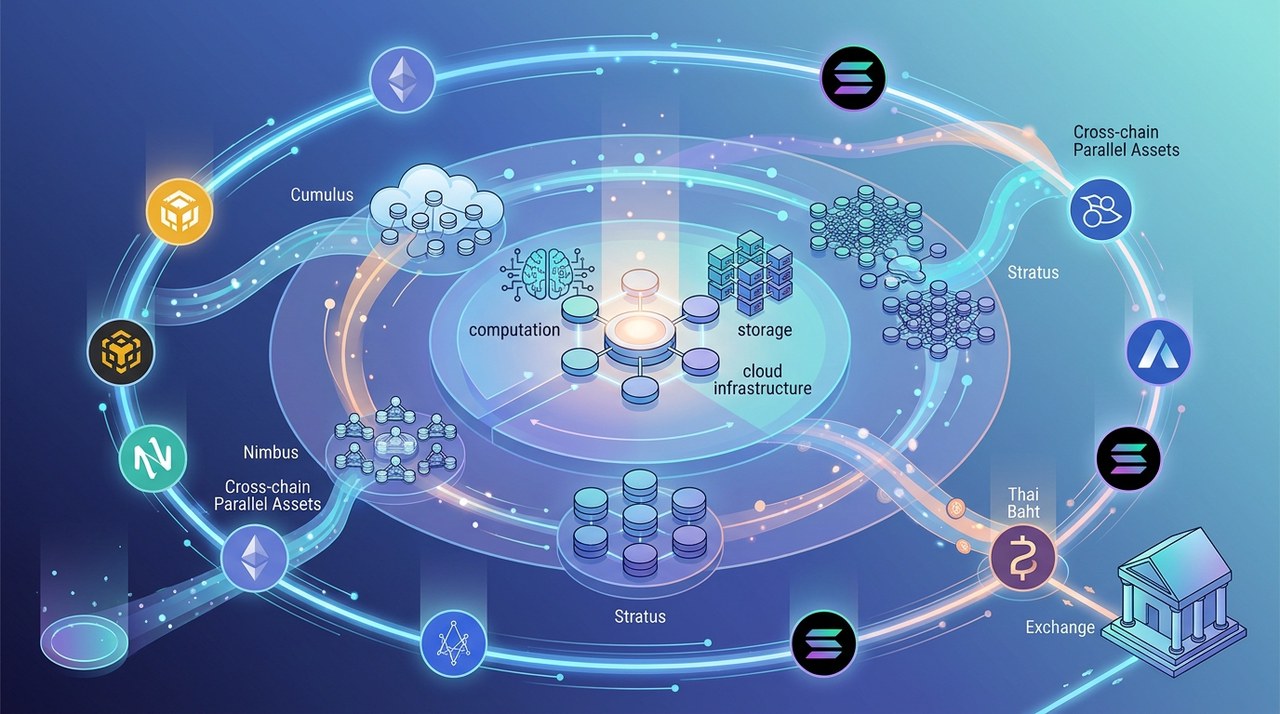
- Flux (FLUX) is a decentralized Web3 cloud infrastructure network (DePIN) providing redundant computational resources.
- The network utilizes a multi-tiered node system (Cumulus, Nimbus, Stratus) combined with Proof-of-Useful-Work (PoUW) for efficient compute tasks.
- Flux features cross-chain Parallel Assets that allow token liquidity across major blockchains like Ethereum, BNB Chain, and Solana.
- Core use cases include dApp hosting, blockchain node operation, distributed storage (FluxDrive), and AI computational workloads.
- FLUX can be safely traded against Thai Baht (THB) on Bitkub Exchange.
What is Flux (FLUX)?
Flux (FLUX) is a decentralized Web3 cloud infrastructure network designed to provide scalable, redundant, and globally distributed computational resources. In traditional information technology, centralized cloud services such as Amazon Web Services (AWS), Google Cloud Platform (GCP), and Microsoft Azure dominate application hosting, database storage, and backend computation. While these platforms offer immense scale, they introduce single points of failure, centralized governance, data privacy risks, and potential service censorship.
Flux operates within the rapidly growing ecosystem known as Decentralized Physical Infrastructure Networks (DePIN). By crowdsourcing hardware capacity from thousands of independent operators around the globe, Flux constructs an alternative cloud layer. Developers can deploy containerized applications without relying on centralized corporate infrastructure, creating a resilient environment where no single entity controls access or infrastructure availability.
At the heart of this network is the native cryptocurrency, FLUX. The token serves multiple functional roles across the ecosystem, including paying for compute resources, rewarding hardware node operators and miners, participating in network governance, and facilitating cross-chain interoperability through parallel asset smart contracts.
History and Background of Flux
The project originally launched in 2018 under the name ZelCash (ZEL). Initially created as a fork of Zcash, the early platform aimed to combine financial privacy features with decentralized utility. However, as the cryptocurrency landscape evolved, the founding team recognized that the Web3 ecosystem lacked robust, decentralized infrastructure to support smart contracts, dApp backends, and distributed web hosting.
In 2021, the project underwent a major structural rebrand, transforming into Flux. This evolution signaled a complete pivot away from being purely a transactional currency toward becoming a comprehensive Web3 cloud computing platform. Co-founded by Daniel Keller, Tadeas Kmenta, and Parker Honeyman, Flux established a transparent, open-source model governed without initial pre-mines or venture capital allocations that might compromise its decentralized nature.
Since the rebranding, Flux has continuously expanded its network capabilities. Key milestones include the deployment of FluxOS, a specialized operating system for cloud computation; the introduction of Parallel Assets, which enable cross-chain liquidity across networks like Ethereum and BNB Chain; and the integration of Proof-of-Useful-Work (PoUW), which optimizes energy consumption by directing mining hardware toward practical computing tasks.
How Flux Works: Technical Architecture
Flux operates by merging blockchain-based consensus mechanisms with containerized server technology. To understand how Flux functions, it is essential to examine its core technological components: FluxOS, the FluxNode network, Proof-of-Useful-Work, and Parallel Assets.
1. FluxOS: The Decentralized Operating System
FluxOS is an application-layer operating system built on top of Linux. It coordinates the global network of compute nodes, managing resource allocation, application deployment, and communication across the decentralized network.
Unlike standard Web2 cloud platforms that deploy applications on virtual machines managed by a single corporate entity, FluxOS utilizes Docker containers. Developers package their software into standardized Docker containers, which FluxOS then automatically distributes across multiple independent nodes globally. This setup ensures high availability: if one node hosting a container goes offline, FluxOS automatically migrates the workload to another operational node, preventing downtime.
2. Multi-Tiered FluxNodes
The infrastructure layer of Flux is supported by thousands of user-operated compute nodes known as FluxNodes. To ensure network stability and cater to different hardware capacities, Flux implements a multi-tiered node structure. Operators must collateralize a specific amount of FLUX tokens and meet minimum hardware specifications to participate:
- Cumulus Tier: The entry point requiring basic hardware capabilities (RAM, storage, and CPU cores) and lower FLUX token collateral. Cumulus nodes process lightweight dApps and lightweight network tasks.
- Nimbus Tier: Mid-range hardware specifications requiring moderate FLUX collateral. Nimbus nodes host more demanding dApps, database layers, and infrastructure nodes for partner projects.
- Stratus Tier: High-performance enterprise-grade hardware requiring significant CPU, storage bandwidth, and higher FLUX collateral. Stratus nodes execute complex computational workloads, enterprise dApp clusters, and intensive computing tasks.
In exchange for providing computing power and collateralizing tokens, node operators earn a portion of block rewards distributed periodically by the network.
3. Proof-of-Useful-Work (PoUW) and ZelHash
Traditional Proof-of-Work (PoW) consensus algorithms consume vast amounts of electrical energy to solve complex cryptographic puzzles that have no utility outside of securing the blockchain. Flux addresses this inefficiency through Proof-of-Useful-Work (PoUW).
Flux uses a customized ASIC-resistant mining algorithm called ZelHash (a variant of Equihash). While ZelHash secures the underlying blockchain, the PoUW framework allows GPU resources that would otherwise be idle or processing raw cryptographic puzzles to solve real-world computational problems. These include rendering 3D graphics, running artificial intelligence model training, processing scientific simulations, and powering video encoding pipelines.
4. Parallel Assets and Interoperability
Recognizing that liquidity and application ecosystems exist across multiple blockchain networks, Flux introduced the concept of Parallel Assets. Parallel Assets are tokens pegged 1:1 with native FLUX that exist on other major blockchains, including Ethereum (Flux-ETH), BNB Chain (Flux-BSC), Solana (Flux-SOL), Avalanche (Flux-AVAX), and Polygon (Flux-POLY).
Through the Fusion bridge within the Zelcore ecosystem, users can swap native FLUX for its parallel asset counterparts seamlessly. This cross-chain architecture allows Flux users to participate in decentralized finance (DeFi) protocols across various ecosystems without losing access to the core utility of the Flux infrastructure.
Key Features and Real-World Use Cases
Flux provides a diverse environment capable of hosting a wide range of Web2 and Web3 workloads. Some of the most notable features and applications running on Flux include:
Decentralized Application (dApp) and Website Hosting
Developers can deploy static and dynamic web applications onto Flux. Frontend user interfaces for decentralized exchanges (DEXs), frontends for DeFi protocols, and decentralized social networks can run on FluxOS, eliminating the risk of website outages caused by centralized host domain suspensions or cloud server failures.
Blockchain Infrastructure and Node Hosting
Running full nodes for proof-of-stake or layer-1 networks often requires dedicated hardware or expensive monthly subscriptions on AWS. Flux allows blockchain developers to deploy RPC (Remote Procedure Call) nodes, validator infrastructure, and block explorers directly onto the Flux cloud network, enhancing overall network decentralization.
Artificial Intelligence (AI) and Machine Learning Compute
With the rise of generative AI and machine learning applications, global demand for high-performance GPU processing power has surpassed supply. Through its PoUW infrastructure, Flux enables companies and researchers to rent distributed GPU clusters at a fraction of the cost charged by conventional centralized cloud providers.
FluxDrive: Decentralized Storage Solutions
FluxDrive is a decentralized cloud storage service powered by the Flux network. Users can store files, media, and application back-ups securely. Unlike conventional centralized storage options, data uploaded to FluxDrive is encrypted, fragmented, and distributed across multiple network nodes, offering enhanced privacy and redundancy.
Decentralized Governance via XDAO
Governance within the Flux ecosystem is driven by XDAO, a decentralized autonomous organization software platform. FLUX token holders and node operators can submit proposals, vote on software upgrades, allocate treasury funds for ecosystem grants, and determine hardware requirements for nodes. Voting weight is balanced between token holders and node operators to maintain fair governance representation.
FLUX Tokenomics and Market Overview
Understanding the economic structure of FLUX is essential for evaluating its role in the broader cryptocurrency landscape.
Supply and Block Reward Distribution
FLUX has a hard maximum supply cap of 440,000,000 FLUX. Newly minted tokens are distributed per block with a 50/50 allocation model split evenly between Proof-of-Work miners and FluxNode operators. This balanced incentive structure maintains both cryptographic chain security and computational network capacity.
Additionally, Flux undergoes halvings similar to Bitcoin approximately every four years, gradually reducing the rate of new token creation and controlling inflation over time.
Market Landscape and Risk Factors
Flux operates in the DePIN and cloud infrastructure sectors alongside competitors like Render (RENDER), Akash Network (AKT), Internet Computer (ICP), and Filecoin (FIL). While Flux provides unique multi-tier infrastructure and cross-chain capabilities, investors and participants should keep key market dynamics and risk factors in mind:
- Market Volatility: Like most digital assets, the market price of FLUX is subject to broad market volatility, shifts in trader sentiment, and macro-economic factors.
- Technical Complexity: Managing decentralized nodes, maintaining hardware uptime, and participating in cross-chain parallel asset bridges involve technical operational steps.
- Competition: Decentralized cloud providers face intense competition not only from existing Web2 giants (AWS, Google Cloud) but also from emerging crypto-native Web3 compute protocols.
- Network Adoption: The long-term economic sustainability of the network depends on real-world demand for containerized compute resources relative to token reward emissions.
Past performance of digital assets is not an indicator of future returns. You can track real-time price trends, volume, and supply details directly on Bitkub Exchange.
How to Buy FLUX on Bitkub Exchange
For users in Thailand interested in acquiring FLUX tokens, Bitkub Exchange provides a secure, fully licensed, and user-friendly platform for trading FLUX against Thai Baht (THB). Follow these steps to purchase FLUX:
- Create and Verify your Bitkub Account: Register on the official Bitkub platform or mobile app. Complete identity verification (KYC) to secure your account and unlock trading privileges.
- Deposit Thai Baht (THB): Link your bank account and make a fast THB deposit using a QR code transaction through the Bitkub deposit menu.
- Navigate to the Market Page: Go to the spot market section and select the FLUX/THB trading pair (or visit bitkub.com/th/market/FLUX).
- Place a Trade Order: Enter the amount of THB you wish to spend or the amount of FLUX you wish to purchase. Choose between a Limit Order (setting your target price) or a Market Order (executing immediately at current market rates).
- Confirm and Store: Review the transaction details and confirm your order. Once executed, your FLUX tokens will automatically reflect in your Bitkub wallet balance.
Conclusion
Flux represents an ambitious approach to solving the centralization challenges facing modern internet infrastructure. By combining Docker containerized cloud hosting, a multi-tiered global node network, Proof-of-Useful-Work, and cross-chain parallel assets, Flux offers a scalable foundation for the next generation of Web3 applications.
As the DePIN ecosystem continues to evolve, decentralized compute protocols like Flux highlight how crowdsourced hardware can compete alongside traditional cloud environments. However, as with any digital asset, users and prospective traders should carefully evaluate their risk tolerance, assess technical requirements, and conduct thorough independent research before participating in the network.
Disclaimer: Cryptocurrency trading and digital asset investments involve substantial risk of loss and are not suitable for every investor. Content provided herein is strictly for educational purposes and should not be construed as financial advice or an endorsement to buy or sell any digital asset.
Latest blog posts


What is GNO (GNO)?
GNO is the utility and governance token powering Gnosis Chain, a decentralized EVM-compatible blockchain network. From pioneering smart contract multisig wallets with Safe to bridging Web3 payments through Gnosis Pay, Gnosis provides vital infrastructure for Ethereum ecosystem scaling. Discover how GNO works, its technical mechanics, market tokenomics, and how to trade GNO on Bitkub.
|

What is SPACE ID (ID)?
SPACE ID is a universal decentralized identity platform designed to simplify Web3 interactions by turning complex wallet addresses into human-readable domain names. Operating across multiple blockchains like BNB Chain and Arbitrum, SPACE ID provides a comprehensive hub for registering, trading, and managing digital identities. Powered by the native ID token, the protocol enables staking rewards, governance voting, and seamless dApp integrations.
|

What is Lido DAO (LDO)?
Lido DAO (LDO) is a market-leading liquid staking protocol designed to eliminate capital illiquidity in Proof-of-Stake blockchains like Ethereum. By depositing ETH, users receive stETH to earn staking rewards while continuing to use their tokens across DeFi applications. LDO serves as the protocol's governance token, enabling holders to direct protocol parameters and treasury allocations.
|