

What Happens When a Bitcoin Block Fills Up?
On November 27, 2026, Bitcoin (BTCBTC+1.85%) traded around $61,661 while EthereumETH+2.23% sat at $1,733. Behind these market prices lies an active technical ecosystem where millions of users send transactions daily. But have you ever wondered what actually happens when the network gets crowded?
The Airport Boarding Gate Analogy
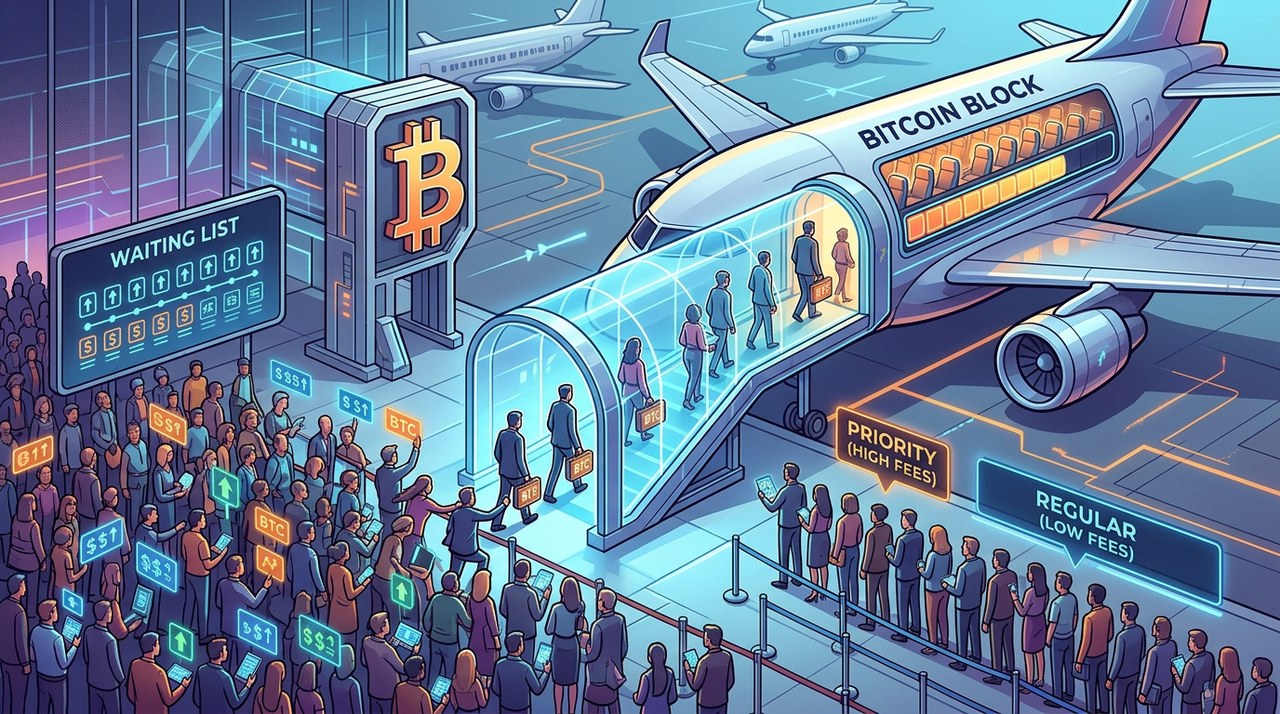
Imagine waiting at a super busy airport gate. Thousands of travelers are trying to board, but every departing plane has a strictly limited number of seats.
There is no single orderly line. Passengers who offer to pay more for their ticket generally get priority boarding.
Everyone left on the ground must wait for the next flight. They might even have to compete with an entirely new crowd of travelers.
Bitcoin works in a very similar way. The transactions are the passengers, the blocks are the airplanes, and transaction fees act as the ticket prices.
Understanding Bitcoin Block Size Limits
Satoshi Nakamoto designed Bitcoin to produce a new block roughly every ten minutes. Miners collect waiting transactions to build these blocks, but space is strictly limited.
Every block has a maximum capacity limit of 4 million weight units. This standard was introduced through the Segregated Witness (SegWit) upgrade back in August 2017.
In practical terms, 4 million weight units equal roughly 1 million virtual bytes (vB). The exact number of transactions in a block depends on how complex each transaction is.
A standard block usually holds a few thousand standard payments. However, data-heavy blocks containing complex scripts can reach up to 4 megabytes in serialized size.
When network activity shoots up, miners cannot simply stretch the block to fit everyone. Unconfirmed payments must wait, turning block space into an open bidding marketplace.
Bitcoin does not use a first-come, first-served system. A payment sent three hours ago might sit unconfirmed while a payment submitted five seconds ago lands in the very next block.
Who Decides Which Transactions Get Confirmed?
Bitcoin miners and mining pool operators decide which transactions make it into their blocks. Their selection process comes down to clear economic incentives.
Miners do not care about who sent the money or how long a transaction has been waiting. Instead, they look at the fee rate, measured in satoshis per virtual byte (sat/vB).
Comparing Two Competing Transactions
To see how miners choose, look at this quick side-by-side comparison between two transactions:
- Transaction A: Virtual size of 200 vB, paying a total fee of 1,000 satoshis (Fee rate = 5 sat/vB)
- Transaction B: Virtual size of 150 vB, paying a total fee of 1,500 satoshis (Fee rate = 10 sat/vB)
Even though Transaction B pays only 500 satoshis more in total, it offers twice the fee rate while taking up less block space. A profit-seeking miner will pick Transaction B first every single time.
Miners also evaluate connected payments known as parent-child transactions. If a newer transaction pays a high fee to clear an older, low-fee transaction, mining software evaluates their combined economic value.
Additionally, some mining pools accept transactions through private out-of-band arrangements. While fee rates guide the market overall, miners retain final flexibility over block assembly.
Crucially, independent full nodes inspect every new block against consensus rules. If a miner builds a block that breaks the 4 million weight unit limit, the rest of the network instantly rejects it.
What Happens to Excluded Transactions?
Transactions that miss out on a block wait inside the mempool (short for memory pool). Contrary to popular belief, there is no single, centralized waiting room for Bitcoin.
Every full node runs its own independent mempool. Node operators decide their own rules for accepting, storing, and sharing unconfirmed transaction data.
Because each node operates independently, different block explorers may display slightly different lists of waiting transactions. A payment visible on one platform might be missing from another.
The default memory limit for Bitcoin Core software is 300 megabytes. When a node's memory fills completely, it begins dropping low-fee transactions to save space.
This eviction process forces the node to raise its minimum fee threshold. Low-fee payments are pushed out until network congestion cools down.
Bitcoin Core sets a default expiration timer of 336 hours (14 days) for waiting transactions. However, heavy network traffic can cause low-fee items to drop out much sooner.
If your transaction gets evicted, your funds are not lost! The unconfirmed payment never moved on the blockchain, so the coins remain safely in your wallet to resend or bump with a higher fee.
Why Traffic Spikes Cause Bitcoin Fees to Soar
When user demand jumps faster than miners can process blocks, transaction fees rise sharply. Because blocks appear about every 10 minutes, incoming traffic builds up rapidly.
We saw a dramatic example of this during the April 2024 Bitcoin halving when the Runes protocol launched. Heavy demand pushed median fee rates up to around 200 sat/vB at block height 840,000.
Fast forward to block 970,789 on October 10, 2026, and median fees dropped all the way down to roughly 0.28 sat/vB.
This huge dynamic shift highlights how flexible market pricing is on Bitcoin. The base protocol capacity never changed, yet fee prices adjusted naturally based on user demand.
Full blocks and crowded mempools do not mean Bitcoin is broken. They simply prove that fixed settlement capacity combined with open competition creates an efficient free-market system.
Recent Security Alerts in Mining Pools
In related network news, major Bitcoin mining pool operator Braiins issued a security warning on Wednesday, November 25. The alert detailed a series of network hijacking attacks targeting mining hash rate.
Braiins urged pool participants to check their security setups to ensure their hashing power remains routed safely and correctly.
Final Takeaways
Bitcoin block space is strictly finite by design. Miners prioritize profitable fee rates, users bid for fast confirmations, and decentralization ensures no single entity can alter the rules alone.
Latest blog posts


US Wins Forfeiture of $674K in Crypto Tied to Scam
A federal court has authorized the forfeiture of nearly $674,000 in stolen Tether, allowing victims of an online investment scam to seek recovery.
|
 +1
Bitcoin's Missing Fuel: USDT Supply Shrinks by $8.1 Billion
Stablecoin liquidity is contracting at its fastest pace in over four years, missing a key condition that accompanied Bitcoin's past record highs.
|

Japan Crypto Group Taps SEAL to Speed Up Hack Response
Japan's crypto security group partnered with the Security Alliance to boost hack response times following a recent customer data breach.
|