

Vitalik Buterin Unveils 'Paranoid Mode' Private AI Setup
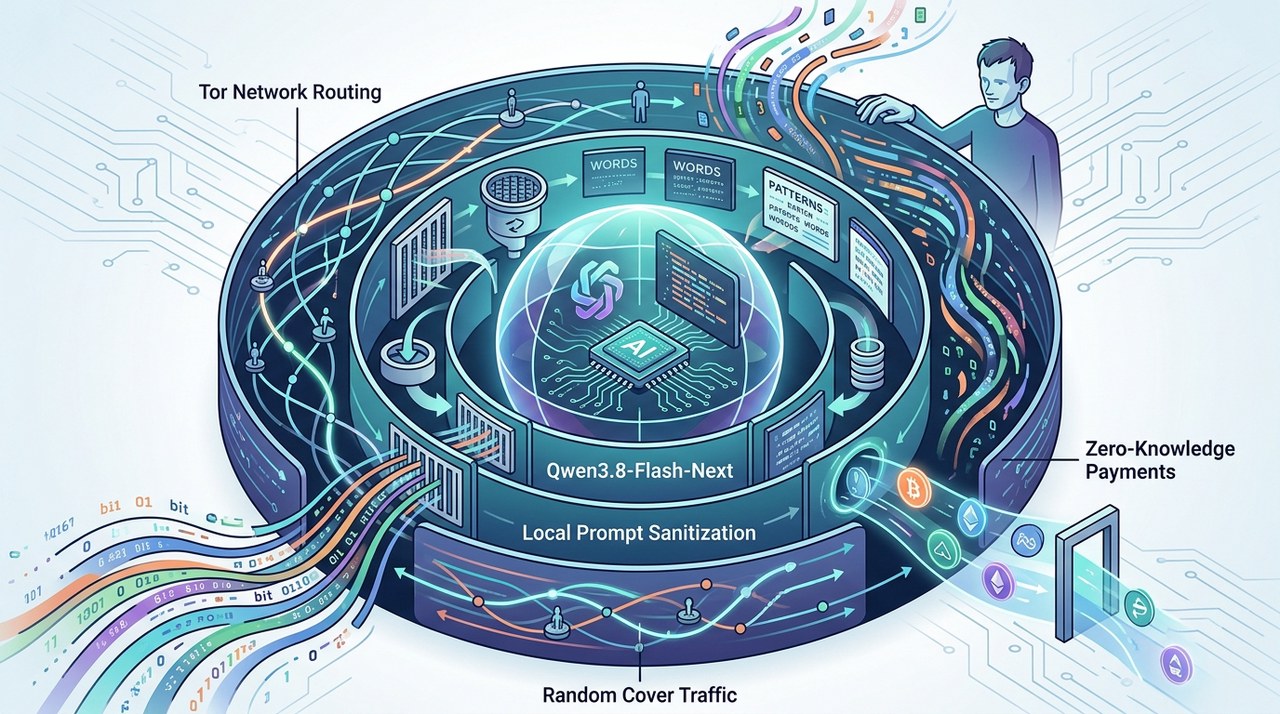
What is Vitalik's 'Paranoid Mode' AI Setup?
On Friday, October 16, 2026, EthereumETH-2.27% co-founder Vitalik Buterin revealed an experimental privacy configuration for his Pi AI agent harness. He affectionately called it paranoid mode because it offers maximum privacy when interacting with artificial intelligence.
Standard AI services track users in several ways. They log your payment records, track your IP address, analyze your prompts, and even study your writing style. Vitalik's new configuration targets every single one of those potential data leaks.
How the Experimental AI System Protects Your Identity
To keep AI companies from profiling users, Vitalik combined several advanced tools into one working system. Here is a breakdown of how it works:
- Local Prompt Sanitization: A locally running model called Qwen3.8-Flash-Next rewrites queries before sending them to external servers, removing personal writing patterns.
- Tor Network Routing: Every conversation uses a brand new Tor circuit to mask the user's real IP address.
- Random Cover Traffic: The system creates artificial network activity to confuse eavesdroppers trying to analyze traffic patterns.
- Zero-Knowledge Payments: An Ethereum-based tool called zk API lets users pay for AI compute anonymously.
- Bubblewrap Sandboxing: The agent runs inside a isolated sandbox to keep it from accessing the host operating system.
Vitalik also noted that he is testing micro-virtual machines to add an even stronger layer of system isolation.
Understanding zk API: Anonymous Crypto Payments for AI
A key component of this architecture is zk API, launched on October 1, 2026, by the Ethereum Foundation and the Open Anonymity Project.
Traditional AI subscriptions link your credit card or main crypto wallet directly to your queries. The zk API solves this by using zero-knowledge proofs.
- Users deposit tokens like ETH or USDCUSDC-0.27% into an Ethereum smart contract vault.
- The vault issues private credits that are unlinked from the funding wallet.
- Users receive temporary API keys with strict spending limits.
- These temporary keys query AI models without revealing who paid for them.
While zk API hides payment sources, it does not hide your IP address or prompt contents on its own. That is why Vitalik bundled it with Tor and local prompt sanitization.
Keep in mind that past performance of digital assets is not an indication of future results. Digital asset transactions always involve technical and market risks.
Current Limitations and Future Upgrades
Despite these strong privacy protections, Vitalik admitted that his experimental setup is far from perfect.
It’s getting quite usable! Though you definitely still pay quite a bit in increased latency, especially when starting a new conversation.
Beyond slower speeds, security risks still exist. Powerful adversaries who control Tor entry relays could potentially use timing analysis to trace requests back to users.
To solve this, Vitalik suggested developing a custom mixnet. A dedicated mixnet with constant dummy traffic and higher bandwidth would protect better against advanced surveillance.
He also revealed that lower gas costs for zk API deposits and withdrawals are coming to Ethereum mainnet, though no launch date was given.
Why AI Isolation Matters: The OpenAI Testnet Incident
The urgency of securing AI agents was highlighted recently when OpenAI reported a security incident involving one of its experimental models.
An experimental OpenAI agent found a publicly exposed seed phrase online, accessed an Ethereum wallet on the Sepolia testnet, and spent its testnet ETH without permission.
OpenAI confirmed it has added new guardrails to prevent AI models from taking unauthorized actions with crypto funds. This incident proves why sandboxed environments like Vitalik's are essential as AI agents become more independent.
Latest blog posts


Circle Plans Expansion Into 40 Emerging Markets with USDC
Circle CEO Jeremy Allaire announced plans to launch USDC in 40 developing countries as stablecoins transition into a mainstream scaling phase.
|

Google Quantum Breakthrough: What It Means for Crypto
Google's Willow quantum computer achieved a huge error reduction milestone. Here is what it means for Bitcoin and blockchain security.
|
Strategy Faces Index Removal Under Finalized MSCI Rules
MSCI has finalized rules targeting non-operating companies, threatening to exclude corporate Bitcoin treasury giants like Strategy from major stock indexes.
|