

Vitalik Buterin Builds Paranoid Mode for AI Privacy
What Is Vitalik's New Paranoid Mode for AI?
Imagine asking an AI assistant to analyze your personal crypto portfolio or help plan your next trade. It sounds like a handy productivity tool, right?
However, chatting with centralized AI tools can expose a lot of private details. The tech companies running these models can see what assets you hold, what tokens you want to buy, and where you connect from.
On October 16, EthereumETH-0.08% co-founder Vitalik Buterin introduced a prototype designed to solve this exact issue. He called it Paranoid Mode.
Built as a special security wrapper for his AI agent harness called pi, this open-source tool makes it far harder for outside parties to trace who is using an AI service, where the requests originate, or how they are paid for.
Why Financial AI Assistants Pose Privacy Risks
As crypto wallets and financial services integrate directly with autonomous AI agents, sharing conversations with an AI model gets riskier.
For instance, if you ask a trading assistant to track specific crypto tokens, you accidentally reveal your trading intentions. If you inquire about managing your personal holdings, you reveal your total wallet balance.
Even if you do not mention your real name, AI service providers can often piece together your identity through these common digital footprints:
- Your internet IP address, which reveals your geographic location
- Payment records and credit card logs tied to subscription accounts
- Repeated personal details scattered across your chat prompts
When combined, these subtle clues allow companies or eavesdroppers to assemble a surprisingly detailed financial profile about you.
How Paranoid Mode Protects Your Sensitive Secrets
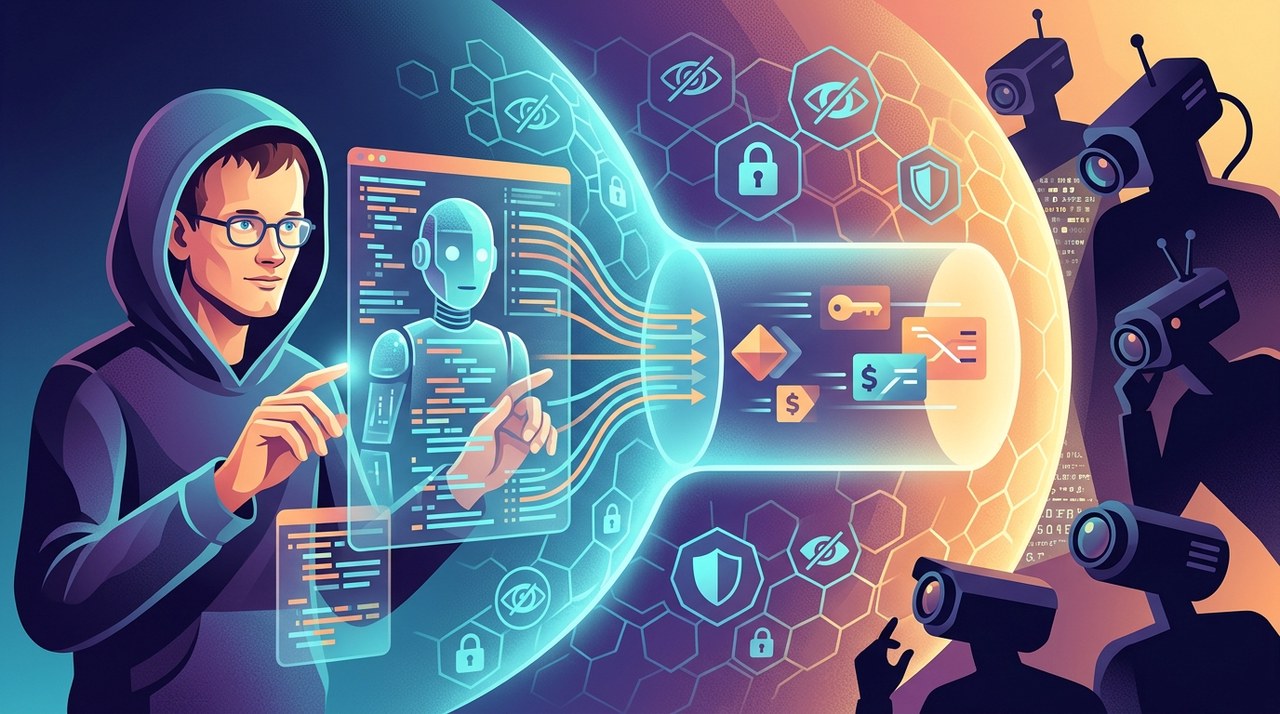
To keep AI models from building a profile on users, Buterin designed a four-step security barrier running inside an open-AI compatible daemon:
1. Tor Circuit Routing
The system assigns a separate Tor circuit to every new chat session. This routes data through multiple encrypted relay nodes to completely mask your actual IP address.
2. Random Cover Traffic
To make real user activity harder to identify, the tool generates fake, random request traffic. This background noise prevents network observers from spotting genuine data transmissions.
3. Local Prompt Rewriting
Before any question is sent over the internet, a small AI model running locally on your computer rewrites your message. It removes obvious personal details while preserving the essential context of your question.
4. Zero-Knowledge Payments via zkAPI
To pay for API usage without linking payments to a bank card or public crypto wallet, the system uses zkAPI. This protocol uses zero-knowledge proofs to confirm payment without exposing who paid.
The payment engine operates on the Ethereum mainnet and supports deposits in digital assets such as ETH and USDCUSDC+0.00%.
Additionally, Buterin contained the AI agent inside an isolated software sandbox. This stops the agent from accessing other sensitive files on his computer.
Direct Technical Details from Vitalik Buterin
Buterin outlined how these components work together in a social media update on October 16:
Wrapped zkAPI + Tor + extra cover traffic + local LLM prompt rewriting in an open-AI compatible daemon, and made a "paranoid mode" wrapper for my agent harness (pi)...
He also addressed why the system handles privacy on a session-by-session basis rather than resetting credentials for every single message:
definitely no point trying to de-link within a session – this daemon treats a session as a unit, and gains efficiency from not refreshing the Tor circuit or doing a zkAPI payment for each message within a session. each new session gets its own Tor circuit + zkAPI payment though
Current Technical Limitations and Real-World Challenges
While Buterin noted that the setup is "getting quite usable," he acknowledged that achieving total anonymity remains challenging.
Because creating a new Tor circuit and generating cryptographic zk-proofs requires computing power, starting a fresh conversation session feels noticeably slower.
Furthermore, two main security challenges remain:
- Readable Prompts: Even rewritten prompts are visible to AI providers, meaning uniquely written phrases could still give away clues.
- Traffic Timing Analysis: If an AI provider collaborates with a malicious Tor entry node, they could compare arrival times to correlate traffic sources.
To solve timing attacks, Buterin mentioned that moving to specialized privacy networks might be necessary in the future, even though it would raise bandwidth costs.
What This Experiment Means for Crypto and Investors
For crypto enthusiasts and investors, Buterin's prototype highlights how blockchain tools can solve modern privacy issues created by centralized AI.
He noted that lower transaction fees for zkAPI payments are expected soon, which could make anonymous AI queries faster and more affordable.
While this setup demonstrates a practical real-world use case for Ethereum infrastructure like ETH and USDC, it is an early experimental prototype. It does not indicate guaranteed commercial adoption or an immediate impact on token valuations.
Investors should remember that crypto markets are subject to significant volatility and risks. Past performance of digital assets is not a guarantee of future returns. You can check current market trends and prices on Bitkub Market.
Latest blog posts


EU and 8 Nations Sign New Treaty to Fight Crypto Crime
The European Union and eight allied countries have signed an updated international protocol to track, freeze, and share illicit crypto assets across borders.
|
Anthropic Junk Rating Sparks Debate on Bitcoin
Anthropic's BB+ credit rating has sparked fresh discussions about AI funding risks, rising bond yields, and Bitcoin's role in traditional portfolios.
|

 +1
+1Dogecoin Volume Drops 50% in Quiet Weekend Trade
Dogecoin saw its 24-hour trading volume drop 49% to $607 million as traders stepped back amid inflation worries and a broader crypto market selloff.
|