


Starknet Considers L1 Shift to Fight Quantum Threats
A New Direction for Starknet
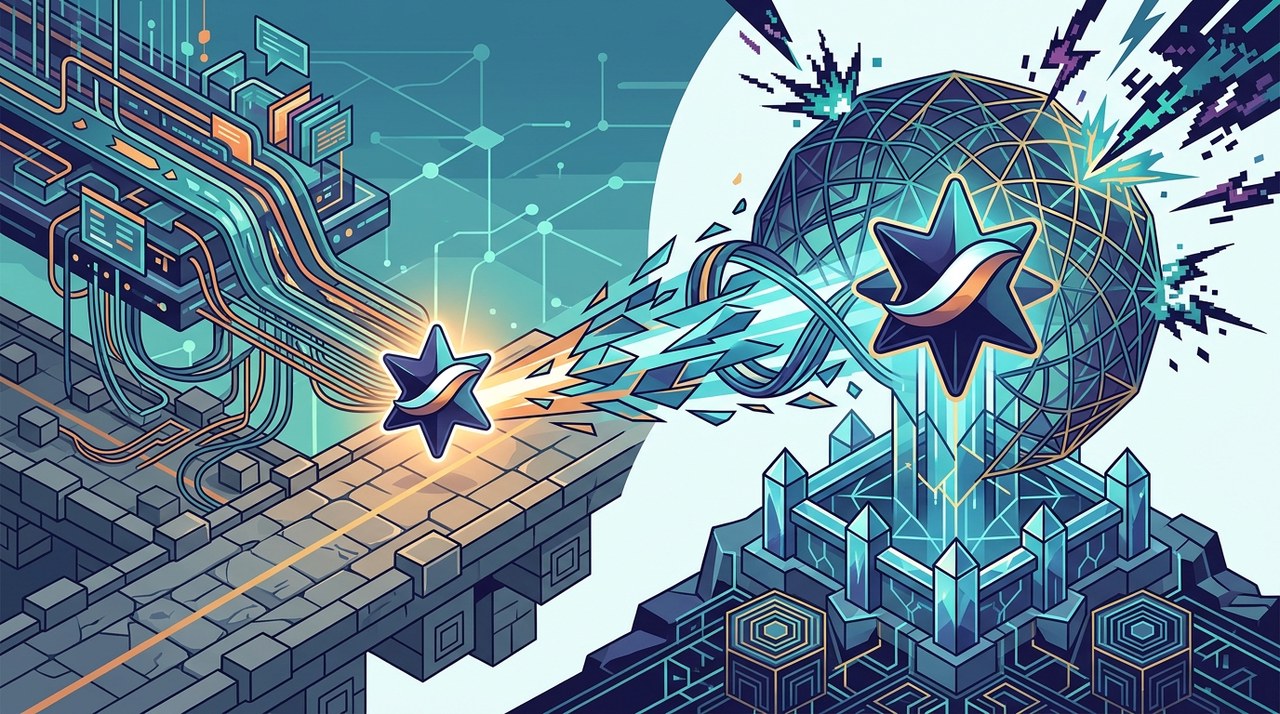
Starknet, a scaling network built by StarkWare, is officially exploring a major transition. The project announced that it is actively considering becoming an independent Layer-1 (L1) blockchain.
The main goal behind this proposal is to build the crypto industry's first fully quantum-resistant network, with a target launch date of 2027. By operating as its own Layer 1, Starknet hopes to move faster in implementing crucial security upgrades.
Following the announcement, the network's native token, STRK, saw a noticeable price movement. However, market participants should keep in mind that crypto assets remain highly volatile, and past price activity is not indicative of future performance.
Understanding the Basics: What Are Layer 1 and Layer 2?
To understand why this proposal matters, it helps to review how blockchains are structured today.
Think of a Layer 1 blockchain like a primary highway. Blockchains like BitcoinBTC+2.28% and EthereumETH+2.84% are Layer 1 networks because they handle, validate, and secure all transactions directly on their own main chain.
A Layer 2 network, on the other hand, acts like an express lane built on top of that highway. Starknet currently operates as a Layer 2 on Ethereum. It bundles large batches of transactions together off-chain and then sends them down to Ethereum for final settlement and security.
While this setup keeps fees low and speeds high, it also means Starknet relies entirely on Ethereum's base layer for its core defense against cyberCYBER+11.33% threats.
The Quantum Threat Explained
Why is Starknet considering such a major structural shift? The short answer comes down to quantum computers.
Traditional blockchains like Bitcoin and Ethereum rely on a mathematical safeguard called elliptic-curve cryptography. This system creates the digital signatures that prove you own your coins.
Future quantum computers might eventually become powerful enough to break elliptic-curve cryptography. If that happens, standard digital signatures could be compromised.
Starknet relies heavily on STARK proofs, which use hash functions. Hash functions scramble data into unique digital fingerprints and are widely considered resistant to quantum attacks. Starknet still retains a few legacy elliptic-curve elements, but it published a technical roadmap on June 30 outlining plans to replace them.
Why StarkWare Wants Complete Control
StarkWare Chief Executive Officer Eli Ben-Sasson shared his thoughts on social media, emphasizing that quantum risks could arrive sooner than previously expected.
Ben-Sasson noted that rapid advances in artificial intelligence and mathematics are accelerating research timelines. He referenced the concept of entering "bunker mode"—a term recently used by Ethereum researcher Justin Drake to urge the community toward proactive security measures.
Because Starknet operates as an L2, its maximum quantum security is naturally capped by Ethereum's base layer. If Ethereum upgrades its security at a slower pace, Starknet must wait for it. Becoming an L1 would give Starknet full autonomy to ship cryptographic upgrades on its own timeline.
Comparing Timelines: Starknet vs. Ethereum vs. Bitcoin
The prospective timelines highlight why StarkWare feels a sense of urgency regarding security standards:
- Starknet Target: Aims to achieve full quantum resistance by 2027 if it moves forward with the L1 transition.
- Ethereum Roadmap: Targets core post-quantum upgrades around 2029, according to official documentation. The Ethereum Foundation established a dedicated post-quantum research team in January.
- Bitcoin Approach: According to Ben-Sasson, Bitcoin has not set a formal commitment or official timeline for post-quantum cryptographic transitions.
Trade-Offs and Potential Challenges
Switching from a Layer 2 to an independent Layer 1 brings clear advantages, but it also introduces notable trade-offs.
The Potential Advantages
- Speed and Agility: Starknet can deploy emergency cryptographic patches without waiting for broader Ethereum consensus.
- First-Mover Position: Starknet could position itself as a specialized, ultra-secure hub for institutional capital that requires long-term quantum defenses.
The Standing Challenges
- Losing Shared Security: As an L2, Starknet inherits Ethereum's massive decentralized validator base. As an L1, Starknet must recruit, incentivize, and maintain its own validator set from scratch.
- User and App Migration: The team has not yet detailed how existing decentralized applications (dApps), smart contracts, and user balances would migrate to a standalone chain.
- Ecosystem Scale: Ethereum is the second-largest blockchain ecosystem in the world. Detaching from its direct pool of security and liquidity is a significant undertaking.
Is the Quantum Threat Really Urgent?
Currently, no existing quantum computer is capable of breaking modern cryptographic encryption. Security experts across academia and tech remain divided on when such hardware might actually emerge.
Industry figures have expressed varying viewpoints on the threat level. For instance, MicroStrategy co-founder Michael Saylor previously noted in an interview that quantum computing is not an immediate concern for crypto networks, suggesting traditional banking systems and global tech infrastructure would face public exposure long before decentralized networks.
STRK Token Performance and Market Overview
Following the announcement, the STRK token traded near $0.073, representing an approximate 20% gain over a 24-hour period. This price point is more than double its low of roughly $0.03 recorded earlier in April, around the time StarkWare adjusted its staffing structure to align with corporate revenue goals.
Investors should analyze market figures within a broader economic context. Token values react to speculation, developer milestones, and overall macroeconomic liquidity.
Past performance of digital assets or service providers is not a reliable indicator of future results. Digital asset trading involves significant financial risk and price volatility.
Final Thoughts
Starknet's proposal to become a Layer-1 network highlights the growing conversation around long-term blockchain infrastructure and cryptography. Whether the team proceeds with the transformation or remains an L2 dependent on Ethereum, quantum security will remain a central topic of discussion in the coming years.
Latest blog posts


Trader Loses $6.6 Million Bitcoin After Using New Ledger
A crypto trader lost 80 Bitcoin worth $6.6 million shortly after transferring the funds to a newly purchased Ledger hardware wallet.
|
Blockchain.com Seeks CFTC License for US Derivatives
Blockchain.com has applied for CFTC licenses to offer prediction markets and crypto derivatives ahead of a planned $500 million IPO.
|
Blockchain.com Seeks CFTC Licenses for Prediction Markets
Crypto platform Blockchain.com has reportedly applied for two CFTC licenses as US courts evaluate the legal status of prediction markets.