


Stablecoins Go Mainstream: 2026 Corporate Payments Shift
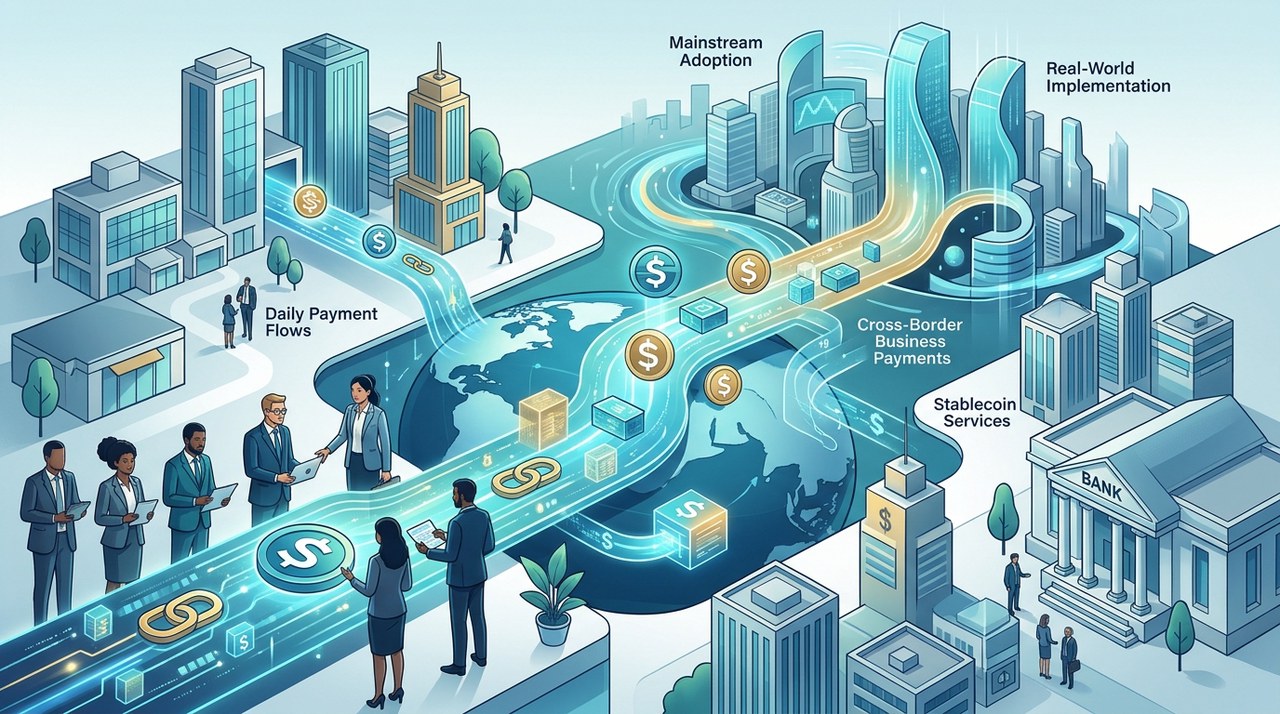
Stablecoins Are Moving From Testing to Real-World Implementation
Just a year ago, financial experts were debating whether stablecoins would ever see real enterprise adoption. Today, fresh survey data shows that businesses are moving past small experiments and integrating digital tokens directly into daily payment flows.
According to the 2026 EY-Parthenon Blockchain Payments Survey, which interviewed 521 corporate and financial decision-makers, 18% of corporations now use stablecoins in production. That is double the 9% adoption rate recorded in 2025.
Tokenized deposits are following a similar path, with 15% of corporate respondents reporting active use. Financial institutions are also taking major steps forward. About 69% of surveyed financial institutions offer stablecoin services or plan to launch them within two years, up from 30% in 2025. Meanwhile, 49% of banks already offer or plan to offer tokenized deposits over the same timeframe.
Cross-Border Business Payments Drive Initial Adoption
Cross-border business payments remain the most popular entry point for digital money. Between 50% and 53% of survey respondents use or explore stablecoins and tokenized deposits for international supplier payments and business-to-business transactions.
Corporate treasurers frequently run into friction with legacy banking networks. Survey respondents highlighted several major challenges with traditional rails:
- Slow processing and settlement times (cited by 56% of respondents)
- High foreign exchange costs and wide currency spreads (52%)
- Regulatory, compliance, and sanctions delays (48%)
- Expensive correspondent banking fees (36%)
Blockchain payment rails address these exact pain points by offering faster execution and lower overall costs. Beyond basic money transfer, 63% of financial institution respondents identified tokenized asset settlement as their biggest opportunity to add value.
The Market Embraces a Multi-Rail Approach
Businesses are not picking just one technology. Among respondents interested in blockchain payments, 45% of corporates and 53% of financial institutions favor using both stablecoins and tokenized deposits together.
This preference reflects the distinct strengths of both payment methods:
- Stablecoins provide broad reach across public blockchain networks, digital wallets, and platforms.
- Tokenized deposits bring commercial bank money into automated, programmable smart contract environments.
Rather than relying on a single rail, organizations pick between options based on their payment counterparty, geographical location, and liquidity needs. Financial service providers that offer easy transitions between traditional fiat and blockchain rails will stand out.
Integration and Programmability Are Key to Scaling
Corporate treasurers prefer embedded payment solutions. A strong 76% of corporates view integration with existing ERP, treasury management, and banking systems as critical. Furthermore, 74% want blockchain payments built directly into their current banking portals, while only 14% prefer a standalone digital asset tool.
This setup gives traditional banks a strong advantage: 63% of corporates report they would likely adopt blockchain payments if offered by their current banking provider.
Programmable payments—agreements that execute automatically when specific conditions are met—present another major growth area. About 54% of financial institutions offer or plan to roll out programmable payments within two years, with 75% viewing them as a solid revenue opportunity. Key priority areas include:
- Automated liquidity and cash management (51%)
- Conditional payments (51%)
- Automated accounting reconciliation (49%)
- Cross-border payment automation (47%)
Expert Insights: Payment Platforms, Bank Consortia, and Euro Tokens
Sam Boboev, founder of Fintech Wrap Up, shared key perspectives on how new stablecoin models are reshaping global finance.
Why Payment Firms Are Launching Custom Stablecoins
Payment companies are issuing tokens like OUSD to capture yield generated by reserve assets backing those tokens. Owning the underlying rail allows companies to link merchant settlements and user balances inside one system, reducing reliance on third-party settlement providers. However, Boboev notes that gaining user distribution is much harder than token issuance itself.
Banking Consortia Enter the Competition
Traditional banks are building stablecoin rails to protect their deposits and payment flows. In Europe, the Qivalis consortium brings together 37 financial institutions across 15 countries to launch a regulated euro token.
At the same time, a global alliance of 21 financial institutions—including Bank of America, Citi, Goldman Sachs, and Wells Fargo—announced plans to launch a US dollar stablecoin in H1 2027, with a euro version to follow. These projects aim to deliver 24/7 institutional trade settlement.
Can Euro Stablecoins Challenge US Dollar Dominance?
Euro stablecoins currently account for a tiny market share. Data from the Bank of Ireland indicates euro tokens made up just 0.2% of global stablecoin circulation in May 2026.
Using USD stablecoins creates foreign exchange costs for European firms. While the EU's MiCA framework offers legal clarity, dethroning dollar dominance worldwide remains difficult. Euro tokens will likely focus on European corporate treasuries and regional B2B settlement.
Key Crypto Industry Updates
Here is a quick summary of major headlines and institutional developments across the market:
- JPMorgan Bitcoin Outlook: JPMorgan analysts suggested Bitcoin could be among the top-performing assets over the next 10 years, assuming continued institutional adoption and favorable macroeconomic trends. Note: If economic headwinds or regulatory friction increase, long-term asset performance can experience significant volatility and downside risk.
- US OCC Stablecoin Rule: The OCC issued its first final rule under the GENIUS Act, requiring crypto exchanges to seek regulatory approval for existing stablecoin yield and reward programs.
- Switzerland Retail Bitcoin Fund: Regulator FINMA approved Switzerland's first retail bitcoin fund, allowing direct exposure under strict custody rules.
- Fireblocks Denies Acquisition Rumors: Crypto custody specialist Fireblocks publicly denied reports regarding acquisition talks with Visa.
- EthereumETH-4.13% Settlement Upgrade: Ethereum developers introduced a four-minute settlement roadmap aimed at lowering transfer costs.
- Market Volatility and BTCBTC-2.98% Pullback: Bitcoin temporarily slid below $82,000 during broader pullbacks in technology stocks and rising energy costs, reflecting short-term market volatility.
- SolanaSOL-3.14% Infrastructure Upgrade: Solana launched its largest network upgrade since 2020 to improve handling during peak transaction volume.
- China Asset Seizure Action: Chinese authorities are seeking to seize 61,800 BTC connected to a historic $5.7 billion fraud case.
- Reliance Jio IPO Valuation: Crypto prediction markets priced India's telecom giant Reliance Jio's prospective IPO valuation near $110 billion.
Research Focus: Real-World Asset Yield Trends
Recent research shows that diversified real-world asset (RWA) stablecoins are sustaining 5% to 7% yields backed by real-world credit, outperforming crypto-native borrowing rates which settled near 4%. Regulatory developments like the GENIUS Act are encouraging issuers to back yield tokens with off-chain credit, expanding the total addressable market toward an estimated $4 billion over three years.
Past performance of digital assets or fixed income products is not an indicator of future results. Real-world credit yields remain subject to underlying market defaults, liquidity shifts, and broader credit risks.
Latest blog posts

SoFi Offers 4.40% Yield on Digital Dollars With FDIC Cover
SoFi launched SoFi Earn (SOFIE), a tokenized bank deposit paying 4.40% APY with FDIC insurance to help crypto investors earn yield on idle cash.

Bitcoin Hashrate Rebounds as Miners Run at Full Capacity
Bitcoin network computing power reached 1,000 EH/s in October 2026 as institutional miners operate at max capacity despite record mining difficulty.
|
Fireblocks Denies $2.5B Visa Buyout Rumors
Fireblocks has denied reports of a potential $2.5 billion acquisition by Visa, stating the claims are not true at present time.