Stablecoins Cut Cross-Border Transfer Costs by 84%
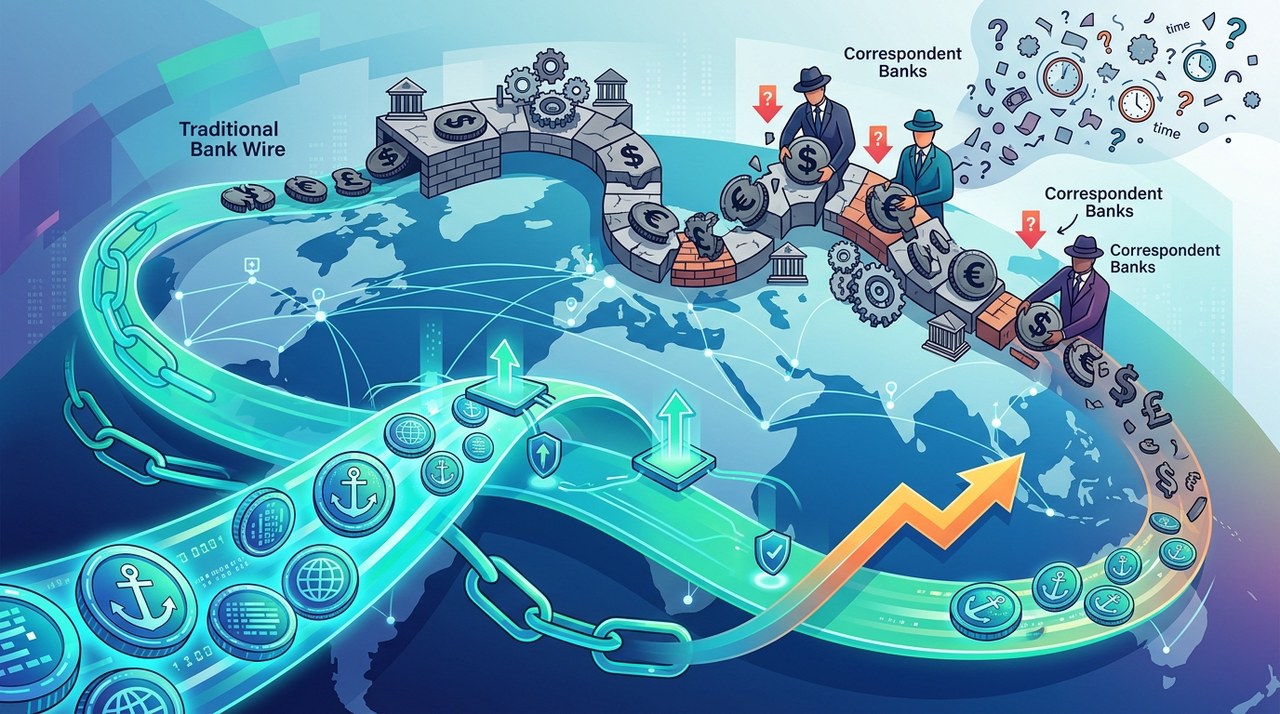
What the Borderless.xyz Report Discovered
Sending money across international borders has traditionally been both expensive and slow. However, recent data published by Borderless.xyz shows that stablecoins are rapidly changing how businesses handle cross-border payments.
According to the report, using stablecoin transfers for cross-border business payments reduces total settlement costs by an average of 84% when compared to standard international bank wires.
In addition to huge cost reductions, stablecoin transactions settle far faster than legacy banking systems, offering a major efficiency boost for global business operations.
Why Traditional Bank Wires Cost So Much
To understand why stablecoins offer such large savings, it helps to look at how international bank wires operate today.
When a company sends money to another country using a traditional bank wire, the funds do not travel straight from the sender to the recipient. Instead, the transaction passes through multiple intermediate institutions known as correspondent banks.
Each intermediary bank along the route charges its own fee for handling the transaction. Furthermore, foreign exchange conversions often include marked-up exchange rate spreads, adding hidden costs to every transfer.
Here are the main friction points associated with traditional bank transfers:
- Multiple Intermediary Fees: Correspondent banks deduct processing charges along the transaction pathway.
- Exchange Rate Spreads: Financial institutions markup currency conversion rates, increasing overhead expenses.
- Delayed Settlement Times: Wires routinely take two to five business days to complete clearing processes.
- Operating Hour Restrictions: Transfers pause outside standard banking hours, weekends, and regional holidays.
How Stablecoins Work for International Transfers
A stablecoin is a digital token on a blockchain designed to maintain a consistent value, usually pegged 1-to-1 to a fiat currency such as the US dollar.
When two businesses complete a cross-border transfer using stablecoins, the transaction takes place on a peer-to-peer blockchain network rather than through centralized legacy banking networks like SWIFT.
Because open blockchain networks operate 24 hours a day, 7 days a week, payments move directly between wallet addresses without requiring third-party clearing agents to authorize the transfer.
Breaking Down the 84% Cost Savings
Where exactly do those 84% savings come from according to the Borderless.xyz research?
In a traditional wire transfer, businesses pay outgoing transfer fees, intermediary banking fees, exchange conversion fees, and incoming receipt fees. These costs quickly add up, especially for frequent global payments.
With stablecoins, the primary fee is the blockchain transaction fee, often referred to as a gas fee. On modern efficient blockchain networks, these network fees remain small regardless of the dollar amount being transferred.
By eliminating unnecessary banking intermediaries and high conversion markups, businesses can retain a much larger portion of their operational funds during global transfers.
Speed Comparison: Seconds vs. Days
Cost is only one side of the coin. Transaction speed plays an equally crucial role in modern commercial finance.
If a corporate payment is initiated via bank wire on a Friday afternoon, the funds may not arrive until mid-week due to non-operating weekend hours and clearing reviews.
In contrast, stablecoin transfers achieve final settlement on the blockchain within seconds or minutes. This allows international companies to instantly compensate overseas suppliers and remote employees.
Real-World Uses for Business Remittances
Cross-border payment infrastructure is essential for companies operating in an increasingly globalized digital economy.
Common business applications for stablecoin remittances include:
- International Payroll: Paying global teams and remote freelancers directly without heavy wire deduction fees.
- Supply Chain Payments: Settling vendor invoices immediately to reduce delivery times and secure inventory.
- E-Commerce Merchant Transfers: Transferring revenues from international storefronts without losing profit margins.
- Intercompany Treasury: Moving cash balances between overseas corporate entities smoothly.
Risks and Regulatory Considerations
While stablecoin payments present significant operational benefits, businesses must remain aware of associated financial and technical risks.
Past performance of digital asset cost efficiencies or historical transaction speeds does not guarantee future performance or results.
Key risk factors to consider before utilizing stablecoins for business transfers include:
- De-Pegging Risk: A stablecoin could temporarily or permanently lose its fixed price parity with the underlying fiat asset.
- Regulatory Changes: Shifting international laws and compliance standards could impact how stablecoins are issued, used, or converted.
- Smart Contract Vulnerabilities: Blockchain networks and smart contract protocols carry technical risks that require proper security practices.
- Fiat Off-Ramp Costs: Converting stablecoins back into local physical currency through local banking partners may generate separate conversion fees.
Conclusion
The findings from Borderless.xyz highlight a growing shift toward blockchain-based solutions for global corporate liquidity. By providing an 84% reduction in transfer fees along with faster settlement times, stablecoin transfers offer a practical alternative to legacy banking rails.
However, organization leaders should ensure they thoroughly evaluate compliance requirements, smart contract reliability, and redemption options when integrating digital asset tools into their financial workflows.
Latest blog posts

Crypto PACs Pour $52M Against Senator Sherrod Brown
Crypto political action committees have spent over $52 million to oppose Senator Sherrod Brown in the Ohio Senate election.


Strategy Plans Daily STRC Dividends Starting November
Strategy Inc. plans to transition its STRC preferred stock to daily cash dividends starting November 2, pending shareholder approval.
|

 +2
+2XRP Trading Volume Beats BTC and ETH in South Korea
XRP spot trading volume surpassed Bitcoin and Ethereum on South Korea's largest exchange, demonstrating strong local trading interest.
|