
Ledger Implant Debate: Are Bitcoin ETFs Safer Than Wallets?
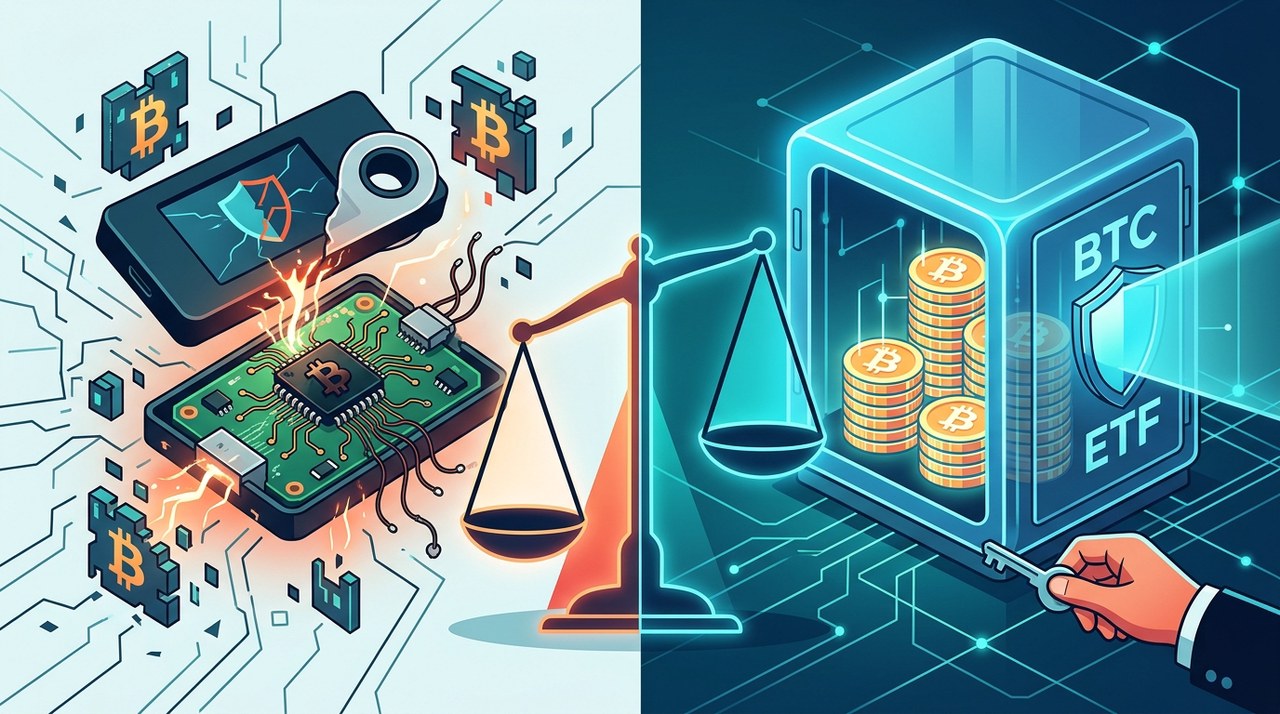
A Malicious Hardware Implant Sparked New Security Questions
The crypto world received a serious wake-up call recently. Security researchers discovered an unauthorized hardware implant hidden inside a Ledger hardware wallet device.
This unexpected discovery instantly reignited a major debate across the community: Is holding your own Bitcoin via a hardware wallet really safer than holding Bitcoin through an exchange-traded fund (ETF)?
For years, crypto veterans have preached the golden rule: Not your keys, not your coins. However, physical tampering raises tough new questions about device supply chain security.
What Is a Supply Chain Attack on a Hardware Wallet?
To understand why this discovery sent shockwaves through the industry, it helps to imagine buying a high-tech safe for your home.
Imagine buying a combination safe directly from a store. Unknown to you, someone intercepted the package during delivery, opened the casing, and secretly added a receiver inside that copies your combination. That is essentially how a hardware supply chain attack works.
In the case of the compromised hardware wallet, an unauthorized microchip was physically implanted onto the circuit board. This tiny modification allows attackers to intercept secret recovery phrases or alter transaction details before you confirm them on screen.
Because the modification happens inside the hardware before it reaches your hands, even careful users can end up compromised through no fault of their own.
Hardware Wallets vs. Bitcoin ETFs: Comparing the Differences
This incident highlights two completely different approaches to storing and securing your digital wealth.
1. Hardware Wallets (Self-Custody)
Self-custody means you take complete control of your digital keys. You rely on specialized hardware devices like Ledger or Trezor to store those private keys offline away from internet hackers.
- Main Advantage: You have full control over your assets without relying on banks or intermediaries.
- Main Risks: Supply chain tampering, losing your recovery seed, physical theft, or making transaction errors.
2. Spot Bitcoin ETFs (Institutional Custody)
A spot Bitcoin ETF lets you invest in Bitcoin through traditional stock brokerage accounts. Professional institutional custodians store the underlying actual Bitcoin on behalf of the fund.
- Main Advantage: Professional security, multi-signature protection, regulated oversight, and freedom from individual physical device tampering.
- Main Risks: Counterparty risk, inability to withdraw actual Bitcoin to a private wallet, management fees, and market volatility.
How Institutional ETF Custodians Secure Assets
Why are some investors looking closer at spot Bitcoin ETFs after this news? Institutional custodians operate vastly different security setups than individual retail investors.
Major ETF custodians store assets in air-gapped cold storage vaults spread across multiple secure geographic locations. They utilize multi-party computation (MPC) and multi-signature approvals.
This structure means no single person or tampered single device can move funds without independent authorization from multiple parties across strict organizational roles.
Choosing the Strategy That Fits Your Risk Profile
Neither self-custody nor institutional custody is completely free of risk. Choosing between them depends on what risks you are willing to manage.
If you prefer traditional market convenience and do not want to manage hardware security, seed phrases, or potential hardware supply chain threats, a spot Bitcoin ETF provides institutional-grade custody protocols.
If you prefer total monetary independence and self-sovereignty, self-custody remains the core foundation of crypto. However, extra care is required: always purchase hardware devices directly from official manufacturers, inspect tamper-evident seals, and verify device software integrity regularly.
Past performance of digital assets is no guarantee of future results. Investors should carefully evaluate both asset price volatility and custodial risks. Check current market conditions at Bitkub BTCBTC-0.83% Market.
Summary Checklist for Crypto Holders
- Always buy hardware wallets directly from verified primary manufacturers.
- Inspect all physical device packaging and casing thoroughly before initializing setup.
- Understand that ETFs offer institutional storage convenience, but you forfeit direct key ownership.
- Evaluate your personal risk tolerance for technical management versus institutional reliance.
Latest blog posts

Would a Bitcoin Standard Slow Down Economic Growth?
Bitcoin analyst Willy Woo explains why a hard-capped currency might lead to slower overall economic growth, but ultimately fewer financial bubbles.
|

 +1
+1Crypto ETFs Lose $1.2B as Big Investors Pull Back
U.S. Bitcoin and Ether ETFs lost over $1.2 billion in a single week as rising oil prices and inflation fears prompted institutional investors to reduce risk.
|
Bitmine Adds $32M ETH, Nearing 5% Total Supply Target
Bitmine acquired another 12,532 Ethereum last week, reaching 4.9% of total ETH supply as Chairman Tom Lee prepares to finalize buying.
|