

Layer 2 Scaling: How Ethereum Stays Fast and Cheap
The EthereumETH-1.77% Traffic Dilemma
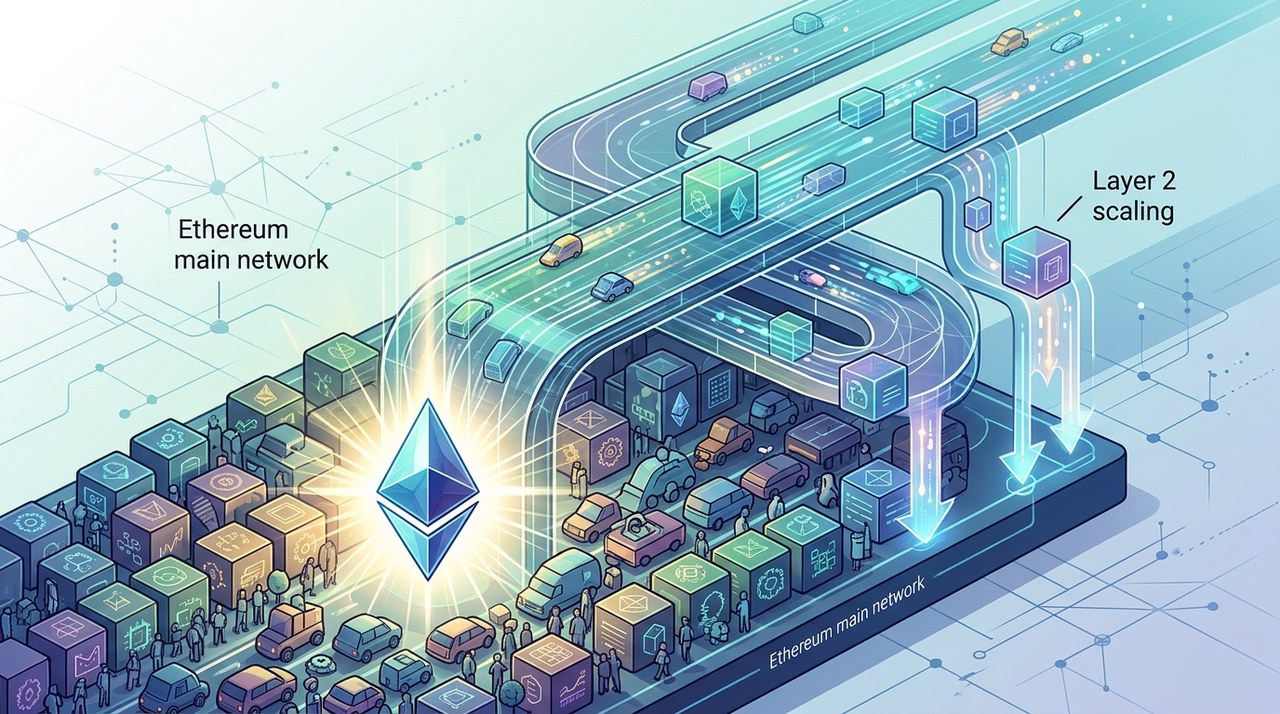
Imagine going to your favorite coffee shop on a busy morning. The shop has only one cashier. If ten people line up, everyone gets their drinks quickly. But if hundreds of people show up at once, the queue stretches down the street. Some customers might even offer to tip extra cash just to skip to the front.
This is very similar to what happens on the Ethereum main network. Ethereum is designed to be highly secure and decentralized. To keep the network safe, thousands of independent computers around the world verify every single transaction. However, Ethereum has a limited amount of space available in each block.
When network activity spikes, users compete with each other by paying higher transaction fees (known as gas fees) to get processed first. During peak times, fees can rise quickly, making everyday transactions expensive for individual users.
What Are Layer 2 Scaling Solutions?
To solve high fees and slow transaction speeds without compromising security, developers built Layer 2 scaling solutions. You can think of Layer 2 (or L2) as an express lane built directly around the main Ethereum blockchain, which is called Layer 1 (L1).
Instead of forcing every single transaction to happen on Ethereum's main highway, Layer 2 networks handle user transactions on a secondary layer. They execute the heavy lifting off the main chain where space is plentiful.
Importantly, Layer 2 networks do not operate entirely on their own. They continue to use Ethereum for final settlement, security, data posting, and verification. By relying on Ethereum as their underlying trust foundation, L2s offer faster and cheaper transactions without losing the safety of the base layer.
How Rollups Power Layer 2 Networks
The most widely used Layer 2 designs today are called rollups. The name describes the process well: rollups bundle hundreds of individual transactions together into a single package.
Here is how the rollup process works step by step:
- Off-Chain Execution: Users perform transactions on the Layer 2 network instantly with low fees.
- Bundling: The Layer 2 system rolls hundreds or thousands of these transactions into one single bundle.
- Data Posting: The rollup submits compressed transaction data or cryptographic proofs back to the main Ethereum blockchain.
- Final Verification: Ethereum checks the proof or records the batch data, securing all transactions with Layer 1 safety.
By compressing transaction data off-chain and sending it back in batches, rollups dramatically reduce the workload on Ethereum. This keeps fees low and speeds up confirmation times for everyday users.
Types of Rollups: Optimistic and Zero-Knowledge
There are two popular technical approaches to building rollups in the crypto ecosystem:
- Optimistic Rollups: These assume transactions are valid by default ('optimistically'). They process data quickly and only perform detailed checks if someone challenges a transaction using a fraud proof.
- Zero-Knowledge (ZK) Rollups: These use advanced cryptography to create mathematical proofs (validity proofs) for every batch. The main Ethereum network verifies these proofs instantly to confirm all transactions are accurate.
Why Layer 2 Matters for Crypto Adoption
Layer 2 solutions make decentralized applications practical for daily use. Lower gas fees mean people can transfer tokens, trade on exchanges, or interact with smart contracts without paying high costs.
By enabling Ethereum to handle higher volume while maintaining decentralization, Layer 2 networks play a key role in expanding blockchain technology to a global audience.
Important Risks to Keep in Mind
While Layer 2 technology provides clear advantages, users should remain mindful of technical and market factors:
- Smart Contract Risk: Layer 2 protocols rely on complex smart contracts and cross-chain bridges, which carry inherent software risks.
- Ecosystem Maturity: Some Layer 2 networks use centralized components, such as single sequencers, while developing towards full decentralization.
- Market Volatility: Prices of crypto assets, including Ethereum (ETH) and Layer 2 governance tokens, can fluctuate significantly.
Past performance of digital assets or historical network metrics do not guarantee future performance or price stability.
For real-time asset details and live market metrics, you can explore updates on official exchanges such as Bitkub Market.
Latest blog posts



South Korea Finalizes Crypto Bill as Tax Debate Heats Up
South Korea is finalizing its digital asset framework covering exchange licensing and stablecoins while lawmakers debate a proposed crypto tax.
|

PHP Flaw Sparks Massive Exploit Surge, Cloudflare Warns
Cloudflare CEO Matthew Prince revealed that thousands of automated exploit attempts targeted a critical PHP security flaw before it was publicly disclosed.
|

 +1
Aerodrome and Velodrome Merge to Launch Aero Platform
Decentralized exchanges Aerodrome and Velodrome have combined into a single platform named Aero to target $120 billion in monthly trading volume across seven blockchain networks.
|