

IMF Warns $65B Tokenization Market Has a Catch
What Did the IMF Report About Tokenization?
On October 12, 2026, writer Jamie Redman highlighted a detailed new warning published by the International Monetary Fund (IMF).
The IMF published Chapter 3 of its October 2026 Global Financial Stability Report. The section is titled 'Scaling Tokenization: New Efficiencies, New Vulnerabilities'.
In this paper, researchers took a close look at how blockchain-based financial tools might transform traditional markets. They analyzed what happens when issuance, trading, clearing, settlement, and servicing all run on programmable ledgers.
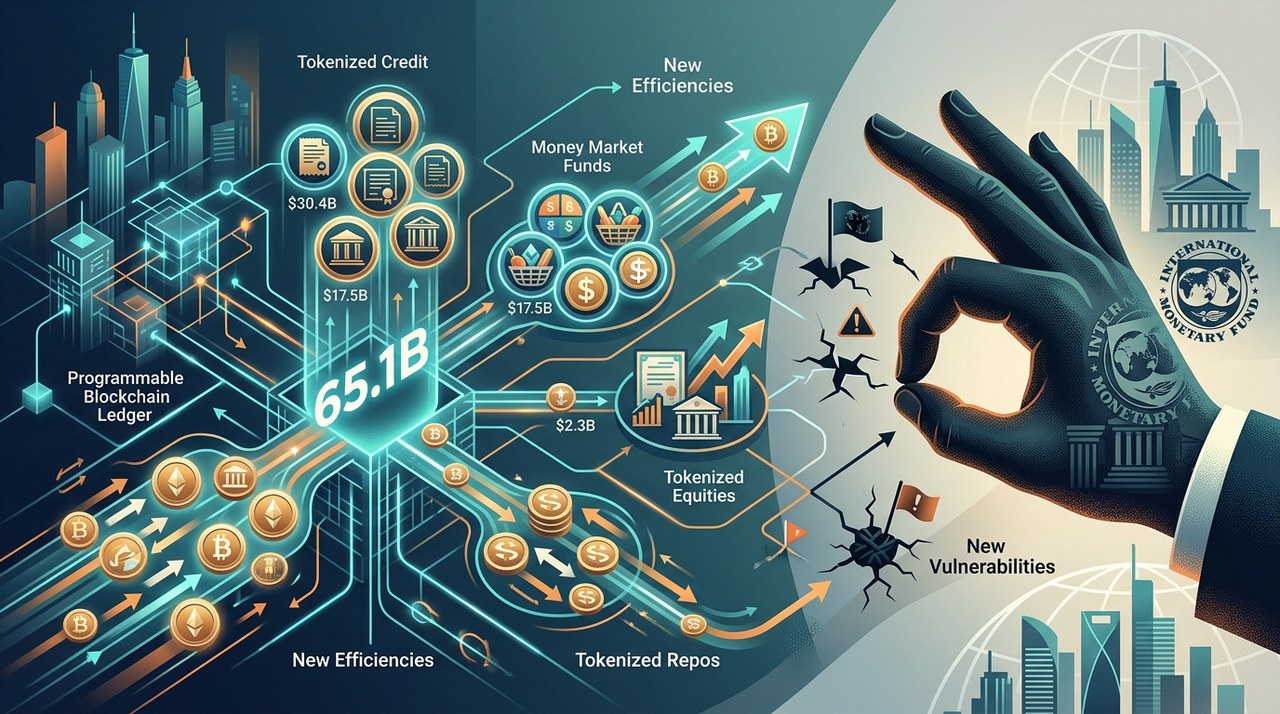
Breaking Down the $65.1 Billion Tokenized Market
By July 31, 2026, the total value of tokenized real-world assets (RWAs) reached approximately $65.1 billion. Note that this total excludes repurchase agreements and standard stablecoins.
Here is a quick look at how that money breaks down across different asset classes:
- Tokenized Credit: Makes up the largest share at $30.4 billion.
- Money Market Funds: Represent $17.5 billion in tokenized value.
- Tokenized Equities: Remain relatively small at $2.3 billion.
Alongside those assets, tokenized repurchase agreements, or repos, recorded massive daily activity. They logged average daily transaction volumes of $303 billion.
This huge volume shows that institutions are eager to move collateral around with higher precision and speed.
Tokenized repo can add greater flexibility and precision to the timing of the transaction, potentially supporting liquidity management.
Why Wall Street Loves Tokenized Assets
Traditional finance has spent decades trying to cut trading delays and eliminate unnecessary middlemen. Tokenization promises to solve those exact problems.
By moving financial assets onto blockchains, institutions gain instant settlement, automated compliance checks, and trading that runs 24 hours a day.
The IMF study uncovered some fascinating data regarding how investors use these networks.
For instance, over 50% of tokenized equity trading happened outside regular U.S. stock market hours.
In addition, about 80% of those equity trades involved less than one full share. This indicates strong global demand for fractional asset ownership.
The Dangerous Catch: Why Speed Can Worsen Market Shocks
While instant trading sounds like a major upgrade, the IMF points out an uncomfortable trade-off.
Traditional financial systems contain natural delays. These time delays act as safety buffers, giving institutions time to reconcile accounts, raise cash, and calm down during panics.
Blockchain settlement removes those breathing spaces completely. When market friction disappears, safety cushions disappear with it.
If prices drop suddenly, programmable collateral and automated margin calls could trigger immediate forced liquidations across continuous markets.
Overall, by reducing the friction, buffers, and intermediation arrangements that traditionally help absorb shocks, these features can also alter how vulnerabilities accumulate and shocks are transmitted across markets and infrastructures.
Smart Contracts, Leverage, and Domino Effects
The report also warns about how interconnected decentralized applications have become.
When collateral gets tokenized, it can easily be reused across multiple platforms. This habit can build up higher leverage across the entire system.
If one application fails, financial stress can spread across institutions much faster than before.
Furthermore, smart contracts heavily rely on third-party software code, cloud infrastructure, and external data feeds called oracles.
Composability can improve coordination and capital efficiency, yet it also propagates contagion and leverage across interconnected applications and expands the operational attack surface.
Four Big Obstacles Facing Tokenization
Despite ongoing tests by big institutions, tokenized markets remain split across different networks, illiquid, and vulnerable to technical disruptions.
The IMF identified four key hurdles blocking wider adoption on Wall Street:
- Legal Certainty: Clean, clear laws defining asset ownership on public ledgers.
- Regulatory Clarity: Unified regulatory frameworks across global borders.
- Interoperability: Smooth connections that let different blockchains talk to each other.
- Reliable Settlement Assets: Safe backing assets used to settle trades reliably.
While central bank money provides the safest settlement foundation, private stablecoins and tokenized deposits carry extra risks related to credit, liquidity, and asset concentration.
What the IMF Recommends to Safeguard Markets
To keep tokenized markets safe, the IMF recommends technology-neutral regulations, stronger oversight, trading circuit breakers, and safeguards against automated liquidation cascades.
For now, the fund considers systemic risks to be limited because the overall tokenized market remains relatively small.
Still, the report highlights a clear paradox. The exact feature that makes tokenization attractive—removing market friction—is the same feature that strips away defenses during a crisis.
Broader Market Snapshot: Bitcoin and EthereumETH-0.38% Context
As these findings were published on Monday, October 12, 2026, broader digital asset prices were trading in a tight range.
Bitcoin (BTCBTC+0.21%) hovered between $82,550 and $83,000, specifically trading near $82,636 (down 1.22% on the day). Meanwhile, Ethereum (ETH) traded near $2,517 (down 0.64%). Technical indicators for Bitcoin painted a largely neutral picture.
While short-term crypto prices fluctuate based on market sentiment, institutional focus remains centered on building sustainable blockchain infrastructure.
Past performance of digital assets is not an indicator of future results. Investors should carefully consider market volatility and structural risks before making financial decisions.
Latest blog posts
Fed Rate Decision: What Markets and Bitcoin Traders Can Expect
The Federal Reserve is set to announce its latest interest rate decision today, with markets anticipating a rate hold while closely watching for signals on Bitcoin and macroeconomic trends.
|
China Could Lead AI by 2030: Here Is What Holds It Back
Bloomberg Intelligence reports China could lead global AI models by 2030, though chip shortages and price wars present major challenges.


Avail Unveils ShieldTX Privacy Tool for Hyperliquid Traders
Avail has launched ShieldTX, a novel privacy tool on Hyperliquid that creates isolated wallets for perpetual futures positions to block copy-trading bots.
|