
Illinois Crypto Tax Plan Sparks Major DeFi Ban Warning
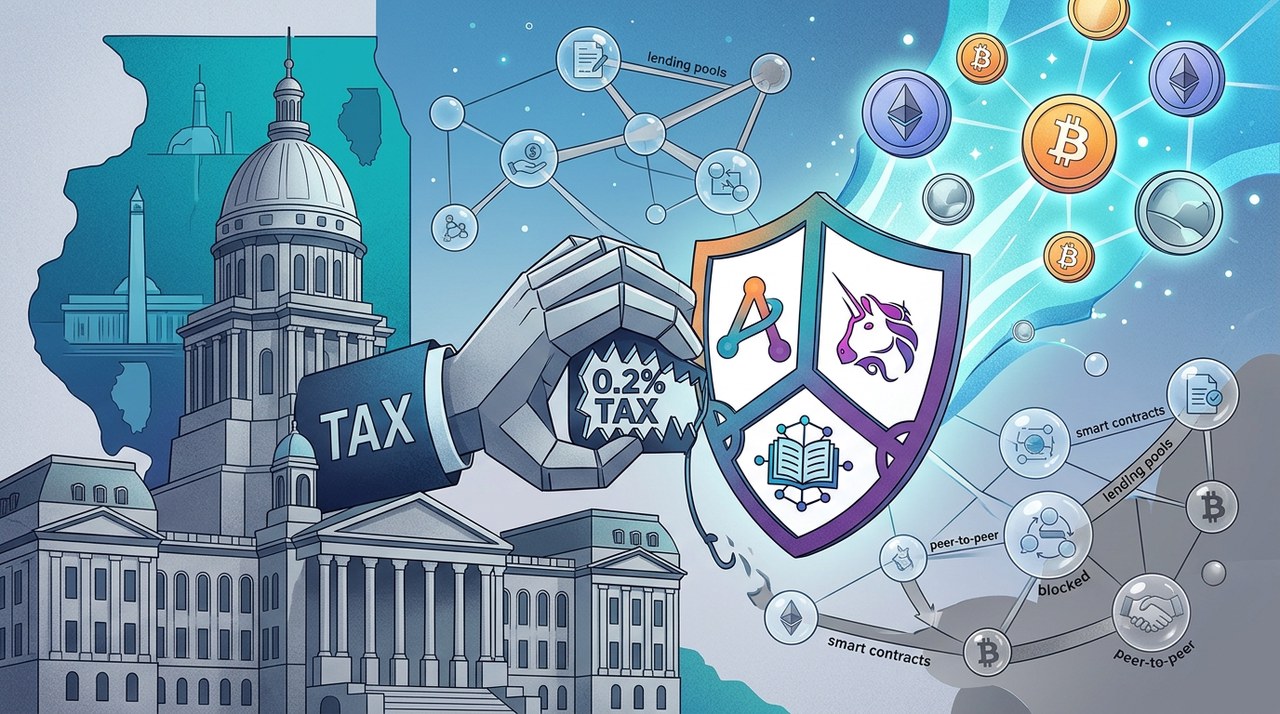
Crypto Heavyweights Stand Up Against Illinois Tax Plan
Imagine asking a vending machine to check your ID, fill out a tax form, and file a return with the government. It sounds practically impossible, right? That is essentially what is happening in Illinois right now.
Three major crypto leaders have teamed up to warn state regulators about proposed digital asset rules. Venture capital powerhouse Andreessen Horowitz (a16z), UniswapUNI+6.44% Labs, and the DeFi Education Fund filed a joint letter on Friday, October 30, 2026.
They argue that proposed tax regulations from the Illinois Department of Revenue could effectively ban decentralized finance (DeFi) in the state. They also warn the rules put everyday users at serious cybersecurity risk.
What is the Illinois Digital Asset Tax Act?
Back in June, Illinois passed the Digital Asset Tax Act. The law introduces a 0.2% transaction tax on the underlying value of covered cryptocurrency transactions.
Unlike capital gains taxes that tax your net investment profit, this levy applies to the full value of assets involved in a transaction. To enforce it, regulators want to treat platforms handling crypto as traditional financial brokers.
The DeFi Dilemma: Why Software Cannot Act Like a Broker
Decentralized applications like Uniswap (UNI) do not operate like traditional stockbrokers. There is no middleman or corporation sitting in an office processing your trades.
Instead, decentralized exchanges (DEXs) run on self-executing software programs called smart contracts. They do not hold customer funds, track personal identities, or execute transactions on anyone's behalf.
Because DEXs cannot identify users, verify their locations, or file tax forms, forcing broker obligations on them creates an impossible compliance bar. The groups argue this acts as a de facto ban on DeFi services.
Miles Jennings, Head of Policy at a16z, criticized the state's approach on X (formerly Twitter). He argued that officials are trying to stretch the law far beyond its scope.
Autonomous software is not a person that can collect a tax. The law is already one of the most anti-innovation bills in the country—a tax on transactions just because they are digital.
Jennings added that classifying DEXs as tax-collecting brokers clashes directly with federal standards and Illinois' own Digital Assets and Consumer Protection Act.
Private Key Requirements Raise Massive Security Risks
One of the most concerning parts of the proposed rules involves private keys. A private key works like a master digital password that controls access to your crypto funds.
The proposed rules suggest that brokers maintain records containing customer private keys. Industry experts pointed out that storing sensitive private keys breaks basic cybersecurity principles.
If a broker or state record is ever hacked, cybercriminals could gain full control over user funds. This forces companies to choose between protecting user assets or obeying state law.
The joint letter offers a straightforward solution: change the term 'private keys' to 'public keys'. Public keys allow regulators to inspect blockchain transactions without taking control of user funds.
Taxing Transfers Between Your Own Wallets?
The letter also opposes rules that could tax withdrawals from exchanges to personal self-custody wallets, as well as token transfers across blockchains (known as bridging).
Miles Jennings compared this requirement to charging someone a tax just for moving cash from their checking account to their savings account.
Charging a 0.2% tax simply for reallocating personal assets creates an unfair burden on everyday users.
Legal Challenges Push Rollout to July 2027
The Digital Asset Tax Act is already facing legal opposition from broader industry groups.
Organizations like the Blockchain Association and the Crypto Council for Innovation have challenged the law in court. Their lawsuits raise several key concerns:
- Double Taxation: The tax overlaps unfairly with existing state and federal taxes.
- Discriminatory Rules: Digital transactions are targeted unfairly compared to traditional financial activities.
- Unreasonable Burdens: Compliance requirements are unrealistic and carry harsh potential penalties.
Due to ongoing litigation, Illinois officials agreed to postpone the law's effective date from January 1 to July 1, 2027, allowing the courts time to review the legislation.
Jennings voiced strong support for the lawsuits, stating that consumers and entrepreneurs in Illinois deserve much better regulatory frameworks.
What the Coalition is Asking Regulators to Do
In their joint letter, a16z, Uniswap Labs, and the DeFi Education Fund urge state regulators to make three key changes:
- Exclude Autonomous Protocols: Clearly exclude decentralized protocols and frontend interfaces from the definition of digital asset brokers.
- Clarify Fee Collections: Explicitly state that collecting automated protocol fees does not automatically make a protocol developer a broker.
- Pause Rulemaking: Hold off on finalizing rules until courts decide whether the tax law itself is legal before the July 2027 rollout.
Why This Regulatory Battle Matters
How Illinois handles decentralized protocols could set an important precedent for other states and countries evaluating DeFi laws.
If regulators treat software tools like human brokers, developers may be forced to block local residents to stay compliant.
As this legal process moves toward 2027, crypto market participants will be keeping a close watch. When following developments around governance tokens like Uniswap (UNI), keep in mind that past performance of digital assets or past performance is not a guarantee of future performance or results.
Latest blog posts


Ledger CTO Warns of Potential Quantum Threats to Bitcoin
Ledger CTO Charles Guillemet recently highlighted two cryptographic studies exploring theoretical long-term risks to Bitcoin's underlying math.
|
Intel Stock Drops 30% as Weak Forecast Shadows AI Growth
Intel shares suffered their worst drop in 50 years after issuing a weak Q4 forecast, despite strong Q3 earnings and rising AI processor demand.


Tether Reports $1.5B Q3 Profit as Reserves Hit $191.5B
Stablecoin issuer Tether generated $1.5 billion in net operating profit during Q3 2026, bringing total reserve assets to $191.5 billion with nearly $8 billion in excess reserves.
|