


Grayscale Warns Token Inflation Can Eat Crypto Rewards
Moving Beyond Pure Market Hype
Have you ever wondered if a crypto protocol is actually worth its price tag? For years, investors mostly relied on pure excitement, social media hype, and market narratives to guess a token's potential value.
Digital asset manager Grayscale wants to change that approach. On Oct. 21, 2026, Zach Pandl, head of research at Grayscale, introduced a valuation framework based on real earnings and protocol economics.
Crypto valuations don’t have to rely on narratives alone.
Onchain applications generate real income from trading fees, lending services, and other financial activities. But just like a traditional business, these crypto applications have real operational costs.
Apps must compensate liquidity providers and lenders to keep their platforms running smoothly. When you subtract these expenses from total fee revenue, you get the true protocol earnings.
How Token Inflation Secretly Shrinks Your Gains
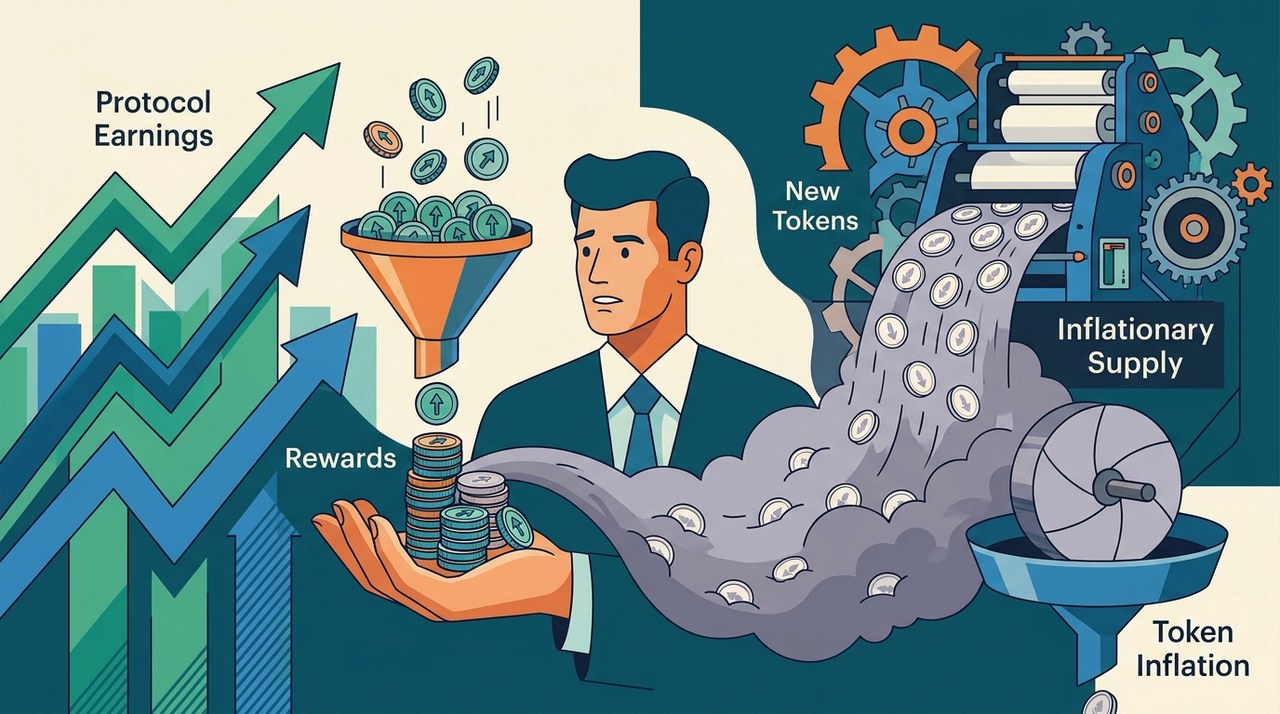
Generating high revenue is a great start, but it does not mean token holders automatically profit. That is where token inflation comes into play.
Many projects try to reward holders through staking distributions and token buybacks. However, scheduled token unlocks and newly minted tokens constantly flood the market with fresh supply.
When new token creation outpaces buybacks and distributions, your share of the protocol gets diluted. Grayscale evaluates this balance using two core metrics:
- Tokenholder Yield: Adds staking rewards and token buybacks, subtracts new token issuance, and divides the result by circulating market capitalization.
- Adjusted Earnings Yield: Takes total protocol earnings divided by market cap, then subtracts circulating supply inflation.
It is also important to know how buybacks differ from token burns. Grayscale notes that buybacks temporarily reduce circulating supply, whereas token burns permanently destroy supply.
Analyzing the Top Protocols: Winners and Losers
To test this valuation framework, Grayscale analyzed tokens in the FTSE Grayscale Financials Crypto Sector ranking in the top 100 by circulating market cap (excluding centralized projects), using data as of Oct. 20, 2026.
The analysis revealed stark differences between projects that deliver value and those suffering from heavy token supply dilution:
- HyperliquidHYPE-0.99%: Led tokenholder yield at 8.0%, powered by revenue-funded buybacks from trading fees.
- PancakeSwap (CAKE): Topped the adjusted earnings yield chart at 14.4%.
- Curve (CRV): Ranked last among the ten featured projects with a tokenholder yield of -5.5%, demonstrating how heavy supply inflation can push yields into negative territory.
Past performance of digital assets or past operational results do not guarantee future returns or operational performance. You can review current market trends at bitkub.com/en/market/BTC.
Staking Rewards and Performance Mechanics
Staking payouts form another crucial layer of tokenholder returns. Users lock up their digital assets to validate transactions and secure the network.
For example, EthereumETH-0.73% network validators earn staking rewards by proposing new blocks and attesting to transaction accuracy.
However, these earnings come with operational responsibilities. Networks enforce penalties for missed duties and slashing for bad behavior, directly linking validator payouts to performance.
Why BitcoinBTC-1.09% Needs a Separate Valuation Approach
Not all cryptocurrencies fit into an earnings-based framework. Grayscale treats Bitcoin differently because it acts as a digital commodity and monetary asset rather than a cash-generating app.
Pandl emphasizes that Bitcoin should be valued like digital gold using historical benchmarks and onchain activity metrics rather than traditional company cash flows.
For other monetary assets such as XRPXRP-2.26% and Zcash, Grayscale compares their market capitalizations to Bitcoin using 30-day moving averages to assess their relative size within the digital currency sector.
Grayscale Rollout for Financial Advisors
Alongside its research paper, Grayscale launched four new model portfolios designed specifically for wealth management professionals.
These standardized strategies help financial advisors build diversified crypto asset exposures for their clients using traditional exchange-traded products (ETPs).
Latest blog posts



Franklin Templeton Adds $150M in Fund Shares to XRPL
Asset manager Franklin Templeton nearly quadrupled its tokenized money market fund shares on the XRP Ledger, placing $150 million into a single wallet address.
|
PHP Flags Third Server Bug as PHP2Shell Attacks Surge
PHP developers revealed a third flaw, CVE-2026-115560, just days after patching two critical vulnerabilities targeted by millions of attacks.


56 Billion Shiba Inu Added to Exchanges as Price Bounces
Shiba Inu recovered above $0.000005, but a net inflow of over 53 billion SHIB to exchanges raises concerns about potential selling pressure.
|